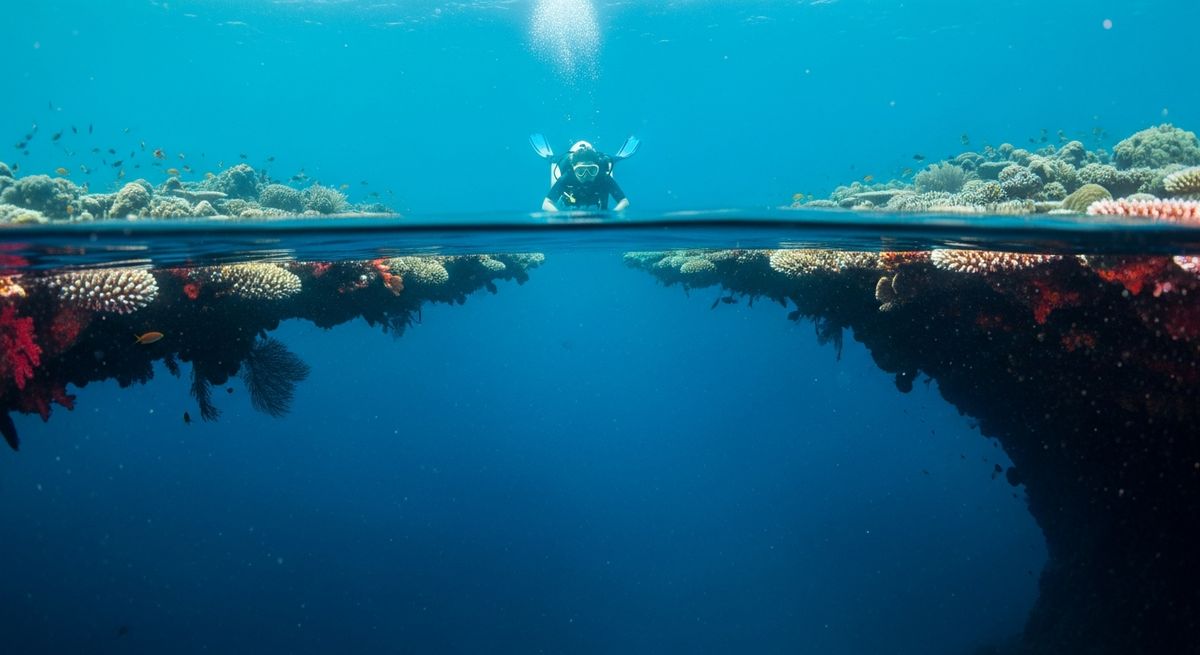
Blue Corner (and Blue Holes)
Protected Area
Ngerukewid Island Wildlife Preserve
Why dive here
With 182+ marine species recorded in the area - including barracuda, lionfish, mandarin fish, napoleon wrasse and nautiluses - Blue Corner (and Blue Holes) offers some of Rock Islands's richest wall diving. Water ranges 29-30°C, warmest June, October, November.
Blue Corner, often paired with the Blue Holes, is where you really start to understand Palau’s reputation. We’ve seen it described as a fish aggregation device, and that feels accurate. Hook in and watch the show: schools of snapper, jacks, and chevron barracuda, sometimes so thick they blot out the sun. Sharks are a constant presence, usually grey reef, with tuna and wahoo making quick passes in the blue. It’s a drift dive, often with strong currents, so it’s definitely one for experienced divers comfortable managing their buoyancy while suspended in the flow.
Typical Blue Corner (and Blue Holes) Dive Profile
Illustrative profile based on site depth and type. Actual dive profiles vary - always follow your dive computer and training.
Safety Notes
Always perform a 3-minute safety stop at 5m before surfacing.
Nearest Dive Centres to Blue Corner (and Blue Holes)
Dive shops near Blue Corner (and Blue Holes)
Cruise Control palau
Cruise Control palau
Sam's Tours
DayDream Dive Center
Blue Marlin
Blue Marlin
Reviews for Blue Corner (and Blue Holes)
Conditions
Ocean conditions, forecast and tides for Blue Corner (and Blue Holes)
Blue Corner (and Blue Holes) Ocean Conditions
Monthly averages for Blue Corner (and Blue Holes), sourced from Open-Meteo marine data + Copernicus Marine (EU) - nearest station: Open-Meteo marine grid (7.2, 134.3) (4km away)
October Averages
Sea Temperature
30°C
86°F · Range: 28.5–31.2°C
Current Speed
10.05 cm/s
Direction: N (5.7°)
Chlorophyll-a
0.026 mg/m³
Very clear (oligotrophic)
Salinity
33.62 PSU
Based on 4 years of monitoring data · Data sources: Open-Meteo marine data + Copernicus Marine (EU)
Plan & book
Ways to dive Rock Islands, from day trips to liveaboards.
Day trips & courses
via GetYourGuideGuided dives, courses and snorkel trips with instant booking.
Find dive trips in Rock IslandsPlaces to stay
via Booking.comHotels and dive resorts near Rock Islands.
Search stays in Rock IslandsDive insurance
Most travel insurance excludes or limits scuba. Check what you need before you go.
Dive insurance explainedPartner links: we may earn a commission if you book, at no extra cost to you. How we make money
Where to Stay near Blue Corner (and Blue Holes)
Prices from Booking.com. We may earn a commission at no extra cost to you.