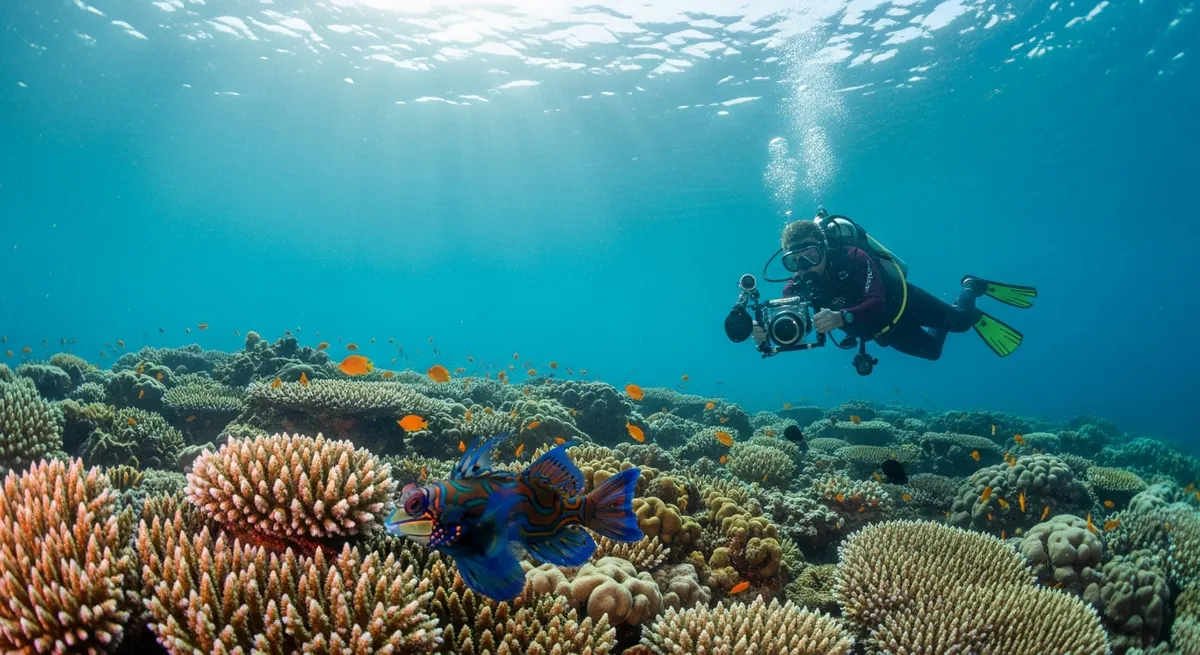
Diving in Milne Bay
Why dive here
Milne Bay offers some of Papua New Guinea's richest diving, with 241+ marine species recorded in the area - including barracuda, blacktip reef sharks, grey reef sharks, sea turtles and sperm whales. Water sits around 31°C.
Milne Bay, it’s fair to say, is where we truly fell in love with Papua New Guinea. This place sets the bar for muck diving, a critter hunter's dream where you’ll find things you’ve only ever seen in books, if at all. We’re talking about the famous pygmy seahorses, yes, but also the hairy scorpionfish, the utterly captivating dwarf atomgoby, and the subtle beauty of a palebarred reefgoby. The beauty of Milne Bay is that it isn't *just* muck. We’ve spent mornings carefully scanning a black sand slope for rare nudibranchs, then jumped in for an afternoon on a vibrant pinnacle, surrounded by schools of fusiliers so thick they block the light. Our favourite dive here is often a wreck dive, WWII relics draped in soft corals, creating artificial reefs that teem with life. There’s a particular thrill to navigating the darkness of an old cargo hold, knowing you might spook a big-eye trevally lurking within. Current can be a factor, especially on the exposed pinnacles, but it’s rarely a problem for the boat crews here. Visibility averages 20 meters, though we've had days where it felt like 30, and others where a passing shower cut it down. Either way, the critters are still there.
Milne Bay Dive Site Map
Dive sites and dive centres in Milne Bay
Milne Bay Dive Sites
12 dive sites in Milne Bay
ADMIRAL WILEY
Admiral Wiley is more than just a wreck; it’s a time capsule off Kitava Island, and frankly, one of our favourite dives in Milne Bay. This 98-metre steamship, built in 1920, lies broken but still impressive. We love tracing the deck, noting the sheer scale, imagining the roar of those turbine engines before she went down. You’ll find schools of batfish here, curious and unafraid, often circling the superstructure as you descend. Look closely and you'll spot pygmy seahorses clinging to gorgonian fans near the deeper sections. The hull plates themselves are encrusted with colourful soft corals, a genuine explosion of reds and purples. We’d suggest focusing on the bow section first; the coral growth there is particularly lush, and the light often catches it just right in the morning. While the visibility can vary, on a good day, the wreck reveals itself gradually, loomimg out of the blue, making the dive genuinely atmospheric. It's an excellent dive for those who appreciate history intertwined with vibrant reef life.
American PT Cruisers
Milne Bay, a place synonymous with WWII wrecks, holds a few deeper secrets, and the American PT Cruisers are certainly among them. Sunk in 1942 near Tufi, these two patrol torpedo boats offer a truly unique, albeit challenging, dive. We’re talking about very complete wrecks, not just scattered fragments, which makes them incredibly evocative. This is a decompression dive for seasoned wreck enthusiasts, divers who understand the nuances of planning and execution when conditions align. If you've got the training and the urge to connect with history in a very profound way, these PT boats are an incredible expedition.
Banana Bommie
Banana Bommie is a popular spot in Milne Bay, and for good reason. This sizable pinnacle rises close to the surface, its coral-encrusted walls attracting a steady stream of pelagics. We’ve often watched impressive schools of batfish and trevally hovering in the current, creating a shimmering wall of silver. Down on the bommie itself, the nooks and crannies hold plenty of smaller critters for those who like to take their time. While not an every-dive occurrence, we’ve occasionally spotted a grey reef shark cruising past, a welcome bonus. It’s a solid dive for photographers and those who appreciate a busy, lively reef.
BlackJack
BlackJack in Milne Bay is the kind of site that makes you pinch yourself, or at least wonder if you’ve somehow stumbled onto a movie set. It’s a B-17 bomber, completely intact, sitting on the seabed like it just landed there a moment ago. We’re talking about a plane draped in sponges and soft corals, with fusiliers swirling around the wings and snappers peeking out from the bomb bay. Exploring the cockpit or the gun turrets, seeing the gauges still in place, it’s a genuinely eerie and incredible feeling. This is a bucket-list wreck for any diver who appreciates history and aviation, a truly remarkable dive.
Dart Reefs
The Dart Reefs in Milne Bay are a solid choice for a dive day. We’ve found good coral coverage here, especially some impressive plate corals in the shallower sections. Look closely for the smaller stuff – nudibranchs and flatworms are often about, tucked into crevices. It’s a good spot for a relaxed dive, suitable for most experience levels.
Dinah’s Beach
Dinah’s Beach holds a special spot in the muck diving world, widely considered the original. Don't come expecting vibrant corals; this is about the hunt. You'll spend your dive on a black sand and mud slope, typically no deeper than 12m, eyes peeled for the incredibly camouflaged. We've often found seahorses clinging to detritus, several species of octopus moving across the sand, and the occasional dwarf lionfish or frogfish blending perfectly. It’s a slow dive, perfect for photographers and anyone who loves seeking out the unusual.
Dorasi Shoal
Dorasi Shoal is a spot we've always found ourselves going back to in Milne Bay, and for good reason. It’s a riot of colour and movement, particularly for those who get a kick out of fish portraiture. We often find the visibility here can be truly astounding, sometimes easily pushing past 30 metres, letting you really appreciate the sheer density of fish. You’ll drop onto a sloping reef, perhaps 5 to 20 metres, and immediately notice the sheer number of parrotfish. We’re talking big schools of Schlegel's and Batavian parrotfish, munching away, their crunching audible if you listen closely. Keep an eye out for the orange-lined triggerfish, always a joy to watch as they patrol their patch. What we really love about Dorasi is the smaller stuff too, the tiny adorned dwarfgobies tucked into crevices and the surprising number of small giant clams scattered across the coral. It’s a site that rewards a slow, observant dive, perfect for photographers wanting to capture both the big picture and the minute details. Currents here are usually mild, making it a relaxed dive for most skill levels.
Lauadi
Lauadi, in Milne Bay, offers some genuinely interesting diving. We've often found schooling barracuda here, sometimes in significant numbers, alongside the usual reef fish. It’s a site that can have moderate currents, which keeps things lively, but it’s generally suitable for most divers looking for good fish action.
Milne Bay
Milne Bay delivers a solid dive experience for those keen on variety. You'll find a good mix of pelagic action along the deeper walls, often with schooling barracuda and reef sharks cruising by. The shallower coral areas are home to a surprising number of nudibranchs and smaller critters, making it great for macro fans too. It’s a rewarding spot for divers who appreciate both the big picture and the tiny details.
Paradise Point
Paradise Point in Milne Bay always feels like a secret, even when you know exactly where you’re going. The wall drops away from a shallow reef flat, plunging past 40 metres, painted in soft corals and enormous gorgonian fans. We love drifting along here, keeping an eye on the thermocline where the water often shimmers with tiny critters. Look closely, and you’ll start spotting the good stuff: pygmy seahorses clinging to the fans, ornate ghost pipefish doing their best impression of a leaf, and nudibranchs we swear we’ve only ever seen in textbooks. It’s a site that rewards slow diving and a good torch. This is a macro lover's dream, no question. We'd suggest budgeting extra bottom time just for photography, especially between 15 and 25 metres. Even if you're not a photographer, the sheer concentration of bizarre and beautiful small stuff, like the famed snakehead cowries and various pygmygobies, makes it utterly captivating. It’s a gentle drift, perfect for advanced open water divers who appreciate the quieter magic of a reef.
Pocklington Reef
Pocklington Reef sits out in Milne Bay, a spot where anything feels possible. It’s a classic coral reef setup, with good visibility often letting you see far into the blue. We’ve come across black marlin here, often cruising the edges of the reef. It’s a good choice for divers who appreciate remote, open-water diving, and a chance for pelagic encounters.
The Joelle
The Joelle, close to Walindi Plantation, is a good spot for a relaxed dive. We’ve found it’s usually pretty calm here, making it a nice option when other sites might have stronger currents. You’ll drift past some healthy coral, a mix of hard and soft, and we often spot good numbers of anemonefish tucked into their homes. It’s a solid choice for an easy afternoon dive, letting you soak in the reef without too much effort.
Milne Bay Dive Centres
8 dive shops and operators in Milne Bay
Ocean Wildlife in Milne Bay
241 species recorded in Milne Bay
Milne Bay Daylight & Sunrise/Sunset
Sunrise and sunset times for Milne Bay, calculated from coordinates
Today - Sunday 11 October
Sunrise
05:35
Sunset
17:51
Daylight
12h 17m
Golden Hour
17:24
First light (dawn) at 05:14 · Last light (dusk) at 18:13
Monthly Averages
| Month | Sunrise | Sunset | Daylight |
|---|---|---|---|
| Jan | 05:46 | 18:25 | 12h 39m |
| Feb | 05:58 | 18:24 | 12h 26m |
| Mar | 06:01 | 18:11 | 12h 10m |
| Apr | 06:00 | 17:53 | 11h 53m |
| May | 06:03 | 17:42 | 11h 39m |
| JunShortest | 06:11 | 17:43 | 11h 32m |
| Jul | 06:15 | 17:49 | 11h 35m |
| Aug | 06:08 | 17:54 | 11h 46m |
| Sep | 05:51 | 17:53 | 12h 2m |
| OctNow | 05:33 | 17:52 | 12h 19m |
| Nov | 05:24 | 17:58 | 12h 34m |
| DecLongest | 05:30 | 18:13 | 12h 43m |
Times are approximate local times based on longitude. Actual times may vary slightly depending on the exact timezone observed in Milne Bay.
Where to Stay near Milne Bay
Prices from Booking.com. We may earn a commission at no extra cost to you.
Marine Protected Areas near Milne Bay
1 protected area near Milne Bay - please respect local regulations when diving
Baniara Island
Getting to Milne Bay
Gurney
Port Moresby
Popondetta
Plan & book
Ways to dive Milne Bay, from day trips to liveaboards.
Day trips & courses
via GetYourGuideGuided dives, courses and snorkel trips with instant booking.
Find dive trips in Milne BayPlaces to stay
via Booking.comHotels and dive resorts near Milne Bay.
Search stays in Milne BayDive insurance
Most travel insurance excludes or limits scuba. Check what you need before you go.
Dive insurance explainedPartner links: we may earn a commission if you book, at no extra cost to you. How we make money