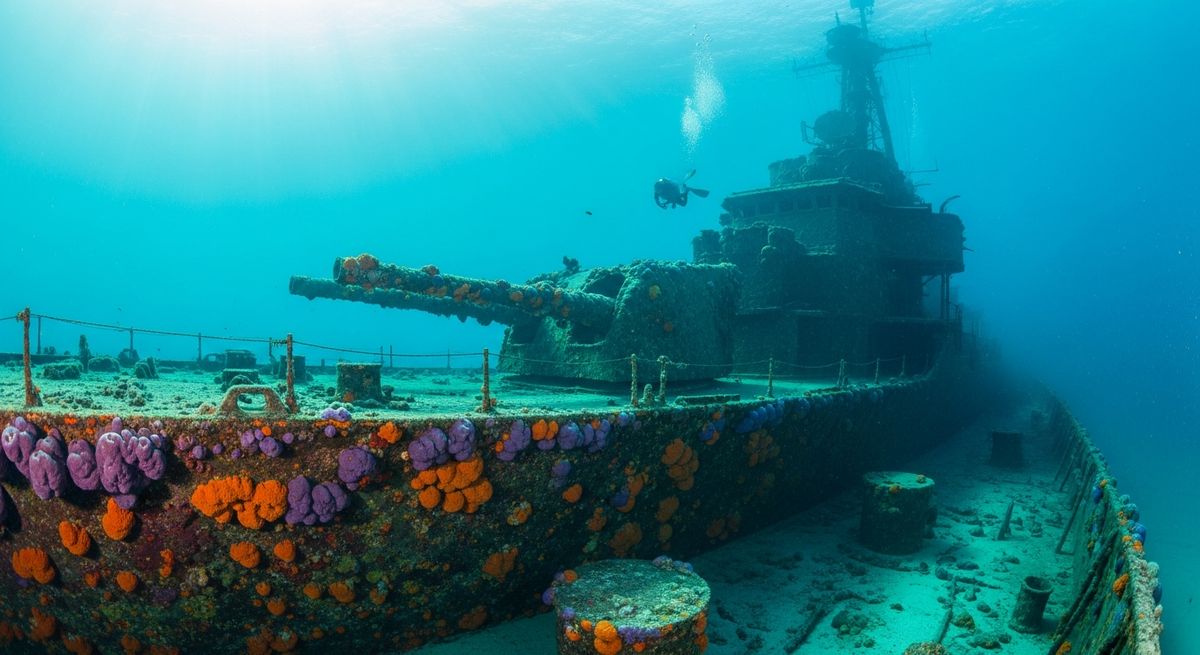
Bell P39 Airacobra (Wreck)
Protected Area
Rendova Harbor
Why dive here
With 391+ marine species recorded in the area - including barracuda, blacktip reef sharks, grey reef sharks, humpback whales and orcas - Bell P39 Airacobra (Wreck) offers some of Iron Bottom Sound's richest wreck diving. Water ranges 29-31°C, warmest January, April, December.
The P39 Airacobra is one of those Iron Bottom Sound wrecks that just makes you grin. She’s mostly intact, sitting upright on a sandy bottom, about 26 metres down. We love seeing the propeller blades still clearly defined and the cockpit, though empty, really brings home the history. It’s an easy dive, a perfect entry into the Solomon’s wreck scene. We’ve found schools of sweetlips hanging around the wings, and lionfish often perch on the fuselage. Look closely, and you’ll spot pipefish hiding amongst the coral growth on the airframe. The visibility here is usually around 20 metres, offering clear views of the plane and the sandy patches where gobies dart about. It’s a compelling site for anyone keen to explore a piece of WWII history that’s become a home for marine life, without demanding deep technical skills.
Typical Bell P39 Airacobra (Wreck) Dive Profile
Illustrative profile based on site depth and type. Actual dive profiles vary - always follow your dive computer and training.
Safety Notes
Wreck site - avoid penetration without wreck diving certification. Watch for sharp metal and entanglement hazards.
Always perform a 3-minute safety stop at 5m before surfacing.
Bell P39 Airacobra (Wreck) Wreck History
Year Sunk
1943
Vessel Type
aircraft
Cause
unknown
Lying in the legendary depths of Iron Bottom Sound, this Bell P-39Q Airacobra is a relatively recent discovery, found in April 2011. The wreck is believed to be one of two fighters lost by the USAAF 68th Fighter Squadron during their service in the Guadalcanal campaign. The 68th, known as the "Lightning Lancers," flew grueling combat patrols and ground-attack missions from Henderson Field against entrenched Japanese forces throughout 1943.
This fighter plane now rests upright and is mostly intact, a ghostly memorial to the pilot who flew it. Its location within Iron Bottom Sound places it among the highest concentration of WWII wrecks in the world, a veritable museum at the bottom of the sea. For technical divers, exploring this P-39 is a journey back in time. The aircraft's guns, cockpit, and propeller are still visible, slowly being colonized by marine life but retaining the clear shape of the formidable war machine it once was.
Reviews for Bell P39 Airacobra (Wreck)
Conditions
Ocean conditions, forecast and tides for Bell P39 Airacobra (Wreck)
Bell P39 Airacobra (Wreck) Ocean Conditions
Monthly averages for Bell P39 Airacobra (Wreck), sourced from Open-Meteo marine data - nearest station: Open-Meteo marine grid (-9.03, 159.16) (58km away)
October Averages
Sea Temperature
30°C
85°F · Range: 28.7–30.5°C
Air Temperature
27°C
80°F
Wind Speed
3.74 m/s
7.3 knots
Atmospheric Pressure
1010.5 hPa
Based on 4 years of monitoring data · Data sources: Open-Meteo marine data
Plan & book
Ways to dive Iron Bottom Sound, from day trips to liveaboards.
Day trips & courses
via GetYourGuideGuided dives, courses and snorkel trips with instant booking.
Find dive trips in Iron Bottom SoundPlaces to stay
via Booking.comHotels and dive resorts near Iron Bottom Sound.
Search stays in Iron Bottom SoundDive insurance
Most travel insurance excludes or limits scuba. Check what you need before you go.
Dive insurance explainedPartner links: we may earn a commission if you book, at no extra cost to you. How we make money
Where to Stay near Bell P39 Airacobra (Wreck)
Prices from Booking.com. We may earn a commission at no extra cost to you.