Diving in Iron Bottom Sound
Why dive here
Iron Bottom Sound offers some of Solomon Islands's richest diving, with 391+ marine species recorded in the area - including barracuda, blacktip reef sharks, grey reef sharks, humpback whales and orcas. Water sits around 30°C.
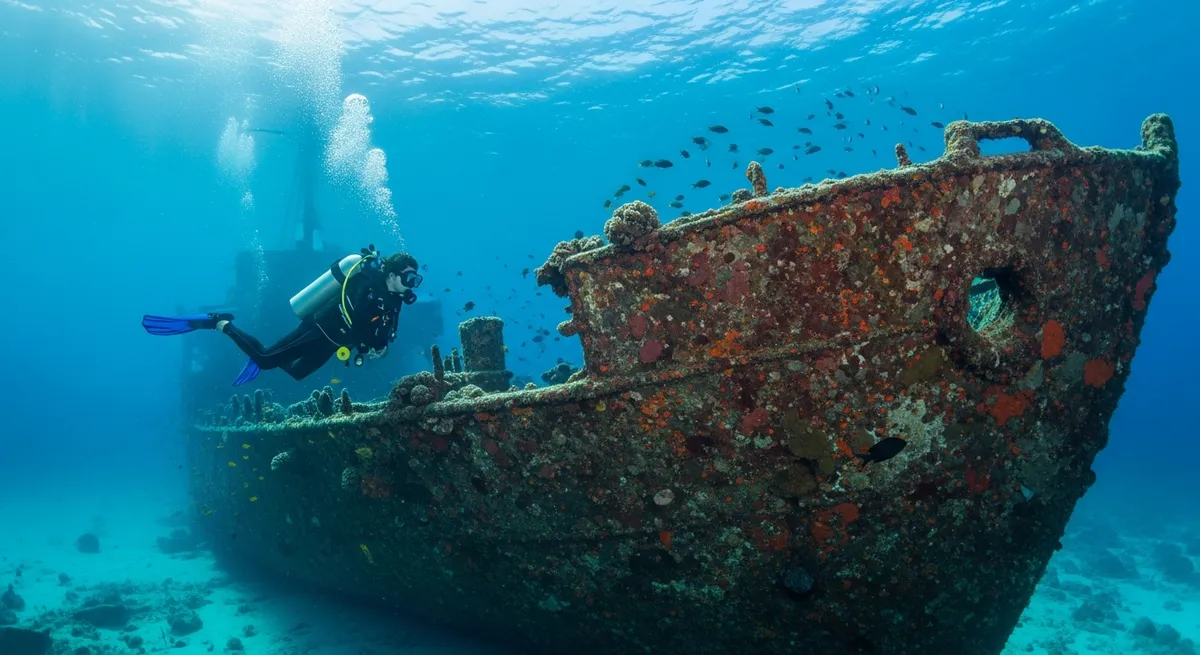
There’s an eerie quiet when you descend into Iron Bottom Sound. It's a vast underwater graveyard, littered with the ghosts of WWII. We're talking dozens of ships and planes, some practically intact, others just scattered debris. Our favourite wrecks are the shallower ones, often bathed in a ghostly blue light, where schools of fusiliers are so thick they practically block out the sun, swarming around gun turrets and cargo holds. The sheer volume of history down here is immense. You might be exploring a landing craft, then drift past a coral-encrusted fighter plane just a few fin kicks away. We’ve spotted Leopard Hind tucked into anti-aircraft guns, and occasionally, a curious Slender Snake Eel poking its head from some forgotten bulkhead. Current can be a factor, especially on some of the deeper sites, but it often just adds to the atmosphere, carrying you slowly past giant anchors and propellers. It's a profoundly humbling experience, a unique blend of history and thriving marine life that you won’t find anywhere else. Go when the dry season brings calmer seas; it makes getting to some of the outer sites much easier.
Iron Bottom Sound Dive Site Map
Dive sites and dive centres in Iron Bottom Sound
Iron Bottom Sound Dive Sites
84 dive sites in Iron Bottom Sound
Abyss’ Triggerfish
Abyss’ Triggerfish, in Iron Bottom Sound, is our pick for a site that truly rewards patience. We recently spent an afternoon here, kicking around in the shallows, and it just kept giving. The current description calls it a "macro heaven," and we agree. This seamount starts at just 5m, then slopes down gently to about 20m, meaning you can spend ages just meticulously exploring the top without ever feeling rushed or needing to manage deep stops. We love dropping in and immediately finding ourselves surrounded by clouds of small fusiliers, which always makes a good first impression. But the real magic is in getting close to the substrate. We saw so many Ostrich Gobies, darting in and out of their burrows, and some really striking Latticed Butterflyfish. Keep an eye out for the smaller stuff like Messmate Pipefish and Banded Blennies tucked into crevices. The visibility averages about 15m here, which is perfectly fine for hunting out those minute creatures. It’s a great spot for photographers who like to take their time and really dial in on the details, rather than chasing after big pelagics. We’d suggest going slow, bring a good macro lens, and be prepared to spend a full dive in just a small area.
Abyss’ Triggerfish
Abyss’ Triggerfish, in Iron Bottom Sound, is our pick for a site that truly rewards patience. We recently spent an afternoon here, kicking around in the shallows, and it just kept giving. The current description calls it a "macro heaven," and we agree. This seamount starts at just 5m, then slopes down gently to about 20m, meaning you can spend ages just meticulously exploring the top without ever feeling rushed or needing to manage deep stops. We love dropping in and immediately finding ourselves surrounded by clouds of small fusiliers, which always makes a good first impression. But the real magic is in getting close to the substrate. We saw so many Ostrich Gobies, darting in and out of their burrows, and some really striking Latticed Butterflyfish. Keep an eye out for the smaller stuff like Messmate Pipefish and Banded Blennies tucked into crevices. The visibility averages about 15m here, which is perfectly fine for hunting out those minute creatures. It’s a great spot for photographers who like to take their time and really dial in on the details, rather than chasing after big pelagics. We’d suggest going slow, bring a good macro lens, and be prepared to spend a full dive in just a small area.
Aichi D3A ’Val’ (Wreck)
Drop down onto the Aichi D3A 'Val' and you're immediately struck by how complete it is. This Japanese dive bomber from WWII rests upside down at around 15 metres, but it's not a broken mess of metal. The wings are still there, the engine cowling largely intact, giving it a real sense of its former self. We love seeing the propeller blades reaching up from the sand, almost beckoning you in. The Val sits right on the edge of a healthy reef, so you get the best of both worlds. Look inside the cockpit for the Barred Blenny or Pacific short-bodied pipefish peeking out. Around the fuselage, you’ll find lionfish sheltering in the crevices. Our favourite is exploring the wing sections, where Blacklined Filefish drift past, and the nearby corals hold plenty of Sangi Cardinalfish. It’s a site that suits those who appreciate history and enjoy a closer look at the smaller stuff that has made this wreck home. Visibility averages 12 metres here, which is more than enough to appreciate the scale of the aircraft.
Aichi D3A ’Val’ (Wreck)
Drop down onto the Aichi D3A 'Val' and you're immediately struck by how complete it is. This Japanese dive bomber from WWII rests upside down at around 15 metres, but it's not a broken mess of metal. The wings are still there, the engine cowling largely intact, giving it a real sense of its former self. We love seeing the propeller blades reaching up from the sand, almost beckoning you in. The Val sits right on the edge of a healthy reef, so you get the best of both worlds. Look inside the cockpit for the Barred Blenny or Pacific short-bodied pipefish peeking out. Around the fuselage, you’ll find lionfish sheltering in the crevices. Our favourite is exploring the wing sections, where Blacklined Filefish drift past, and the nearby corals hold plenty of Sangi Cardinalfish. It’s a site that suits those who appreciate history and enjoy a closer look at the smaller stuff that has made this wreck home. Visibility averages 12 metres here, which is more than enough to appreciate the scale of the aircraft.
Aussie Point
Aussie Point gives you that classic Iron Bottom Sound feel, even without a wreck. The point itself drops off deep, though we usually stick to the top 21 meters, where the reef is in great shape. You’ll spot huge gorgonian sea fans swaying in the current and the place is alive with fish – schools of barracuda and trevally are common. We’ve had some good luck here with pelagics too, seeing reef sharks and the occasional mobula ray glide by. For divers who appreciate a healthy reef with a chance for big animal encounters, it’s a solid choice.
Aussie Point
Aussie Point gives you that classic Iron Bottom Sound feel, even without a wreck. The point itself drops off deep, though we usually stick to the top 21 meters, where the reef is in great shape. You’ll spot huge gorgonian sea fans swaying in the current and the place is alive with fish – schools of barracuda and trevally are common. We’ve had some good luck here with pelagics too, seeing reef sharks and the occasional mobula ray glide by. For divers who appreciate a healthy reef with a chance for big animal encounters, it’s a solid choice.
Azumasan Maru
The Azumasan Maru is one of those wrecks we keep coming back to in Iron Bottom Sound. She’s not one of the colossal ones, but her character really shines. Sitting upright, the bow is the shallower end, peaking around 34m, which means you get a good chunk of bottom time if you're mindful of your deco. We always start at the bow, dropping down to that sandy patch to look back at the silhouette; it's a fantastic shot, especially if you catch some schooling fish in the foreground. Our favourite part, though, is the cargo. Head to the second hold, and you'll find a jumble of motorbikes and sidecars. It’s a real snapshot of wartime logistics, frozen in time. Around the wreck, the soft corals have really taken hold, painting the metal in purples and oranges. Look closely, and you’ll spot Hexagon Groupers peeking from crevices, and the flash of Black Butterflyfish against the hull. Visibility averages around 15m, which is decent enough to appreciate the scale and the details, but keep an eye on your depth here; it slopes quickly past the bow. This site really suits divers who appreciate historical context and enjoy a bit of wreck penetration without going too deep or complex.
Azumasan Maru
The Azumasan Maru is one of those wrecks we keep coming back to in Iron Bottom Sound. She’s not one of the colossal ones, but her character really shines. Sitting upright, the bow is the shallower end, peaking around 34m, which means you get a good chunk of bottom time if you're mindful of your deco. We always start at the bow, dropping down to that sandy patch to look back at the silhouette; it's a fantastic shot, especially if you catch some schooling fish in the foreground. Our favourite part, though, is the cargo. Head to the second hold, and you'll find a jumble of motorbikes and sidecars. It’s a real snapshot of wartime logistics, frozen in time. Around the wreck, the soft corals have really taken hold, painting the metal in purples and oranges. Look closely, and you’ll spot Hexagon Groupers peeking from crevices, and the flash of Black Butterflyfish against the hull. Visibility averages around 15m, which is decent enough to appreciate the scale and the details, but keep an eye on your depth here; it slopes quickly past the bow. This site really suits divers who appreciate historical context and enjoy a bit of wreck penetration without going too deep or complex.
Baby Cakes Reef
Baby Cakes Reef is that reliable friend in Iron Bottom Sound, always delivering a good dive. We love this site for its sheer, unadulterated fish action. It’s a mound reef, sitting right in the current’s path, which basically turns it into a giant drive-thru for every pelagic in the neighbourhood. You'll often find yourself just hanging out, reef hooked in, watching mackerel and rainbow runners zip past, sometimes with tuna in hot pursuit. The coral here is healthy, though not what you’d call spectacular – it’s really the fish that are the stars. We’ve seen enormous schools of black-barred and mimic surgeonfish, so dense they create a shimmering wall. Keep an eye out for humpback groupers lurking in the shadows and the vibrant splash of a clown tang. The current can be brisk, so it’s best for divers comfortable with a bit of a ride, and if you time it right, you'll feel like you're in the middle of a bustling marine highway.
Baby Cakes Reef
Baby Cakes Reef is that reliable friend in Iron Bottom Sound, always delivering a good dive. We love this site for its sheer, unadulterated fish action. It’s a mound reef, sitting right in the current’s path, which basically turns it into a giant drive-thru for every pelagic in the neighbourhood. You'll often find yourself just hanging out, reef hooked in, watching mackerel and rainbow runners zip past, sometimes with tuna in hot pursuit. The coral here is healthy, though not what you’d call spectacular – it’s really the fish that are the stars. We’ve seen enormous schools of black-barred and mimic surgeonfish, so dense they create a shimmering wall. Keep an eye out for humpback groupers lurking in the shadows and the vibrant splash of a clown tang. The current can be brisk, so it’s best for divers comfortable with a bit of a ride, and if you time it right, you'll feel like you're in the middle of a bustling marine highway.
Balydon Shoals
Balydon Shoals is one of those spots where you just know there’s always something happening. It’s a long, shallow reef, maybe 400 metres, generally topping out around 18 metres. The flat top gets hit hard by currents, leaving it pretty barren, but that’s just a prelude to the main event. Our pick here is the southwest wall. That’s where the action is. The reef drops sharply to 21 metres, and it’s a total fish magnet. We’ve seen everything from schools of surgeonfish and bonito, to squadrons of bumphead parrotfish. The current just funnels them in. Visibility isn't always fantastic, maybe 12 metres on an average day, but you’re often so close to the schools, it hardly matters. You’ll feel the pull of the water, a steady drift that carries you along, watching the drama unfold. We love drifting along this wall, letting the current do the work while we scan for sharks or rays cruising by. It’s not a site for poking into every crevice; this is about being out in the blue, watching the big stuff move.
Balydon Shoals
Balydon Shoals is one of those spots where you just know there’s always something happening. It’s a long, shallow reef, maybe 400 metres, generally topping out around 18 metres. The flat top gets hit hard by currents, leaving it pretty barren, but that’s just a prelude to the main event. Our pick here is the southwest wall. That’s where the action is. The reef drops sharply to 21 metres, and it’s a total fish magnet. We’ve seen everything from schools of surgeonfish and bonito, to squadrons of bumphead parrotfish. The current just funnels them in. Visibility isn't always fantastic, maybe 12 metres on an average day, but you’re often so close to the schools, it hardly matters. You’ll feel the pull of the water, a steady drift that carries you along, watching the drama unfold. We love drifting along this wall, letting the current do the work while we scan for sharks or rays cruising by. It’s not a site for poking into every crevice; this is about being out in the blue, watching the big stuff move.
Show all 84 dive sites in Iron Bottom Sound
- Base 1 Muck Site
- Base 1 Muck Site
- Bell P39 Airacobra (Wreck)
- Bell P39 Airacobra (Wreck)
- Bilikiki
- Bilikiki
- Blanche Wall
- Blanche Wall
- Castaway Island
- Cave of the Kastom Shark
- Charapoanna Point
- Coral Corner
- Dolphin Garden
- Dolphin Outer wall
- Dolphin wall
- Doma Reef
- Douglas SBD Dauntless (Wreck)
- Ed’s Wall
- ELIZABETH ANN
- Erik’s Encounter
- Florida Islands
- Gavutu F4F Wildcat (Wreck)
- Grandma’s Garden
- G Spot
- Guadalcanal
- Haipe Reef
- Heron’s Wall
- HMNZS MOA
- HMNZS Moa (Wreck)
- Jamie’s Jungle
- JOHN PENN
- Kawanashi “Mavis“ Seaplane # 1 (Wreck)
- Kid Reef
- KINUGAWA MARU
- KYUSU MARU (POSSIBLY)
- Langarana
- Lumbaria Island
- Maravagi F4F Wildcat (Wreck)
- MASA MARU NO.8
- Mbelo Mbelo
- Mborokua (Mary) Island
- METIKEI
- Mitsubishi G3M ’Nell’ (Wreck)
- Munda
- Nanjalakalau Wall
- Nusa Roviana Wall
- Papatura point
- PBY Catalina Seaplane (Wreck)
- Pilena Reef
- Raiders / F4F Wildcat (Wreck)
- Rainbow Wall
- REGINA M (PROBABLY)
- Rolly’s Reef
- Russell Islands
- Sasavele Dump Site
- Secret Spot
- SOLOMON PRINCESS
- Tama Maru (Japanese Minesweeper)
- Tanavula Point Drift
- The Pinnacle
- The Pond
- Tombatuni Point
- Twin Tunnels Reef
- Uepi Point
- USS Aaron Ward (Wreck)
- USS Kanawa (Wreck)
- VONU (PROBABLY)
- Vought F4U Corsair (Wreck)
- WORLD DISCOVERER
- YAMAZUKI MARU (POSSIBLY)
- ZUIRYO MARU NO 18
- Zuzuao Plane Wreck
Iron Bottom Sound Dive Centres
4 dive shops and operators in Iron Bottom Sound
Ocean Wildlife in Iron Bottom Sound
391 species recorded in Iron Bottom Sound
Iron Bottom Sound Daylight & Sunrise/Sunset
Sunrise and sunset times for Iron Bottom Sound, calculated from coordinates
Today - Sunday 11 October
Sunrise
06:05
Sunset
18:20
Daylight
12h 15m
Golden Hour
17:52
First light (dawn) at 05:44 · Last light (dusk) at 18:41
Monthly Averages
| Month | Sunrise | Sunset | Daylight |
|---|---|---|---|
| Jan | 06:17 | 18:52 | 12h 34m |
| Feb | 06:28 | 18:51 | 12h 23m |
| Mar | 06:30 | 18:39 | 12h 10m |
| Apr | 06:28 | 18:23 | 11h 55m |
| May | 06:30 | 18:14 | 11h 44m |
| JunShortest | 06:37 | 18:15 | 11h 37m |
| Jul | 06:41 | 18:21 | 11h 40m |
| Aug | 06:36 | 18:25 | 11h 49m |
| Sep | 06:20 | 18:23 | 12h 3m |
| OctNow | 06:03 | 18:20 | 12h 17m |
| Nov | 05:55 | 18:25 | 12h 30m |
| DecLongest | 06:02 | 18:39 | 12h 37m |
Times are approximate local times based on longitude. Actual times may vary slightly depending on the exact timezone observed in Iron Bottom Sound.
Where to Stay near Iron Bottom Sound
Prices from Booking.com. We may earn a commission at no extra cost to you.
Marine Protected Areas near Iron Bottom Sound
46 protected areas near Iron Bottom Sound - please respect local regulations when diving
Kia
Arnavon Islands
Tetepare
Tetepare
Pipa/Kororo (Marovo)
Rendova Harbor
Barasipo
Sasavele/NB
Vena Island
Alale, Grant Island
Niumala
Nazareti
Showing 12 largest of 46
Getting to Iron Bottom Sound
Honiara
Munda
Plan & book
Ways to dive Iron Bottom Sound, from day trips to liveaboards.
Day trips & courses
via GetYourGuideGuided dives, courses and snorkel trips with instant booking.
Find dive trips in Iron Bottom SoundPlaces to stay
via Booking.comHotels and dive resorts near Iron Bottom Sound.
Search stays in Iron Bottom SoundDive insurance
Most travel insurance excludes or limits scuba. Check what you need before you go.
Dive insurance explainedPartner links: we may earn a commission if you book, at no extra cost to you. How we make money