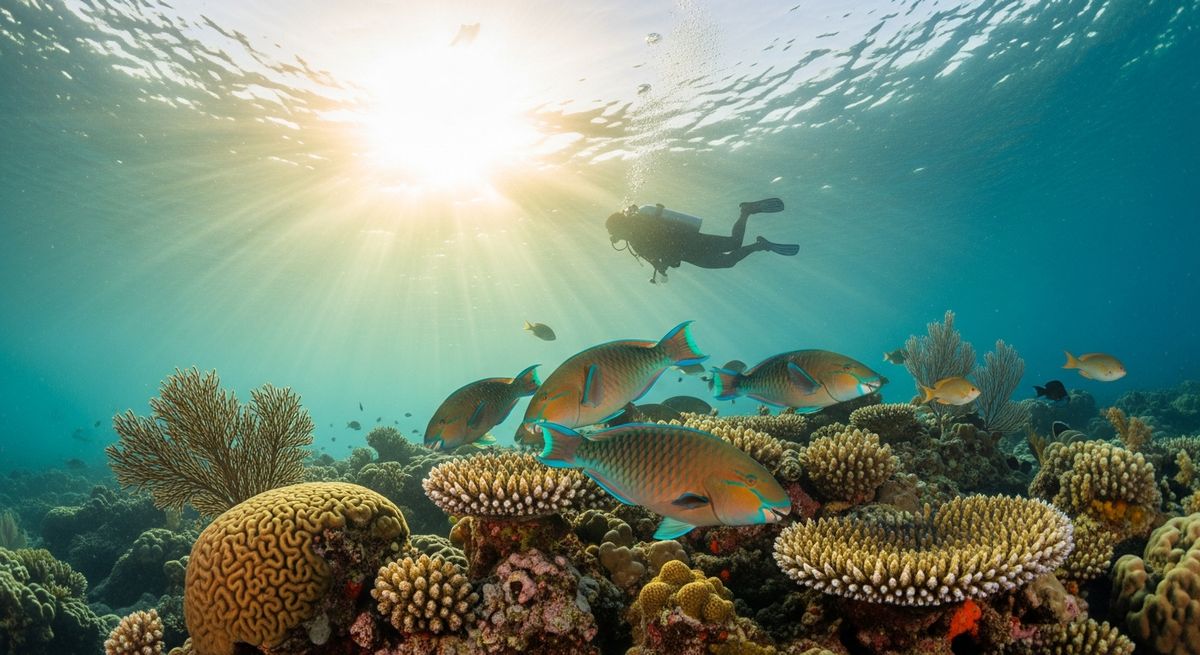
Dolphin wall - Iron Bottom Sound

We spent a good chunk of our trip exploring the Infinity Bay House Reef. It’s far more than just a convenience dive. For an easy entry, just off the beach in West Bay, it delivers some serious punch. The inner reef, shallow and bright, is a fantastic spot to just cruise, spotting juvenile parrotfish and cheeky Beau Gregories zipping around. We often saw divers getting comfortable here, and it’s perfect for that. Venture a little further, past the turtle grass beds where we've seen stingrays glide by, and the reef really drops off. The wall itself isn’t a grand canyon, but it’s a healthy descent to 16 meters. We’ve had great luck finding Mottled Conger Morays peeking out from crevices, and the Yellowhead Jawfish are a real treat, always hovering just above their sandy burrows. Keep an eye out for the smaller stuff; the Sand Gobies and Saddled Blennies are well worth a closer look if you slow down. Visibility averaged around 18 meters when we were there, which gives you plenty of scope to take it all in. Our pick for a relaxed afternoon dive, no major current to fight, just good diving.

Location
Iron Bottom Sound, Solomon Islands, Central & South Pacific
Coordinates
-7.563600, 158.768400
Type
reef

Marine Protected Area: Kia

Best Time to Dive in Iron Bottom Sound

The warmest water temperatures in Iron Bottom Sound occur in January, averaging 30.5°C. The coolest conditions are in December at 30.5°C.

Monthly Water Temperatures

  • January: 30.5°C (air: 26.9°C)
  • February: 30.5°C (air: 26.7°C)
  • March: 30.5°C (air: 26.7°C)
  • April: 30.5°C (air: 26.8°C)
  • May: 30.5°C (air: 26.9°C)
  • June: 30.5°C (air: 26.5°C)
  • July: 30.5°C (air: 26.5°C)
  • August: 30.5°C (air: 26.3°C)
  • September: 30.5°C (air: 26.5°C)
  • October: 30.5°C (air: 26.7°C)
  • November: 30.5°C (air: 26.7°C)
  • December: 30.5°C (air: 26.9°C)

Nearby Dive Sites in Iron Bottom Sound

Nearest Dive Centres to Dolphin wall

Marine Life in Iron Bottom Sound

Home to 415 recorded species including 320 reef fish, 29 hard corals, 18 sea snails & nudibranchs, 16 sea cucumbers, 7 seagrass & algae, 5 clams & mussels.

Notable Species

Recommended Packing List for Dolphin wall

Based on average water temperature of 30.5°C.

  • Shorty or Rashguard - warm 30°C water needs minimal exposure protection
  • Mask - essential for every dive
  • Fins
  • BCD - buoyancy compensator
  • Regulator - your most safety-critical piece of gear
  • Dive Computer - tracks depth, time, and NDL
  • Surface Marker Buoy (SMB) - essential for boat pickups
  • Dive Torch - useful for crevices and colour at depth
  • Underwater Camera - capture your diving memories

Frequently Asked Questions

What is the typical depth range for diving at Dolphin Wall?
Diving at Dolphin Wall typically ranges from 5 meters down to 30 meters deep, offering a diverse profile for various dive plans. While the wall itself extends to 30 meters, many dives commonly explore depths up to 24 meters.
What kind of marine life and corals can divers expect to see at Dolphin Wall?
Divers exploring Dolphin Wall can expect to encounter a vibrant array of marine life amidst colourful corals. You'll frequently spot species such as wrasse, trigger fish, clownfish, various nudibranchs, and batfish. Keep an eye out for reef sharks, which are often seen in the deeper sections of the wall.
How challenging is the diving at Dolphin Wall, especially regarding currents and overall difficulty?
Diving at Dolphin Wall is rated as intermediate difficulty, primarily due to its dynamic current conditions. The site experiences bi-directional currents that are significantly influenced by tidal movements, requiring divers to be mindful of the changing water flow.
What is the best time of year or day to dive Dolphin Wall for optimal conditions and marine life sightings?
The provided data does not specify a "best time of year or day" for diving Dolphin Wall regarding optimal conditions or marine life sightings. However, given the bi-directional currents influenced by tidal movements, consulting local tide charts would be crucial for planning dives to manage current exposure. Understanding local conditions is always key.
What scuba diving certifications are recommended or required to dive Dolphin Wall?
While specific certification requirements are not detailed, the intermediate difficulty rating for Dolphin Wall suggests that divers should have experience beyond entry-level. It is recommended that divers are comfortable with varying current conditions and have a good understanding of their diving equipment and procedures.
What are the typical current conditions and other environmental factors divers should be aware of at Dolphin Wall?
Divers at Dolphin Wall should be aware of its bi-directional currents, which are heavily influenced by tidal movements. The site is semi-sheltered from large swells due to its angle but remains exposed to wind, which can affect surface conditions. Visibility is generally good, averaging around 20 meters.