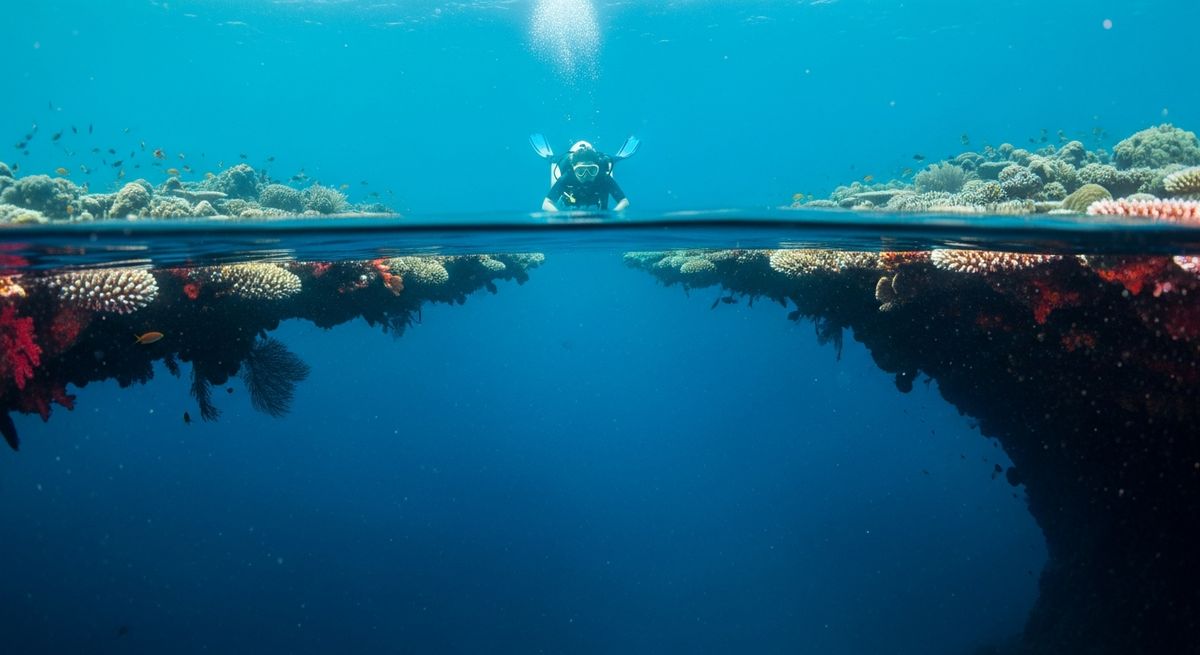
Tama Maru (Japanese Minesweeper) - Iron Bottom Sound

Wall to Wall near Virgin Gorda gets its name for a reason, and it’s not subtle. We've seen this place absolutely crammed with fish, a real wall of silver and scales that sometimes feels like swimming through a live aquarium. Schools of Atlantic spadefish drift by, not quite knowing where to go next, and we always keep an eye out for the eagle rays that sometimes glide past the deeper sections. You’ll find a good collection of the usual Caribbean suspects here – we often spot spotted morays peeking from crevices and stingrays hanging out on the sand below the wall. The maximum depth of 20m means it’s accessible for most, but those currents the data mentions are real. We've been pulled along here more than once, so staying close to your guide is a smart move. Our pick for a standout moment is finding the dusky jawfish tending its eggs, though it takes a keen eye. The visibility averages 16m, which is decent, but when the current picks up, it can kick up some particulate. Still, for sheer fish volume, Wall to Wall is a winner. It’s a site for divers who appreciate being enveloped by marine life, and who don’t mind a bit of a drift.

Location
Iron Bottom Sound, Solomon Islands, Central & South Pacific
Coordinates
-8.920700, 159.964200
Type
wall

Marine Protected Area: Komarindi

Best Time to Dive in Iron Bottom Sound

The warmest water temperatures in Iron Bottom Sound occur in January, averaging 30.5°C. The coolest conditions are in December at 30.5°C.

Monthly Water Temperatures

  • January: 30.5°C (air: 26.9°C)
  • February: 30.5°C (air: 26.7°C)
  • March: 30.5°C (air: 26.7°C)
  • April: 30.5°C (air: 26.8°C)
  • May: 30.5°C (air: 26.9°C)
  • June: 30.5°C (air: 26.5°C)
  • July: 30.5°C (air: 26.5°C)
  • August: 30.5°C (air: 26.3°C)
  • September: 30.5°C (air: 26.5°C)
  • October: 30.5°C (air: 26.7°C)
  • November: 30.5°C (air: 26.7°C)
  • December: 30.5°C (air: 26.9°C)

Nearby Dive Sites in Iron Bottom Sound

Nearest Dive Centres to Tama Maru (Japanese Minesweeper)

Marine Life in Iron Bottom Sound

Home to 415 recorded species including 320 reef fish, 29 hard corals, 18 sea snails & nudibranchs, 16 sea cucumbers, 7 seagrass & algae, 5 clams & mussels.

Notable Species

Recommended Packing List for Tama Maru (Japanese Minesweeper)

Based on average water temperature of 30.5°C.

  • Shorty or Rashguard - warm 30°C water needs minimal exposure protection
  • Mask - essential for every dive
  • Fins
  • BCD - buoyancy compensator
  • Regulator - your most safety-critical piece of gear
  • Dive Computer - tracks depth, time, and NDL
  • Surface Marker Buoy (SMB) - essential for boat pickups
  • Dive Torch - useful for crevices and colour at depth
  • Underwater Camera - capture your diving memories

Frequently Asked Questions

What is the typical depth range for diving the Tama Maru (Japanese Minesweeper)?
The Tama Maru wreck lies intact in a depth range of 65 to 74 meters of water. This makes it a deep technical dive, requiring specialized training and equipment. Divers exploring this site should be prepared for significant depths.
What specific wreck features and marine life are visible at the Tama Maru (Japanese Minesweeper) dive site?
At the Tama Maru, divers can explore the intact hull and decks of this Japanese trawler, which was concreted into a minesweeper. While much of her superstructure is gone, the main body of the wreck provides an interesting exploration. Additionally, large schools of Barracuda frequently surround divers as they descend, offering a spectacular marine life encounter.
How challenging is the Tama Maru (Japanese Minesweeper) dive, and what makes it so?
The Tama Maru is considered a highly challenging dive, classified as a technical dive in all aspects. Its significant depth, with the wreck lying between 65 and 74 meters, contributes to its advanced difficulty. Consequently, this dive is exclusively for certified technical divers who possess the necessary training and experience for such deep expeditions.
What are the optimal conditions or time of year to dive the Tama Maru (Japanese Minesweeper)?
While no specific time of year is mentioned as optimal, divers can expect excellent conditions at depth. At the wreck's depth of 65 to 74 meters, the visibility is often crystal clear, enhancing the exploration experience. For general information on dive conditions in the region, consult when to dive resources.
What level of diving certification is required to explore the Tama Maru (Japanese Minesweeper)?
To explore the Tama Maru, a high level of diving certification is strictly required. This site is designated as a technical dive, meaning it is only accessible to certified technical divers. Standard recreational diving certifications are not sufficient for this deep and challenging wreck.
What can divers expect regarding currents and underwater visibility at the Tama Maru (Japanese Minesweeper)?
Divers can expect generally good visibility at the Tama Maru, with an average visibility of 20 meters. Notably, at the wreck's depth of 65 to 74 meters, the visibility is often crystal clear, providing excellent viewing conditions for the wreck. While specific current information isn't provided, divers should always be prepared for potential currents on deep wreck dives in the Iron Bottom Sound.