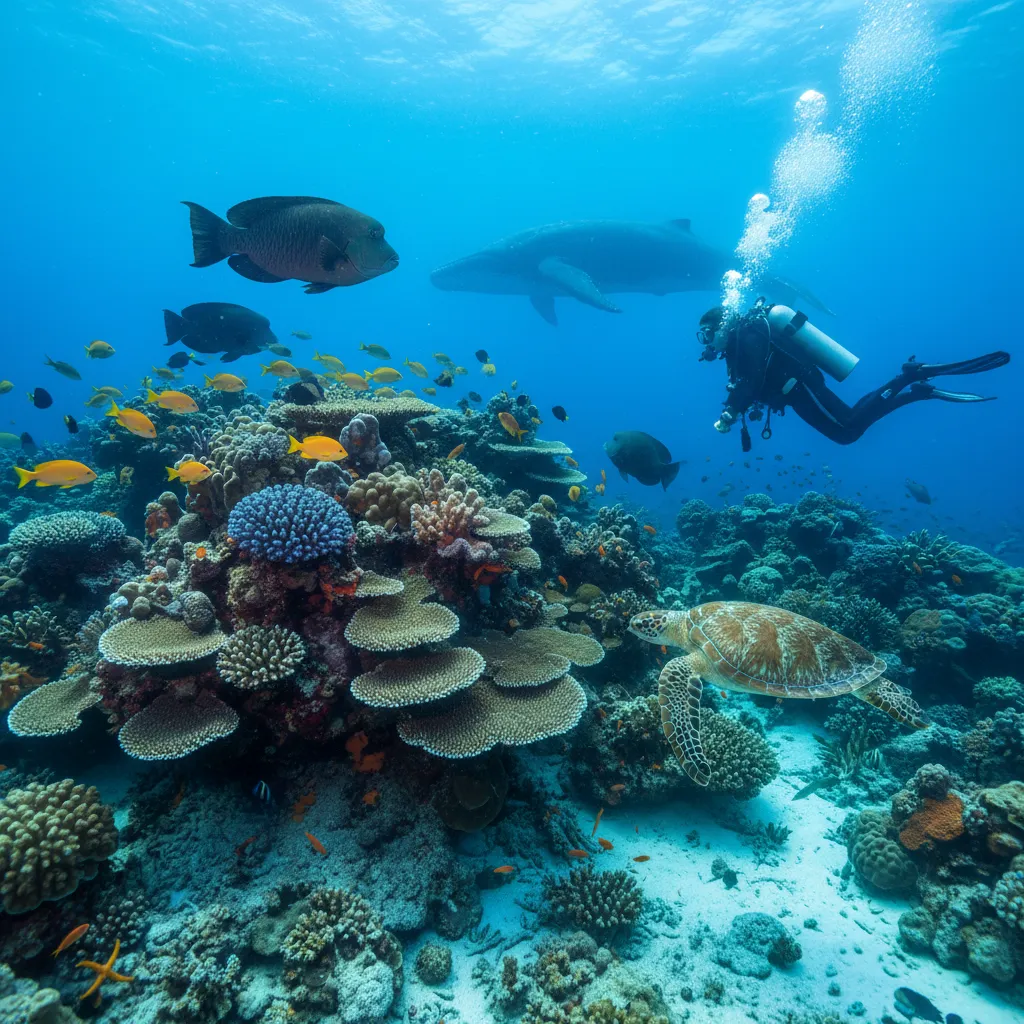
Diving in Ha'apai Group
Why dive here
Ha'apai Group offers some of Tonga's richest diving, with 289+ marine species recorded in the area - including barracuda, blacktip reef sharks, giant moray eels, humpback whales and whitetip reef sharks. Water sits around 27°C.
The Ha’apai Group is the Tonga you picture in your head, all deserted islands and slow island time. We love that it feels so remote, yet the diving is surprisingly approachable, especially if you’re a newer diver finding your fins. Here, the diving is mostly gentle drifts along pretty reef slopes, punctuated by the occasional wall or even a small wreck. What really makes Ha'apai shine, though, are the humpback whale encounters from July to October. We’ve found the reefs here aren't as dramatic as Vava'u's sheer drop-offs, but they’re still lovely, with schools of Black Butterflyfish darting through the shallows and the occasional bright flash of a Raggedtooth Parrotfish. Keep an eye out for the quieter residents too, like the Biocellate wrasse meticulously tending its patch. Visibility tends to be very good, giving you plenty of time to soak in the colours. Our favourite time to dive is early morning; the light is softer, and the reefs feel more alive before the day warms up too much. It’s not a place for big pelagic action generally, but the sheer joy of seeing whales surface nearby, or even hearing their song underwater, is what draws us back every time. Just be prepared for a slower pace, both above and below the surface.
Ha'apai Group Dive Site Map
Dive sites and dive centres in Ha'apai Group
Ha'apai Group Dive Sites
4 dive sites in Ha'apai Group
EKIAKI
Ekiaki is one of those wrecks that just makes you smile. Sitting in a ludicrously shallow one metre of water, it’s a fully exposed fishing vessel, around 35 metres long. We love how the Tongan sun glints off the barnacled superstructure, with the occasional white tern perched on the highest point. You can literally snorkel it, but we prefer a mask and fins and a leisurely fin around the hull, peering into the shadows. It's a fantastic spot for photographers, especially early morning or late afternoon when the light is softer. The sheer amount of small fish darting in and out of the rusted metal is incredible. Look for juvenile emperor angelfish and the electric flash of damselfish. Our favourite is watching the octopus change colours as you swim by. If you’re lucky, you might even spot a tiny reef shark cruising the perimeter. It’s not a challenging dive, just pure, simple wreck exploration.
Ha'apai Reef
Ha'apai Reef is a brilliant introduction to Tongan diving, especially if you’re still getting comfortable in the water. We love it because the shallow depth, 5 to 20 metres, really lets you slow down and appreciate the details. Visibility here can often hit 20 metres, so you get these wide, clear views of the reef structure and all the fish hanging about. We’ve spent hours just drifting along, watching schools of Whitetail Surgeonfish and Manini move like liquid silver over the corals. Keep an eye out for the Blue Trim Parrotfish, their colours are ridiculously vivid. If you come during whale season, between July and October, this spot is famous for humpback encounters. You might just hear their songs vibrating through the water, even if you don't see them up close, which is always a moment. It’s an easy, relaxed dive, perfect for beginners, or frankly, anyone who wants to just unwind and soak it all in without battling a current.
MESNA
The wreck of the Mesna, a substantial steamship from 1917, now rests on Hakaufisi Reef. We’ve found her a fascinating dive, especially for those who appreciate a wreck with history. At 117 meters long, there’s plenty to explore, from the exposed portions of the hull to the superstructure that’s become a home for all sorts of reef fish. You'll often spot schools of snapper darting in and out of the metalwork, and the coral growth, while not as vibrant as a dedicated reef, adds a unique texture to the ship's skeleton. It's a great choice for divers interested in both maritime history and the resilient marine life that colonises artificial reefs.
Uoleva Drop-off
Uoleva Drop-off is one of those sites we always circle back to in Ha'apai. It’s a proper wall dive, starting shallow at around ten metres and just dropping away into the blue. Our favourite way to dive it is to drift along the top, watching the bigger stuff cruise past in the deeper water. You’ll find some seriously impressive sea fans clinging to the wall, their colours muted but still vibrant against the deep blue. The current can pick up here, which is usually when you get the best show from the pelagics. We've seen schools of fusiliers so thick they almost block out the light, and always a few reef sharks patrolling the edge. Keep an eye out for the smaller residents too – we particularly love spotting the tiny Arc-eye Hawkfish perched on the corals, or a bold Orange-lined Triggerfish darting about. It’s an intermediate dive, really, best suited to those comfortable with deeper water and a bit of current.
Ha'apai Group Dive Centres
1 dive shop and operator in Ha'apai Group
Ocean Wildlife in Ha'apai Group
289 species recorded in Ha'apai Group
Ha'apai Group Daylight & Sunrise/Sunset
Sunrise and sunset times for Ha'apai Group, calculated from coordinates
Today - Sunday 11 October
Sunrise
05:13
Sunset
17:39
Daylight
12h 27m
Golden Hour
17:10
First light (dawn) at 04:50 · Last light (dusk) at 18:02
Monthly Averages
| Month | Sunrise | Sunset | Daylight |
|---|---|---|---|
| Jan | 05:12 | 18:24 | 13h 12m |
| Feb | 05:31 | 18:16 | 12h 45m |
| Mar | 05:41 | 17:55 | 12h 14m |
| Apr | 05:50 | 17:29 | 11h 39m |
| May | 06:00 | 17:11 | 11h 11m |
| JunShortest | 06:12 | 17:08 | 10h 56m |
| Jul | 06:14 | 17:16 | 11h 2m |
| Aug | 06:01 | 17:26 | 11h 25m |
| Sep | 05:36 | 17:34 | 11h 58m |
| OctNow | 05:09 | 17:41 | 12h 31m |
| Nov | 04:52 | 17:55 | 13h 3m |
| DecLongest | 04:54 | 18:14 | 13h 19m |
Times are approximate local times based on longitude. Actual times may vary slightly depending on the exact timezone observed in Ha'apai Group.
Where to Stay near Ha'apai Group
Prices from Booking.com. We may earn a commission at no extra cost to you.
Marine Protected Areas near Ha'apai Group
41 protected areas near Ha'apai Group - please respect local regulations when diving
Nomuka SMA
'O'ua SMA
Tonumea and Kelefesia SMA
Mango SMA
Fanga'uta and Fanga Kakau Lagoons
Fonoifua SMA
Matuku SMA
Felemea SMA
Kotu SMA
Hunga SMA
Ha'afeva SMA
'Ovaka SMA
Showing 12 largest of 41
Getting to Ha'apai Group
Lifuka
Nuku'alofa
Vava'u Island
Plan & book
Ways to dive Ha'apai Group, from day trips to liveaboards.
Day trips & courses
via GetYourGuideGuided dives, courses and snorkel trips with instant booking.
Find dive trips in Ha'apai GroupPlaces to stay
via Booking.comHotels and dive resorts near Ha'apai Group.
Search stays in Ha'apai GroupDive insurance
Most travel insurance excludes or limits scuba. Check what you need before you go.
Dive insurance explainedPartner links: we may earn a commission if you book, at no extra cost to you. How we make money