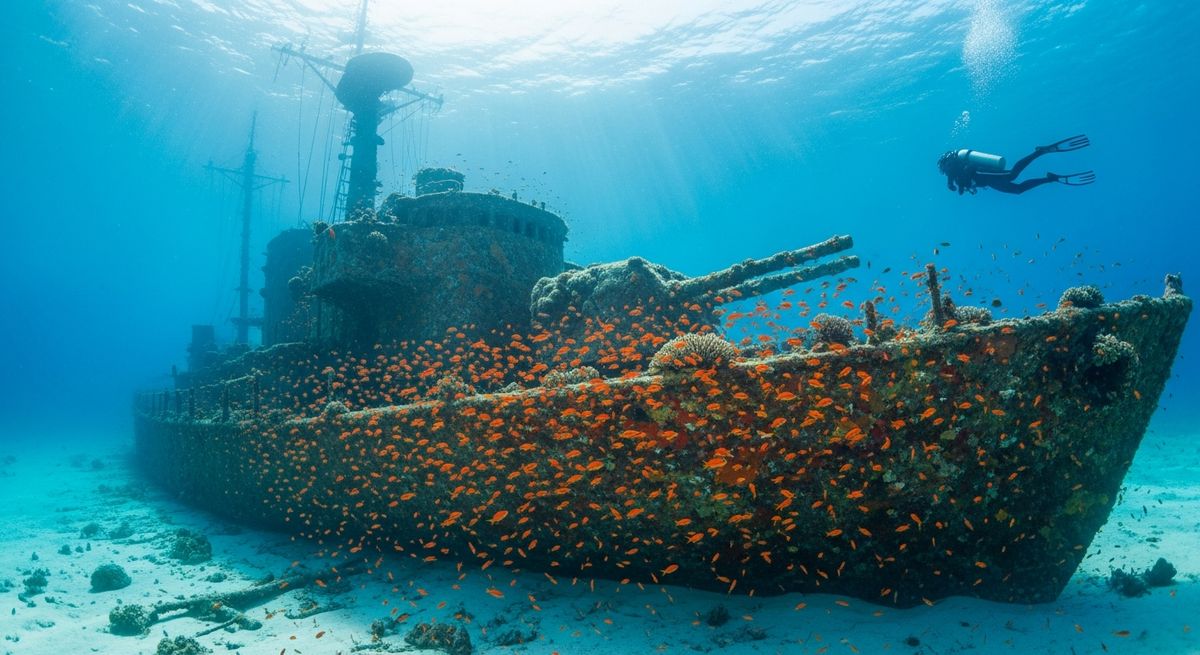
MESNA - Ha'apai Group

The wreck of the Mesna, a substantial steamship from 1917, now rests on Hakaufisi Reef. We’ve found her a fascinating dive, especially for those who appreciate a wreck with history. At 117 meters long, there’s plenty to explore, from the exposed portions of the hull to the superstructure that’s become a home for all sorts of reef fish. You'll often spot schools of snapper darting in and out of the metalwork, and the coral growth, while not as vibrant as a dedicated reef, adds a unique texture to the ship's skeleton. It's a great choice for divers interested in both maritime history and the resilient marine life that colonises artificial reefs.

Location
Ha'apai Group, Tonga, Central & South Pacific
Coordinates
-20.156216, -174.917220
Type
wreck
Maximum Depth
0m

Marine Protected Area: Nomuka SMA

Best Time to Dive in Ha'apai Group

The warmest water temperatures in Ha'apai Group occur in January, averaging 27.5°C. The coolest conditions are in December at 27.5°C.

Monthly Water Temperatures

  • January: 27.5°C (air: 26.9°C)
  • February: 27.5°C (air: 26.8°C)
  • March: 27.5°C (air: 26.8°C)
  • April: 27.5°C (air: 26.5°C)
  • May: 27.5°C (air: 25.5°C)
  • June: 27.5°C (air: 24.5°C)
  • July: 27.5°C (air: 23.9°C)
  • August: 27.5°C (air: 23.3°C)
  • September: 27.5°C (air: 23.8°C)
  • October: 27.5°C (air: 24.2°C)
  • November: 27.5°C (air: 25.3°C)
  • December: 27.5°C (air: 26.3°C)

Nearby Dive Sites in Ha'apai Group

Nearest Dive Centres to MESNA

Marine Life in Ha'apai Group

Home to 294 recorded species including 279 reef fish, 6 sea snails & nudibranchs, 4 sea cucumbers, 3 sharks & rays, 1 sea urchins, 1 crabs & lobsters.

Notable Species

Recommended Packing List for MESNA

Based on average water temperature of 27.5°C.

  • Shorty or Rashguard - warm 27°C water needs minimal exposure protection
  • Mask - essential for every dive
  • Fins
  • BCD - buoyancy compensator
  • Regulator - your most safety-critical piece of gear
  • Dive Computer - tracks depth, time, and NDL
  • Surface Marker Buoy (SMB) - essential for boat pickups
  • Dive Torch - useful for crevices and colour at depth
  • Underwater Camera - capture your diving memories

Frequently Asked Questions

What is the typical diving depth at the MESNA dive site?
The MESNA dive site is listed with a typical diving depth of 0m. This indicates it is an extremely shallow wreck, likely with portions of its hull or superstructure visible at or just below the surface. As a steam ship vessel that went ashore on Hakaufisi Reef, it offers a unique opportunity to explore a historical wreck in very accessible conditions.
What kind of marine life and underwater features can divers expect to see at MESNA?
At the MESNA dive site, divers can expect to explore a significant underwater feature: a large steam ship vessel. This impressive wreck, built in 1917 and measuring 117.3m x 16.2m, offers a unique historical experience. Its classification as a wreck showing any portion of hull or superstructure suggests a substantial structure to investigate.
How difficult is diving at MESNA, and is it suitable for beginner divers?
Diving at the MESNA dive site is classified as intermediate difficulty. While not suitable for absolute beginners due to this rating, divers with some experience and appropriate training can enjoy exploring this historical wreck. It's recommended that divers have a good grasp of buoyancy control and wreck diving procedures for a safe and rewarding experience.
What is the best time of year to dive at MESNA for optimal conditions?
The provided data context for the MESNA dive site does not specify the best time of year for optimal diving conditions. For general information on when to dive in the Tonga region, please refer to our When to Dive guide. We recommend checking local dive operators for current seasonal advice.
What scuba diving certifications are required to dive at MESNA?
While specific certifications are not explicitly listed for the MESNA dive site, its intermediate difficulty rating suggests that divers should possess at least an Advanced Open Water certification or equivalent. Proficiency in buoyancy control and potentially a specialty in wreck diving would be highly beneficial for safely exploring this steam ship vessel. Always consult with local dive operators regarding their specific requirements.
What are the typical current conditions and visibility like at the MESNA dive site?
The provided data context for the MESNA dive site does not include information on typical current conditions or visibility. For the most up-to-date details on these environmental factors, it is always best to consult with local dive centers in the Ha'apai Group before planning your dive.