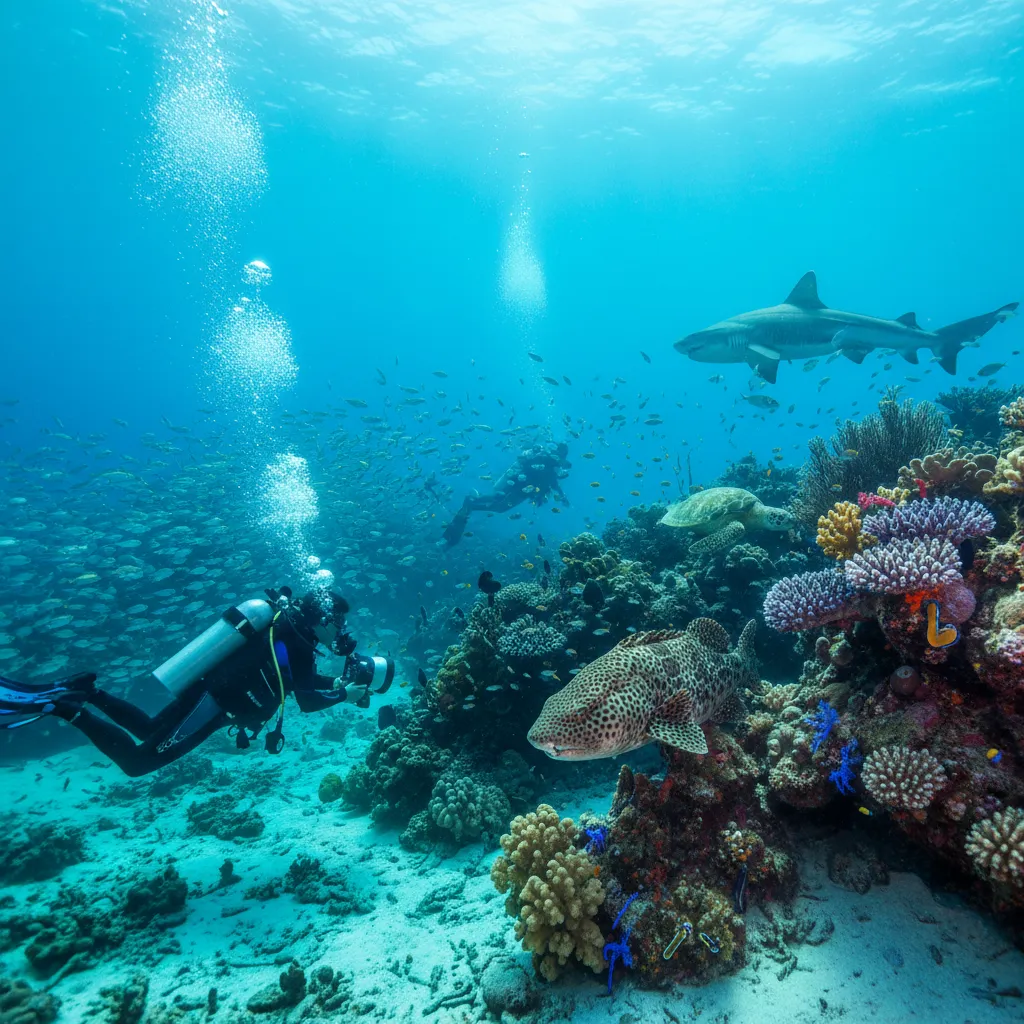
Diving in KwaZulu-Natal
Why dive here
KwaZulu-Natal offers some of South Africa's richest diving, with 490+ marine species recorded in the area - including barracuda, blue sharks, bull sharks, eagle rays and great white sharks. Water sits around 27°C.
KwaZulu-Natal is where the Indian Ocean really flexes its muscles on South Africa's subtropical east coast. We love it for its raw energy, especially when the Sardine Run kicks off - that chaotic, beautiful frenzy is something else, but it’s not for the faint of heart. Beyond the baitball action, Aliwal Shoal is our favourite, a true magnet for serious shark encounters. Diving here means you’ll often be tackling drift dives, getting swept along with the current past ragged pinnacles and dramatic wall drops. You’ll frequently spot grey nurse sharks cruising through the gullies, their toothy grins surprisingly placid, or watch schools of tuna flash by like silver missiles. We’d suggest timing your trip for late winter if the Sardine Run is your goal, but even outside of that, the consistent flow of the Agulhas Current keeps the bigger pelagics moving through year-round. Expect strong currents and dynamic conditions; this isn't a place for gentle bobbing. It’s a proper, adrenaline-pumping dive every time you get in.
KwaZulu-Natal Dive Site Map
Dive sites and dive centres in KwaZulu-Natal
KwaZulu-Natal Dive Sites
52 dive sites in KwaZulu-Natal
Aliwal Shoal
Aliwal Shoal really shines as a big animal destination, particularly for shark lovers. We've spent many a dive here, hanging in the blue, just waiting for the next shape to emerge from the deeper water. It's a fossilized sand dune, now a rocky reef, sitting about 5km offshore, and that exposed position means you often get big currents. Don't let that put you off, though; it’s usually what brings in the action. Visibility can swing wildly, from glorious 30m days to a more challenging 8m, especially if there's been some weather. But even in murkier conditions, those ragged-tooth sharks (we call them 'raggies' here) are impossible to miss during their winter aggregation, a truly spectacular sight. You’ll also bump into honeycomb stingrays patrolling the sandy patches and the occasional oceanic manta ray gliding past. On the reef itself, look out for the vibrant Red Sea Half-and-half Chromis darting amongst the cauliflower corals and the inquisitive Talang queenfish. We'd suggest aiming for a morning dive; the light is better, and the boat traffic is usually a bit lighter. This spot is definitely one for the intermediate diver, comfortable with some chop and the possibility of a strong drift.
Aliwal Shoal
Aliwal Shoal is an ancient fossilized sand dune, now a rocky reef in the Indian Ocean off KwaZulu-Natal. It’s a reliable spot for encounters with ragged-tooth sharks, particularly between May and November, when they congregate in the caves and overhangs. We've seen oceanic blacktip sharks and tiger sharks here too. The currents can be lively, so it’s a site better suited for divers comfortable with drift diving and managing varied conditions.
Aliwal Shoal
Aliwal Shoal is one of those places that genuinely feels alive, even before you hit the water. The surf launch itself is part of the fun, a proper rush in an 8.5m rubber duck – definitely not for the faint of heart, but it sets the tone for a real adventure. Once you’re down, it’s a fossilised sand dune turned reef, which gives it this unique, almost mountainous structure, full of swim-throughs and gullies. We love just drifting along the reef's contours, poking into crevices. Visibility averages around 13m, so it’s not always gin-clear, but that often adds to the drama. What you will see are sharks; ragged-tooth sharks in their season (June to November) are a big draw, often just chilling in the gutters. But even outside of that, we often spot great hammerheads cruising by, along with blackfin barracuda schooling. The smaller stuff is there too: frogfish hiding in plain sight, brightly coloured rainbow wrasse, and plenty of butterflyfish flitting about. It’s a site that really suits divers looking for those larger pelagic encounters combined with interesting topography, and who don’t mind a bit of an adrenaline kick getting out there.
Aliwal Shoal
Aliwal Shoal is one of those places that genuinely feels alive, even before you hit the water. The surf launch itself is part of the fun, a proper rush in an 8.5m rubber duck – definitely not for the faint of heart, but it sets the tone for a real adventure. Once you’re down, it’s a fossilised sand dune turned reef, which gives it this unique, almost mountainous structure, full of swim-throughs and gullies. We love just drifting along the reef's contours, poking into crevices. Visibility averages around 13m, so it’s not always gin-clear, but that often adds to the drama. What you will see are sharks; ragged-tooth sharks in their season (June to November) are a big draw, often just chilling in the gutters. But even outside of that, we often spot great hammerheads cruising by, along with blackfin barracuda schooling. The smaller stuff is there too: frogfish hiding in plain sight, brightly coloured rainbow wrasse, and plenty of butterflyfish flitting about. It’s a site that really suits divers looking for those larger pelagic encounters combined with interesting topography, and who don’t mind a bit of an adrenaline kick getting out there.
Amanzi Harbour
Amanzi Harbour, a private spot in KwaZulu-Natal, isn't your typical reef dive, but it's a solid choice for specific training. With a maximum depth of 9m and average visibility around 7m, it's perfect for honing navigation skills or practicing search and recovery. We’ve found it particularly good for night dives, where the limited visibility during the day actually works to your advantage. You'll likely encounter smallmouth and largemouth yellows, barbel, and carp, with the occasional bass or trout making an appearance. Remember, permission is essential before you even think about getting wet here.
Amanzi Harbour
Amanzi Harbour, a private spot in KwaZulu-Natal, isn't your typical reef dive, but it's a solid choice for specific training. With a maximum depth of 9m and average visibility around 7m, it's perfect for honing navigation skills or practicing search and recovery. We’ve found it particularly good for night dives, where the limited visibility during the day actually works to your advantage. You'll likely encounter smallmouth and largemouth yellows, barbel, and carp, with the occasional bass or trout making an appearance. Remember, permission is essential before you even think about getting wet here.
Amanzi Rock Face
Amanzi Rock Face might not be the poster child for KwaZulu-Natal diving, but we’re here to tell you it’s a site with a quiet charm, especially if you’re into something a little different. Forget your usual reef dive; here, it’s all about the freshwater magic. We love it as a shallow, easy exploration, particularly after sundown. The main draw is a small, deliberately scuttled fishing boat, resting gently at a maximum of 8 metres. It's a nice little wreck, small enough to navigate leisurely, and it’s become a real magnet for the local freshwater species. You’ll weave through sunken trees, their branches creating eerie silhouettes against the limited visibility, which averages around 3 metres. That’s not a lot, we know, but it lends a wonderfully intimate feel to the dive. You’ll spot schools of small mouth and big mouth yellows darting around the structure, their scales catching what little light penetrates. Barbel often lurk in the shadows, and you’re almost guaranteed to see common carp grubbing about. Keep an eye out for an occasional bass or trout, too; they’re a pleasant surprise. This really is a site for divers who appreciate the subtle beauty of freshwater ecosystems and the unique character of a small wreck transformed into a living habitat. It’s not about vibrant colours or huge pelagics; it’s about discovery in the quiet depths.
Amanzi Rock Face
Amanzi Rock Face might not be the poster child for KwaZulu-Natal diving, but we’re here to tell you it’s a site with a quiet charm, especially if you’re into something a little different. Forget your usual reef dive; here, it’s all about the freshwater magic. We love it as a shallow, easy exploration, particularly after sundown. The main draw is a small, deliberately scuttled fishing boat, resting gently at a maximum of 8 metres. It's a nice little wreck, small enough to navigate leisurely, and it’s become a real magnet for the local freshwater species. You’ll weave through sunken trees, their branches creating eerie silhouettes against the limited visibility, which averages around 3 metres. That’s not a lot, we know, but it lends a wonderfully intimate feel to the dive. You’ll spot schools of small mouth and big mouth yellows darting around the structure, their scales catching what little light penetrates. Barbel often lurk in the shadows, and you’re almost guaranteed to see common carp grubbing about. Keep an eye out for an occasional bass or trout, too; they’re a pleasant surprise. This really is a site for divers who appreciate the subtle beauty of freshwater ecosystems and the unique character of a small wreck transformed into a living habitat. It’s not about vibrant colours or huge pelagics; it’s about discovery in the quiet depths.
Amphitheatre
Amphitheatre really earns its name, not for huge drop-offs or dramatic walls, but for the sheer volume of fish that gather here. We love dropping onto the top at 18 metres and just settling in, letting the show come to us. You’ll be surrounded by schools of Bleeker's Surgeonfish, so dense they sometimes dim the light, and the flashing scales of Silver Javelin. Our favourite is spotting the Blackside Hawkfish perched on corals, completely unfazed by divers, or if you’re lucky, a common seahorse tucked away in the soft corals. It’s an excellent spot for photographers or anyone who enjoys simply observing the natural ballet. Visibility averages 14 metres, which is decent enough to appreciate the scale of the schools, and the maximum depth of 27 metres means plenty of bottom time to take it all in. If you’re looking for a relaxed dive with consistent, impressive fish action, Amphitheatre is a firm favourite of ours.
Amphitheatre
Amphitheatre really earns its name, not for huge drop-offs or dramatic walls, but for the sheer volume of fish that gather here. We love dropping onto the top at 18 metres and just settling in, letting the show come to us. You’ll be surrounded by schools of Bleeker's Surgeonfish, so dense they sometimes dim the light, and the flashing scales of Silver Javelin. Our favourite is spotting the Blackside Hawkfish perched on corals, completely unfazed by divers, or if you’re lucky, a common seahorse tucked away in the soft corals. It’s an excellent spot for photographers or anyone who enjoys simply observing the natural ballet. Visibility averages 14 metres, which is decent enough to appreciate the scale of the schools, and the maximum depth of 27 metres means plenty of bottom time to take it all in. If you’re looking for a relaxed dive with consistent, impressive fish action, Amphitheatre is a firm favourite of ours.
Birthday Ledges
Birthday Ledges, off KwaZulu-Natal, offers a series of rocky ledges and crevices that attract a good variety of reef fish. We often spot resident potato bass patrolling the deeper sections and rays gliding over the sand patches. It’s a straightforward dive, well-suited for newer divers looking for an easy introduction to the local reef environment without strong currents. Expect a relaxed pace and plenty of smaller critters tucked into the overhangs.
Butchers
Butchers reef in KwaZulu-Natal feels like exploring an ancient, sunken city. It's a landscape of immense boulders, creating deep gullies and shaded overhangs where all sorts of characters hide. We love drifting through the deeper sections, maybe 25 metres down, scanning for blotchfin scorpionfish perfectly camouflaged against the rock, or a tiger shark cruising by in the blue. The reef top, at around 19 metres, is home to dense schools of blue and gold fusiliers, sometimes so thick they completely obscure the sun for a moment. Look closely for snakehead cowries tucked into crevices and keep an eye out for bluespotted stingrays on the sand patches. Visibility averages around 14 metres, which is often enough to appreciate the scale of this site. Butchers is our pick for experienced divers who enjoy exploring structure and have a keen eye for finding the more elusive residents. It’s a dive that rewards slow exploration over speedy finning.
Show all 52 dive sites in KwaZulu-Natal
- Butchers
- Canyons
- Castle
- Cathedral
- Cathedral
- Chunnel
- Cohen’s Corner
- Coral gardens
- Cowrie
- Crystal Cliffs
- Eelskins
- Farm House
- FONTAO
- FRONTIER
- GRIQUALAND
- Inside Edge - Aliwal Shoal
- JOHN WILLIAMSON
- KARIN
- Landers
- M & M
- Manta Point Aliwal
- Msea Hammer
- MV Produce, wreck
- Nebo Wreck, Aliwal Shoal
- North Sands
- Outside Edge, Aliwal Shoal
- PETINGO
- Pinnacles
- PRODUCE
- Protea banks
- Protea Banks
- Protea Banks
- Protea Banks
- Raggies Cave
- Sardine Run
- South Sands
- Sunken Forest
- Vetchies Pier
- WEOL-MI NO 303
- Wreck of MTS Oceanos
KwaZulu-Natal Dive Centres
7 dive shops and operators in KwaZulu-Natal
Ocean Wildlife in KwaZulu-Natal
490 species recorded in KwaZulu-Natal
KwaZulu-Natal Daylight & Sunrise/Sunset
Sunrise and sunset times for KwaZulu-Natal, calculated from coordinates
Today - Sunday 11 October
Sunrise
05:26
Sunset
18:06
Daylight
12h 40m
Golden Hour
17:34
First light (dawn) at 05:01 · Last light (dusk) at 18:30
Monthly Averages
| Month | Sunrise | Sunset | Daylight |
|---|---|---|---|
| Jan | 05:12 | 19:04 | 13h 52m |
| Feb | 05:39 | 18:47 | 13h 8m |
| Mar | 05:59 | 18:17 | 12h 18m |
| Apr | 06:18 | 17:40 | 11h 23m |
| May | 06:37 | 17:14 | 10h 37m |
| JunShortest | 06:53 | 17:06 | 10h 13m |
| Jul | 06:53 | 17:16 | 10h 23m |
| Aug | 06:33 | 17:34 | 11h 1m |
| Sep | 05:58 | 17:51 | 11h 53m |
| OctNow | 05:21 | 18:08 | 12h 47m |
| Nov | 04:55 | 18:32 | 13h 37m |
| DecLongest | 04:52 | 18:56 | 14h 4m |
Times are approximate local times based on longitude. Actual times may vary slightly depending on the exact timezone observed in KwaZulu-Natal.
Where to Stay near KwaZulu-Natal
Prices from Booking.com. We may earn a commission at no extra cost to you.
Marine Protected Areas near KwaZulu-Natal
6 protected areas near KwaZulu-Natal - please respect local regulations when diving
uThukela Marine Protected Area
Pondoland Marine Protected Area
Protea Banks Marine Protected Area
Aliwal Shoal Marine Protected Area
Trafalgar Marine Protected Area
Trafalgar Marine Reserve
Getting to KwaZulu-Natal
Pietermaritzburg
Durban
Maseru(Mazenod)
Plan & book
Ways to dive KwaZulu-Natal, from day trips to liveaboards.
Day trips & courses
via GetYourGuideGuided dives, courses and snorkel trips with instant booking.
Find dive trips in KwaZulu-NatalPlaces to stay
via Booking.comHotels and dive resorts near KwaZulu-Natal.
Search stays in KwaZulu-NatalDive insurance
Most travel insurance excludes or limits scuba. Check what you need before you go.
Dive insurance explainedPartner links: we may earn a commission if you book, at no extra cost to you. How we make money