AMALFI
Why dive here
With 46+ marine species recorded in the area - including dolphins, sea turtles and cuttlefish - AMALFI offers some of Istria Peninsula's richest wreck diving. Water ranges 12-26°C, warmest July, August, September.
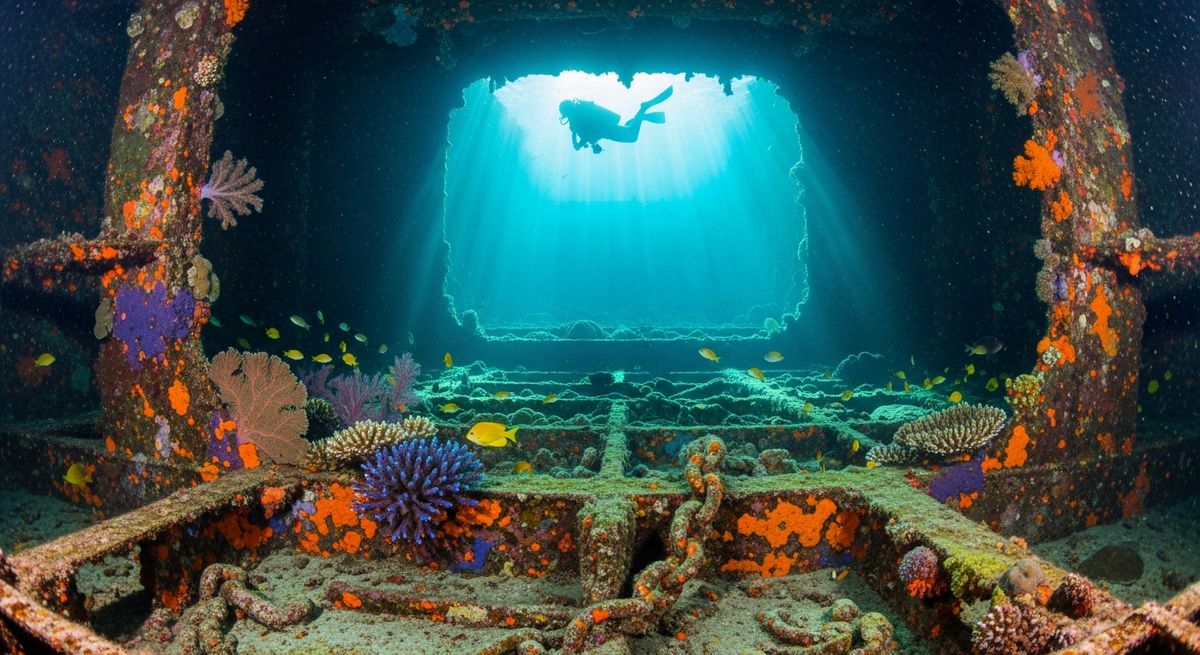
The Amalfi wreck, off the coast of Istria, is a proper time capsule. We love how it’s not just a pile of metal, but a genuinely dangerous wreck, which really adds to the excitement. She lies upright on a sandy bottom at 29 metres, surprisingly intact for a cargo ship sunk over a century ago. You can still make out the superstructure, the deck, and even some of the holds. What makes the Amalfi special is the life that’s claimed it. We’ve finned past schools of glinting damselfish flitting through the open hatches, and watched moray eels peeking from the gloom of the engine room. Our favourite memory is finding a huge conger eel curled up in the anchor chain locker, practically posing for photos. Visibility here can vary, but on a good day, the light filters down, giving the wreck an eerie, almost ghostly glow. It’s a dive for those who appreciate history and don’t mind a bit of a current sometimes. Definitely bring a good torch; there’s plenty to illuminate inside if you’re comfortable with wreck penetration.
Typical AMALFI Dive Profile
Illustrative profile based on site depth and type. Actual dive profiles vary - always follow your dive computer and training.
Safety Notes
Depth of 29m - Advanced Open Water certification recommended.
Wreck site - avoid penetration without wreck diving certification. Watch for sharp metal and entanglement hazards.
Always perform a 3-minute safety stop at 5m before surfacing.
AMALFI Wreck History
Year Sunk
1915
Vessel Type
warship
Cause
torpedo
Tonnage
10,118 tons
The Amalfi was a formidable Pisa-class armored cruiser of the Italian Royal Navy (Regia Marina), launched in 1908. Representing the cutting edge of naval technology of her time, she and her sister ship Pisa were powerful warships, designed for speed and heavy armament. With the outbreak of World War I, the Amalfi was actively involved in patrolling the Adriatic Sea against the forces of the Austro-Hungarian Navy.
Her career was cut short in the early morning of July 7, 1915. While on a reconnaissance mission near Venice, she was spotted by the German submarine UB-14, which was operating under the Austro-Hungarian flag to avoid implicating Germany in the Mediterranean conflict. The submarine fired a single torpedo that struck the Amalfi, causing catastrophic flooding. Despite efforts to save her, the mighty cruiser listed heavily and sank within 30 minutes, taking 67 of her crew with her to the bottom of the Adriatic.
Resting upside down at a depth of around 30 metres off the Istrian Peninsula, the Amalfi is now one of Croatia's most famous and impressive wreck dives. The sheer scale of the 140-metre-long hull is breathtaking. Divers can explore the inverted deck, peer into the casemates where the secondary guns are still visible, and see the massive propeller shafts and rudder. The wreck is a protected cultural monument and war grave, demanding a respectful visit. It has become a magnificent artificial reef, attracting a dense population of fish and marine invertebrates, creating a vibrant ecosystem on a tragic piece of history.
Nearest Dive Centres to AMALFI
Dive shops near AMALFI
View all dive centres in Istria PeninsulaReviews for AMALFI
Conditions
Ocean conditions, forecast and tides for AMALFI
AMALFI Ocean Conditions
Monthly averages for AMALFI, sourced from Open-Meteo marine data + Copernicus Marine (EU) - nearest station: Open-Meteo marine grid (45.08, 14.15) (21km away)
October Averages
Sea Temperature
20°C
68°F · Range: 18.4–22.3°C
Current Speed
3.16 cm/s
Direction: W (288.4°)
Salinity
37.74 PSU
Based on 4 years of monitoring data · Data sources: Open-Meteo marine data + Copernicus Marine (EU)
Plan & book
Ways to dive Istria Peninsula, from day trips to liveaboards.
Day trips & courses
via GetYourGuideGuided dives, courses and snorkel trips with instant booking.
Find dive trips in Istria PeninsulaPlaces to stay
via Booking.comHotels and dive resorts near Istria Peninsula.
Search stays in Istria PeninsulaDive insurance
Most travel insurance excludes or limits scuba. Check what you need before you go.
Dive insurance explainedPartner links: we may earn a commission if you book, at no extra cost to you. How we make money
Where to Stay near AMALFI
Prices from Booking.com. We may earn a commission at no extra cost to you.