B.Y.M.S. 2053
Why dive here
With 46+ marine species recorded in the area - including dolphins, sea turtles and cuttlefish - B.Y.M.S. 2053 offers some of Istria Peninsula's richest wreck diving. Water ranges 12-26°C, warmest July, August, September.
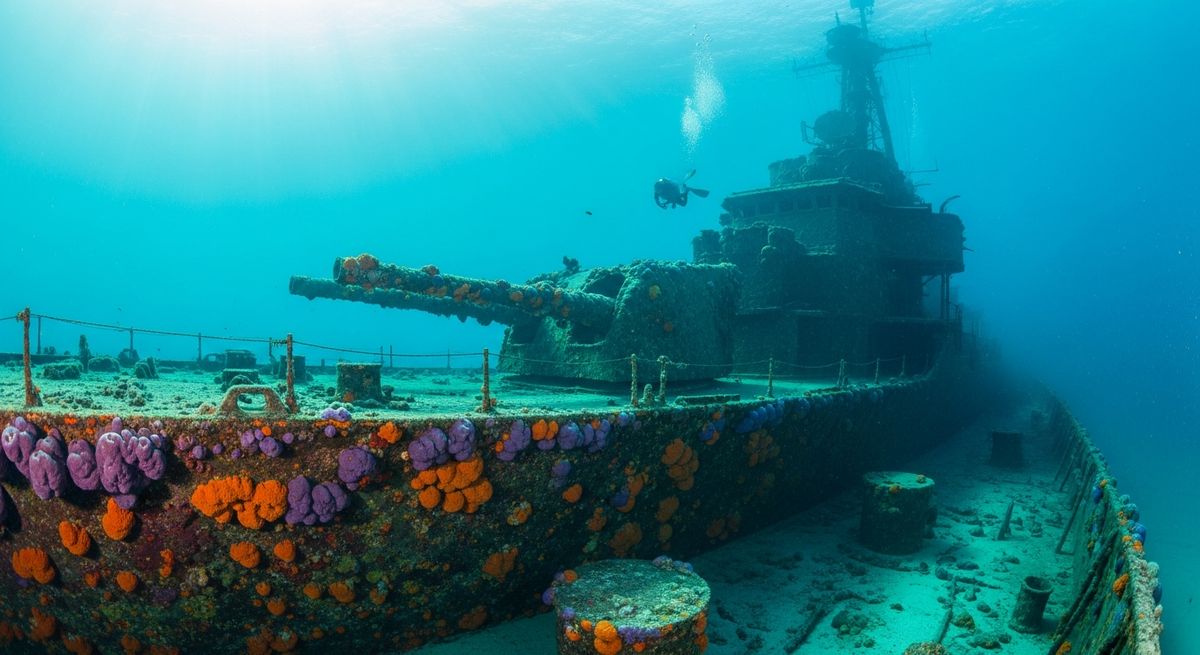
Diving the B.Y.M.S. 2053 off the Istria Peninsula is like stepping back into a moment in time, a tangible piece of history sitting upright on the seabed. This minesweeper, sunk in 1945, isn’t just a pile of metal; it’s remarkably intact, making it one of our favourite wreck dives in the northern Adriatic. You can swim over the deck, tracing the outline of where the superstructure once stood, feeling the cool water slide past as you peer into open hatches. The bow section is particularly impressive, rising from the sand, often draped in schools of damselfish that scatter as you approach. We love how the Adriatic’s soft corals have begun to colonise the metal, a subtle palette of oranges and purples against the grey steel. Look closely, and you’ll spot scorpionfish tucked into crevices and moray eels peeking from the shadows of the engine room. It’s a dive that suits those who appreciate historical context as much as the marine life, offering a quiet, contemplative experience at 28 meters. The visibility here can be excellent, especially on a calm morning, letting the Mediterranean sun filter through the water and illuminate the wreck’s details.
Typical B.Y.M.S. 2053 Dive Profile
Illustrative profile based on site depth and type. Actual dive profiles vary - always follow your dive computer and training.
Safety Notes
Depth of 28m - Advanced Open Water certification recommended.
Wreck site - avoid penetration without wreck diving certification. Watch for sharp metal and entanglement hazards.
Always perform a 3-minute safety stop at 5m before surfacing.
B.Y.M.S. 2053 Wreck History
Year Sunk
1945
Vessel Type
warship
Cause
mine
BYMS-2053 was a British Yard Minesweeper, part of a large class of rugged, wooden-hulled vessels built in the United States for the British Royal Navy under the Lend-Lease Act. These ships were the unsung heroes of naval warfare, tasked with the incredibly dangerous job of clearing sea lanes of explosive mines to ensure safe passage for convoys and larger warships. Their work was tedious, nerve-wracking, and essential to the Allied war effort in every theater of operation.
On April 29, 1945, with the war in Europe just days from its conclusion, BYMS-2053 was engaged in clearing a minefield off Ravenna, Italy. In a tragic turn of irony, the vessel fell victim to the very weapon it was designed to defeat. It struck a German mine and sank, a stark reminder of the persistent dangers sailors faced even as the conflict drew to a close. The ship became one of the last Allied warship casualties in the Mediterranean.
Now resting on the seabed off the Istrian coast, the wreck of BYMS-2053 is a fascinating dive into naval history. Although its wooden hull has deteriorated over time, the ship's metal components, such as its engine, minesweeping gear, and deck fittings, remain. Divers can explore the compact layout of this specialized vessel and reflect on the perilous mission of its crew. The wreck serves as an underwater memorial to those who undertook one of World War II's most hazardous duties.
Nearest Dive Centres to B.Y.M.S. 2053
Dive shops near B.Y.M.S. 2053
IDENTICI DIVING SCHOOL RAVENNA A.S.D.
Albarella Diving Center SSDRL
Reviews for B.Y.M.S. 2053
Conditions
Ocean conditions, forecast and tides for B.Y.M.S. 2053
B.Y.M.S. 2053 Ocean Conditions
Monthly averages for B.Y.M.S. 2053, sourced from Open-Meteo marine data + Copernicus Marine (EU) - nearest station: Open-Meteo marine grid (45.08, 14.15) (21km away)
October Averages
Sea Temperature
20°C
68°F · Range: 18.4–22.3°C
Current Speed
3.16 cm/s
Direction: W (288.4°)
Salinity
37.74 PSU
Based on 4 years of monitoring data · Data sources: Open-Meteo marine data + Copernicus Marine (EU)
Plan & book
Ways to dive Istria Peninsula, from day trips to liveaboards.
Day trips & courses
via GetYourGuideGuided dives, courses and snorkel trips with instant booking.
Find dive trips in Istria PeninsulaPlaces to stay
via Booking.comHotels and dive resorts near Istria Peninsula.
Search stays in Istria PeninsulaDive insurance
Most travel insurance excludes or limits scuba. Check what you need before you go.
Dive insurance explainedPartner links: we may earn a commission if you book, at no extra cost to you. How we make money
Where to Stay near B.Y.M.S. 2053
Prices from Booking.com. We may earn a commission at no extra cost to you.