Baron Gautsch
Protected Area
Datule Barbariga
Why dive here
With 46+ marine species recorded in the area - including dolphins, sea turtles and cuttlefish - Baron Gautsch offers some of Istria Peninsula's richest wreck diving. Water ranges 12-26°C, warmest July, August, September.
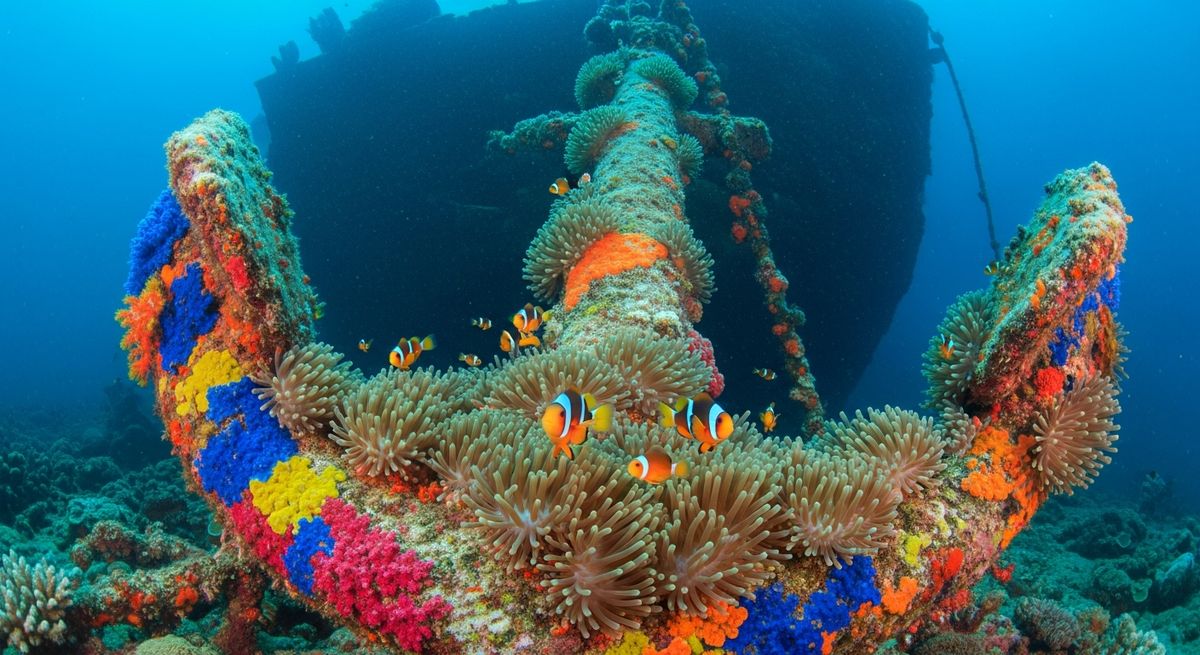
The Baron Gautsch. Now *this* is a wreck. We’ve done our share of Adriatic dives, and while many wrecks are just a pile of scattered metal, the Gautsch is something else entirely. She sits upright, a ghost ship in the deep blue, her structure remarkably intact. You can still make out the promenade decks, the bridge, even some of the lifeboats davits. Dropping down, the sheer scale hits you. This isn’t a quick swim-through. We’re talking a proper exploration. Entering the lower decks, you’re enveloped in a sense of history; it’s dark, almost cathedral-like, with shafts of light piercing through broken portholes. We love seeing the blackspotted smoothhounds resting on the deck, and you’ll often spot a thornback skate or a dogfish tucked into the sand nearby. Keep an eye out for the hairy sea-mat, a quirky splash of colour against the rusted steel. The dory are usually hovering around the bow, almost like sentinels. The depth, 28-40 metres, means it’s definitely one for advanced divers, giving you the time to properly soak it all in. Our favourite time to dive it is early morning, before any potential currents pick up and when the light filters down just right. It adds to the drama.
Typical Baron Gautsch Dive Profile
Illustrative profile based on site depth and type. Actual dive profiles vary - always follow your dive computer and training.
Safety Notes
Depth of 28m - Advanced Open Water certification recommended.
Wreck site - avoid penetration without wreck diving certification. Watch for sharp metal and entanglement hazards.
Always perform a 3-minute safety stop at 5m before surfacing.
Baron Gautsch Wreck History
Year Sunk
1914
Vessel Type
passenger ship
Cause
mine
The SS Baron Gautsch was a magnificent Austro-Hungarian passenger steamship, the pride of the Österreichischer Lloyd shipping line. Built in 1908 in Dundee, Scotland, she was a modern and luxurious vessel servicing the route between Trieste and Kotor along the Dalmatian coast. She represented the height of civilian maritime travel in the final, gilded years of the Austro-Hungarian Empire.
With the outbreak of World War I in the summer of 1914, her fate was sealed. On August 13, 1914, just weeks into the war, she was on a voyage to Trieste, carrying civilian refugees and the families of servicemen. In a tragic irony, her captain ignored warnings and steered directly into a defensive minefield laid by his own Austro-Hungarian Navy. The explosion was catastrophic, sinking the elegant liner in minutes and claiming the lives of 127 passengers and crew.
Often called the 'Titanic of the Adriatic,' the wreck of the Baron Gautsch is one of Croatia's premier dive sites. She sits perfectly upright on a sandy seabed at a depth ranging from 28 to 40 meters. The wreck is remarkably well-preserved, and its decks, promenade, and bridge are draped in nets and teeming with marine life. For qualified divers, penetration is possible, offering a haunting glimpse into the corridors and saloons of a bygone era. As a protected Croatian cultural monument, it is a profoundly moving dive into history.
Nearest Dive Centres to Baron Gautsch
Dive shops near Baron Gautsch
THE OLD DIVER
Diving Rovinj
Morski Puz
Mediterraneum Mare Sport
Rovinj Sub - Diving Center
Hippocampus Diving Center
Reviews for Baron Gautsch
Conditions
Ocean conditions, forecast and tides for Baron Gautsch
Baron Gautsch Ocean Conditions
Monthly averages for Baron Gautsch, sourced from Open-Meteo marine data + Copernicus Marine (EU) - nearest station: Open-Meteo marine grid (45.08, 14.15) (21km away)
October Averages
Sea Temperature
20°C
68°F · Range: 18.4–22.3°C
Current Speed
3.16 cm/s
Direction: W (288.4°)
Salinity
37.74 PSU
Based on 4 years of monitoring data · Data sources: Open-Meteo marine data + Copernicus Marine (EU)
Plan & book
Ways to dive Istria Peninsula, from day trips to liveaboards.
Day trips & courses
via GetYourGuideGuided dives, courses and snorkel trips with instant booking.
Find dive trips in Istria PeninsulaPlaces to stay
via Booking.comHotels and dive resorts near Istria Peninsula.
Search stays in Istria PeninsulaDive insurance
Most travel insurance excludes or limits scuba. Check what you need before you go.
Dive insurance explainedPartner links: we may earn a commission if you book, at no extra cost to you. How we make money
Where to Stay near Baron Gautsch
Prices from Booking.com. We may earn a commission at no extra cost to you.