ARROYO (CIT)
Protected Area
Cap Sicie - Six Fours
Why dive here
With 157+ marine species recorded in the area - including blue sharks, dolphins, dwarf minke whales, humpback whales and mobula rays (devil rays) - ARROYO (CIT) offers some of Marseille & Calanques's richest wreck diving. Water ranges 14-25°C, warmest July, August, September.
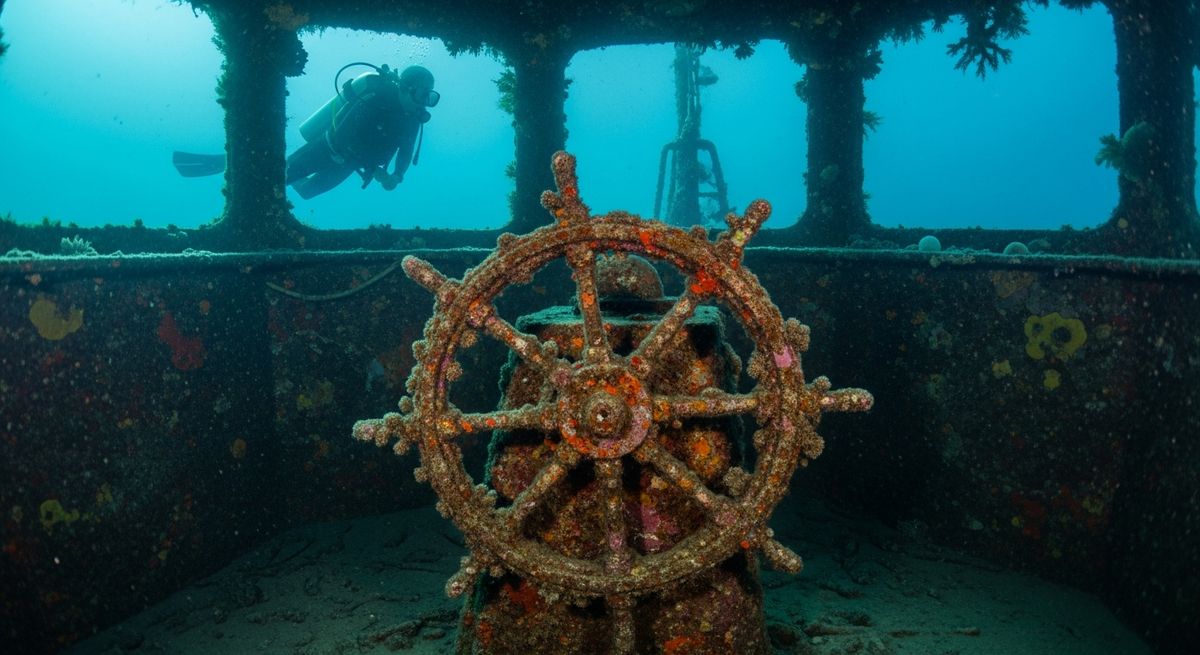
The Arroyo, or CIT as many divers call it, is one of our absolute favourite wrecks in the Calanques. It’s not a natural sinking; the French Navy scuttled this tanker in 1953 as a training ground for their early dive groups. That history just adds a layer of intrigue, knowing it was deliberately placed for exploration. You’ll find the 55-meter wreck sitting upright at 33 meters, making it a solid deep dive for advanced recreational divers. We love dropping down onto the deck, the light filtering through the clear Mediterranean water, illuminating the superstructure. Penetrating the engine room is a highlight, though it’s silty, so good buoyancy is key. Inside, you’ll likely spook conger eels out of their hiding spots, and we often spot lobsters tucked into crevices in the cargo holds. The wreck itself has become a busy apartment block for marine life, with schools of glasseyes darting through the darker sections and vibrant jewel anemonies clinging to the metalwork. It’s a proper historical playground, a dive that feels like uncovering a secret every time.
Typical ARROYO (CIT) Dive Profile
Illustrative profile based on site depth and type. Actual dive profiles vary - always follow your dive computer and training.
Safety Notes
Deep dive (33m) - monitor air consumption closely. Advanced certification recommended.
Wreck site - avoid penetration without wreck diving certification. Watch for sharp metal and entanglement hazards.
Always perform a 3-minute safety stop at 5m before surfacing.
ARROYO (CIT) Wreck History
Year Sunk
1953
Vessel Type
tanker
Cause
scuttled
Unlike wrecks born of tragedy, the tanker Arroyo was sunk with a clear purpose. In August 1953, this 55-meter vessel was intentionally sent to the seabed by the GERS (Groupe d'Etudes et de Recherches Sous-Marines), a pioneering French Navy group once associated with Jacques Cousteau. Its new mission: to serve as a realistic training ground for navy divers, creating a challenging and accessible environment to hone critical underwater skills.
Today, the Arroyo rests upright at a depth of 33 meters, offering a fantastic dive into maritime history. Its deck is at about 28 meters, making it accessible to advanced recreational divers. The wreck is largely intact, allowing for exploration of its superstructure and deck features. While its 'Dangerous Wreck' classification serves as a reminder to be cautious of sharp metal and potential entanglement points, for the prepared diver, the Arroyo is a purpose-built underwater playground and a direct link to the golden age of scuba diving exploration.
Nearest Dive Centres to ARROYO (CIT)
Dive shops near ARROYO (CIT)
Saint-Mandrier Plongée
Le Brusc Plongée
Bubble Diving
Toulon Plongée
UCPA Sanary-sur-Mer
OMNIBLUE FREEDIVE
Reviews for ARROYO (CIT)
Conditions
Ocean conditions, forecast and tides for ARROYO (CIT)
ARROYO (CIT) Ocean Conditions
Monthly averages for ARROYO (CIT), sourced from Open-Meteo marine data - nearest station: Open-Meteo marine grid (43.11, 5.89) (32km away)
October Averages
Sea Temperature
21°C
69°F · Range: 15.7–23.1°C
Air Temperature
18°C
64°F
Wind Speed
6.69 m/s
13.0 knots
Atmospheric Pressure
1016.9 hPa
Based on 4 years of monitoring data · Data sources: Open-Meteo marine data
Plan & book
Ways to dive Marseille & Calanques, from day trips to liveaboards.
Day trips & courses
via GetYourGuideGuided dives, courses and snorkel trips with instant booking.
Find dive trips in Marseille & CalanquesPlaces to stay
via Booking.comHotels and dive resorts near Marseille & Calanques.
Search stays in Marseille & CalanquesDive insurance
Most travel insurance excludes or limits scuba. Check what you need before you go.
Dive insurance explainedPartner links: we may earn a commission if you book, at no extra cost to you. How we make money
Where to Stay near ARROYO (CIT)
Prices from Booking.com. We may earn a commission at no extra cost to you.