VOLTA - Alonissos Marine Park

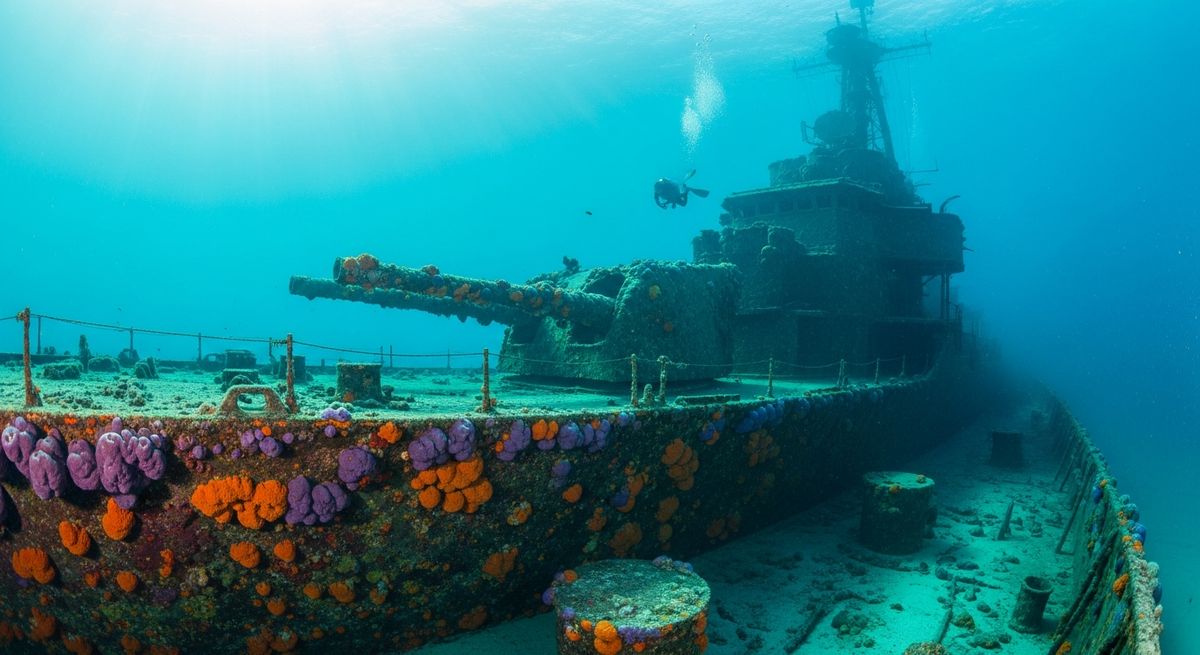
Dropping onto the Volta, you're immediately struck by the sheer scale of the wreck. This isn't just a jumble of metal; it’s a substantial steamship, built in Glasgow, lying broken but still imposing at a surprisingly shallow 0 meters. It’s an unusual sight, given its age and depth. We often find the bow section particularly photogenic, with its chain locker visible and schools of damselfish flitting through the beams. While much of the superstructure is gone, the hull itself, stretching 61 meters, provides plenty to explore, especially for those interested in maritime history.

Location
Alonissos Marine Park, Greece, Mediterranean & Europe
Coordinates
37.491184, 25.310467
Type
wreck
Maximum Depth
0m

Marine Protected Area: NISIDES MYKONOU: RINEIA, CHTAPODIA, KAI TRAGONISI KAI THALASSIA PERIOCHI

Best Time to Dive in Alonissos Marine Park

The warmest water temperatures in Alonissos Marine Park occur in August, averaging 27.2°C. The coolest conditions are in February at 13.9°C.

Monthly Water Temperatures

  • January: 14.5°C
  • February: 13.9°C
  • March: 14.2°C
  • April: 15.4°C
  • May: 18.7°C
  • June: 23.5°C
  • July: 26.5°C
  • August: 27.2°C
  • September: 25.3°C
  • October: 22.8°C
  • November: 19.9°C
  • December: 16.9°C

Nearby Dive Sites in Alonissos Marine Park

Nearest Dive Centres to VOLTA

Marine Life in Alonissos Marine Park

Home to 16 recorded species including 3 whales & dolphins, 3 reef fish, 2 other, 2 hard corals, 2 crabs & lobsters, 1 seagrass & algae.

Notable Species

Recommended Packing List for VOLTA

Based on average water temperature of 19.9°C, currents 3 cm/s.

  • Wetsuit (3-5mm) - comfortable for 20°C water
  • Mask - essential for every dive
  • Fins
  • BCD - buoyancy compensator
  • Regulator - your most safety-critical piece of gear
  • Dive Computer - tracks depth, time, and NDL
  • Surface Marker Buoy (SMB) - essential for boat pickups
  • Dive Torch - useful for crevices and colour at depth
  • Underwater Camera - capture your diving memories

Frequently Asked Questions

What is the typical diving depth at the Volta dive site, including both the river and the lake?
The Volta dive site, a fascinating steamship wreck, is listed with a typical diving depth of 0m. This indicates it is a very shallow wreck, possibly at the surface or just below, showing portions of its hull or superstructure. Please note that the provided data specifically refers to a marine wreck in Alonissos Marine Park, Greece, and does not include information about a river or lake.
What kind of marine life and underwater features can divers expect to see when exploring the Volta River and Lake Volta?
When exploring the Volta dive site, divers can expect to encounter the impressive features of a steam ship vessel wreck, measuring 61m x 8.8m. This wreck, built in 1882 and sunk in 1887, is classified as showing portions of its hull or superstructure. While specific marine life details are not provided in the data, wrecks typically serve as artificial reefs, attracting various species of marine life.
How challenging is diving in the Volta River and Lake Volta, and is it suitable for beginner divers?
Diving at the Volta dive site is classified as intermediate difficulty. This suggests it is suitable for divers who have some experience beyond basic certification and may involve conditions or features that require more advanced skills than a beginner dive. Therefore, it may not be ideal for absolute beginner divers.
What are the best months or seasons to go diving in the Volta region for optimal conditions and visibility?
Unfortunately, the provided data for the Volta dive site does not include specific information regarding the best months or seasons for optimal diving conditions and visibility. For general guidance on diving in Greece, you may want to consult our When to Dive section.
Are there any specific diving certifications or experience levels recommended or required for diving in the Volta River or Lake Volta?
Given that the Volta dive site is rated as intermediate difficulty, it is recommended that divers possess certifications beyond entry-level, such as Advanced Open Water Diver, or have equivalent experience. This ensures divers are prepared for the potential challenges and features of a wreck dive. Always ensure your equipment is suitable for the dive conditions.
What are the typical current and visibility conditions divers might encounter at the Volta dive sites?
The provided data for the Volta dive site does not specify typical current or visibility conditions. Divers planning to visit this wreck should consult local dive operators for up-to-date information on site conditions before their dive. This will help ensure a safe and enjoyable experience.