TRITONA - Algarve & Berlengas

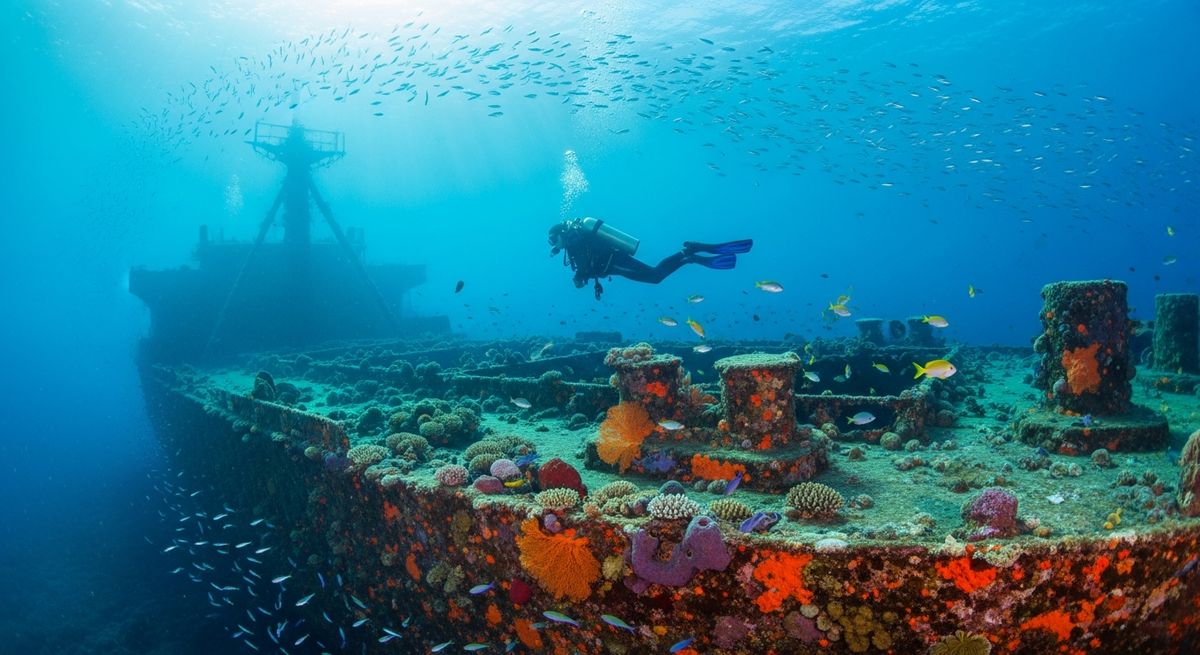
The Tritona is one of our favourites in the Algarve, a proper old sailing vessel that went down in ‘89 after breaking free in a storm. She’s a great example of how quickly the sea reclaims things. We’ve always found it an atmospheric dive, especially when the visibility is good and you can make out the whole profile against the blue. What makes her special is the way she’s opened up. The bow section is still fairly intact, but the midships and stern are quite broken, revealing ribs and frames like a skeleton. You can really get a sense of her structure, picking through the debris. Expect to see plenty of resident conger eels, tucked into any crevice they can find, and we often spot cuttlefish drifting around the broken hull. It’s a shallower wreck, which means good bottom times and usually decent light penetration, making her perfect for advanced open water divers looking for a relaxed wreck explore. Just keep an eye on the current if there's been recent bad weather; it can pick up a bit near the harbour entrance.

Location
Algarve & Berlengas, Portugal, Mediterranean & Europe
Coordinates
37.118668, -8.525500
Type
wreck
Maximum Depth
0m

Marine Protected Area: Leixão da Gaivota

Best Time to Dive in Algarve & Berlengas

The warmest water temperatures in Algarve & Berlengas occur in January, averaging 16.7°C. The coolest conditions are in December at 16.7°C.

Monthly Water Temperatures

  • January: 16.7°C (air: 13.9°C)
  • February: 16.7°C (air: 14.4°C)
  • March: 16.7°C (air: 14.4°C)
  • April: 16.7°C (air: 15.5°C)
  • May: 16.7°C (air: 16.9°C)
  • June: 16.7°C (air: 18.0°C)
  • July: 16.7°C (air: 18.7°C)
  • August: 16.7°C (air: 19.0°C)
  • September: 16.7°C (air: 19.3°C)
  • October: 16.7°C (air: 18.4°C)
  • November: 16.7°C (air: 16.7°C)
  • December: 16.7°C (air: 15.3°C)

Nearby Dive Sites in Algarve & Berlengas

Nearest Dive Centres to TRITONA

Marine Life in Algarve & Berlengas

Home to 121 recorded species including 61 reef fish, 20 whales & dolphins, 14 sharks & rays, 7 crabs & lobsters, 4 other, 3 hard corals.

Notable Species

Recommended Packing List for TRITONA

Based on average water temperature of 16.7°C.

  • Wetsuit (5-7mm) - recommended for 17°C water
  • Hood & Gloves (3-5mm) - helps retain warmth
  • Mask - essential for every dive
  • Fins
  • BCD - buoyancy compensator
  • Regulator - your most safety-critical piece of gear
  • Dive Computer - tracks depth, time, and NDL
  • Surface Marker Buoy (SMB) - essential for boat pickups
  • Dive Torch - useful for crevices and colour at depth
  • Underwater Camera - capture your diving memories

Frequently Asked Questions

What are the typical diving depths at Triton Bay?
The TRITONA wreck, located near Ferragudo in Algarve & Berlengas, Portugal, is exceptionally shallow, with a reported depth of 0 meters. This indicates the wreck is likely at or just below the surface, having run aground on a sandbar and broken up. Divers exploring TRITONA should expect extremely shallow conditions, possibly even snorkeling or free diving opportunities depending on exact water levels.
What kind of marine life and underwater features can divers expect to see at Triton Bay?
At the TRITONA site, the primary underwater feature is the remains of a 43m x 9.1m sailing vessel that sank in 1989. While specific marine life is not detailed in our records for this particular wreck, structures like this often become artificial reefs, attracting various local species over time. Divers can expect to explore the "wreck showing any portion of hull or superstructure" as it lies on a sandbar. For general information on marine life in the region, you can visit our wildlife database.
How challenging are the dive sites at Triton Bay for different skill levels?
The TRITONA wreck is classified with an intermediate difficulty level. This suggests that while it may not be suitable for absolute beginners, certified Open Water divers with some experience should be comfortable exploring the site. Given its shallow nature, the challenge might stem from currents or the broken-up structure of the wreck itself.
When is the best time of year to dive in Triton Bay for optimal conditions and marine life sightings?
Our current data for the TRITONA wreck does not specify the best time of year for optimal diving conditions or marine life sightings. We recommend checking local dive operators in Algarve & Berlengas for up-to-date information on seasonal conditions. For general guidance on planning your dives, please consult our when to dive resource.
What scuba diving certifications are recommended or required to dive in Triton Bay?
Given the intermediate difficulty rating for the TRITONA wreck, a minimum of an Open Water Diver certification is generally recommended. While the reported depth is 0m, implying very shallow conditions, the "intermediate" classification suggests there might be other factors, such as currents or the nature of the broken wreck, that require a certain level of experience. Always consult with local dive centers in Algarve & Berlengas regarding specific requirements.
What are the typical water conditions, currents, and visibility like at Triton Bay?
Specific details regarding typical water conditions, currents, and visibility at the TRITONA wreck are not available in our current dataset. As the wreck ran aground on a sandbar near the entrance to Portimão Harbor, conditions could be influenced by coastal factors and local weather. We advise divers to contact local dive operators in Algarve & Berlengas, Portugal for the most current information before planning a dive.