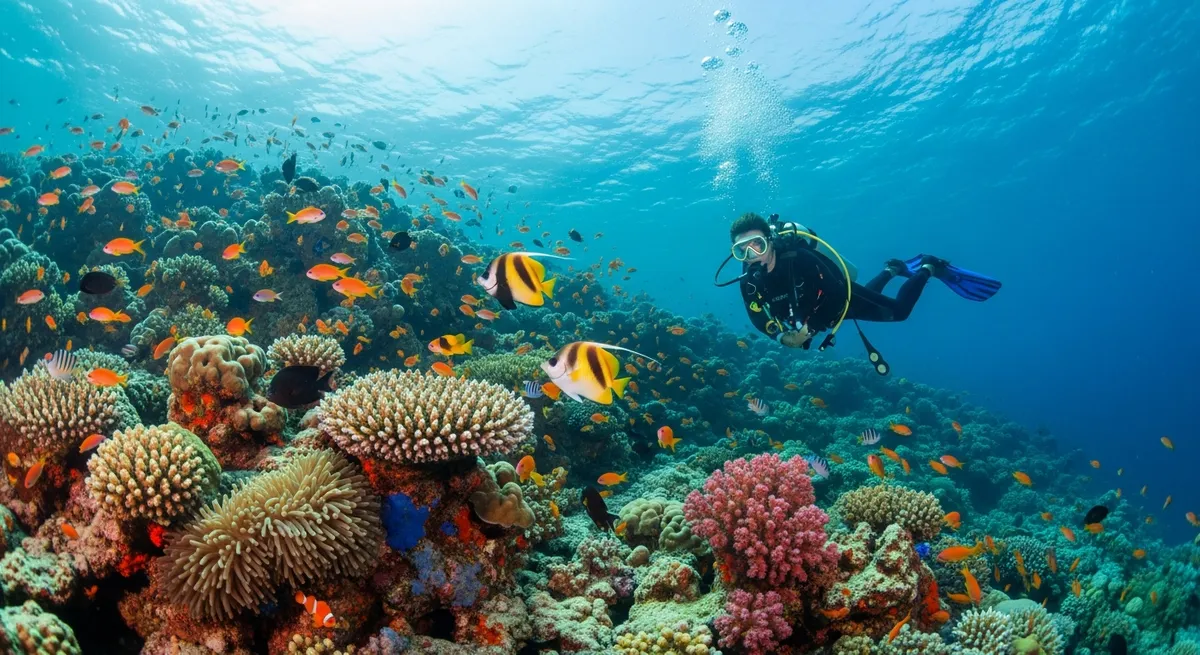
Diving in Sharm el-Sheikh
Why dive here
Sharm el-Sheikh is a diving destination where divers can encounter dolphins, spinner dolphins and whale sharks. Water ranges 23-30°C, warmest July, August, September.
Sharm el-Sheikh is where many of us got our first taste of proper Red Sea diving, and it still holds a special place. Forget the crowded resorts; the real draw is the easy access to some truly epic sites. We love the drift dives along the walls of Ras Mohammed National Park, especially around Shark and Yolanda Reefs. You’re practically guaranteed to see those enormous schools of fusiliers, so thick they blot out the sun, and usually a grey reef shark or two cruising past. The Thistlegorm wreck is another absolute classic. Go early to beat the crowds and watch the resident batfish and barracuda wake up. We’d suggest visiting outside of peak summer if you can, the water is still warm and the dive boats are a bit less packed. Visibility is generally excellent year-round, often pushing 30 metres, which is handy when you're trying to spot a bullethead parrotfish munching on coral. The currents can pick up, especially in the Straits of Tiran, making for some exhilarating drifts, but nothing an intermediate diver can't handle. Keep an eye out for dolphins, we've had some incredible encounters with Indian Ocean bottlenose pods here. Sharm delivers consistent, vibrant diving without too much fuss.
Sharm el-Sheikh Dive Site Map
Dive sites and dive centres in Sharm el-Sheikh
Sharm el-Sheikh Dive Sites
91 dive sites in Sharm el-Sheikh
Amphoras
Amphoras is a solid introductory dive in Sharm, good for those still building confidence. We usually stick to the shallow coral gardens, where plenty of bannerfish and angelfish flit between the bommies. It's a relaxed spot, typically without strong currents, making it ideal for longer bottom times and practicing buoyancy. Expect a gentle drift along the main reef, dropping to around 20 metres.
Anemone City
Anemone City, true to its name, delivers on the anemone front. We're talking large patches of them, often Sebae Anemones, swaying gently on the reef plateau. It’s a good spot to really slow down and watch the resident clown surgeonfish darting in and out, or maybe a shy Candelamoa Parrotfish chewing on the coral nearby. Keep an eye out into the blue too, because while they're not a daily occurrence, we’ve had some fantastic encounters with various dolphin species here, and even the occasional whale shark cruising by. It’s a comfortable, relatively shallow dive, perfect for a relaxed afternoon with plenty to observe.
AYIA VARVARA
Ayia Varvara isn’t a deep dive, peaking at about five metres, which makes it perfect for a leisurely explore. This old motor vessel, sunk back in '76, has been down long enough for the Red Sea to really reclaim her. We love how much of the superstructure is still there, allowing you to swim through the bridge area and down into some of the cargo holds. It’s not just a hull on the bottom; you get a real sense of a ship. Because it’s so shallow, the light here is incredible, illuminating the schools of glassfish that shimmer inside the darker sections. Moray eels are often found tucked into crevices, and we’ve seen some hefty lionfish patrolling the decks. Our favourite part has to be the stern, where the prop shaft is still visible, encrusted with soft corals that wave gently in the mild current. It’s a superb site for photographers, especially early morning when the light really plays with the wreck's silhouette, and because it’s so shallow, your bottom time is generous. Definitely a site for those who enjoy wreck penetration without the depth concerns.
Barge de Gubal
The Barge de Gubal is a personal favourite when we’re after a solid wreck dive in Sharm, away from the big-name ships. It’s not a deep dive, making it perfect for extending bottom time and really getting to explore. We love swimming through the holds, which are often packed with glassfish, and we’ve seen some surprisingly large Brown-spotted Groupers lurking in the shadows. The outside of the wreck is a canvas for soft corals, and you’ll find plenty of inquisitive Bandcheek Wrasse darting about. Keep an eye out for Snakefish on the sandy bottom nearby, they’re masters of camouflage. The real treat here, though, is the chance of spotting dolphins passing by; we’ve had incredible encounters with both Indian Ocean bottlenose and Grey Dolphins. It’s a great site for photographers, especially with the ambient light filtering into the wreck.
Beacon Rock
Beacon Rock, just off Sharm el-Sheikh, is a solid choice when you want a reliable dive without venturing too far. It's essentially a rocky outcrop, but don't let that simplicity fool you; the rock face itself provides plenty of nooks and crannies for resident blennies and gobies. We’ve had pleasant encounters here with schools of fusiliers darting around, and it's one of those spots where you might, just might, catch a glimpse of a passing dolphin pod if you're lucky and the conditions are right. It’s a comfortable dive, suitable for most experience levels, especially if you’re looking for a relaxed afternoon in the water after a more challenging morning.
Black Pearl - Red Sea
The Black Pearl sits a bit differently from the usual Red Sea suspects. It’s a site that brings a consistent, solid dive, often with a relaxed drift if the currents are right. We've seen Spotted Groupers holding court in rocky outcrops and the occasional Red Sea Clown Surgeon darting through the shallows. It’s a good spot for divers who appreciate a steady, calm dive without needing extreme thrills, though we’ve had lucky encounters with pods of Long-beaked Dolphins passing by in the blue. Keep an eye out for the smaller stuff too, the Yellowtail Sweepers are often thick on the reef.
Bluff Point
Bluff Point, tucked into the Sharm el-Sheikh coastline, often serves as a good warm-up dive. It's not one of those sites that shouts for attention, but it has a quiet charm. We’ve found the reef slopes gently, perfect for getting reacquainted with your buoyancy or for new divers finding their fins. Keep an eye out for the smaller stuff here; we’ve spotted plenty of bandcheek wrasse darting between coral heads, and often a cowfish or two grazing in the sandy patches. You might even get lucky and see a pod of bottlenose dolphins passing through – it’s a regular route for them. It’s a comfortable, relaxed dive, ideal for an easy afternoon in the water.
CSCL HAMBURG
The CSCL Hamburg is a wreck with a bit of a story, sitting upright not far from the shore in Sharm. We often suggest it for divers looking to get their first real feel for wreck penetration, as it's pretty open and the holds are accessible. You drop down onto the bow, usually in calm conditions, and the sheer scale of this container ship hits you. What makes it special for us is how quickly marine life has adopted it. We’ve seen clouds of glassfish thick enough to hide parts of the superstructure and lionfish perched on every railing. Head into the forward holds and you're surrounded by the cargo containers, some still in place, others toppled. Sunlight streams through the openings, creating these dramatic shafts of light. Our favourite part is exploring the bridge, where you can still make out the command console and steering mechanisms. It’s a great site for a longer bottom time, allowing you to really soak in the eerie quiet of a ship taken by the sea. Just be mindful of overhead environments and your air.
Dunraven
The Dunraven doesn't always get the airtime of her more famous wreck neighbours in the Red Sea, but for us, that’s part of her charm. She’s a Victorian steamship, upright at around 28m, and she really feels her age – in a good way. The stern is our favourite part; the propeller is still intact, and the rudder looks impossibly huge, encrusted with colourful hard corals. We love swimming through the engine room, shafts of light cutting through the gloom, watching glassfish shimmer in the shadows. Look for the resident moray eels peeking from the nooks and crannies. The bow section is more broken up, a bit of an artificial reef now. If you're lucky, you might even spot a lone cowfish navigating the debris, or catch a glimpse of a pod of dolphins cruising by in the blue. Keep an eye out for dolphins – the data suggests there's a good chance of seeing them here. The Dunraven is a solid choice for intermediate divers looking for a relaxed wreck dive with a sense of history, without the crowds you often find elsewhere. It’s a proper historical wreck, slowly being reclaimed by the reef.
DUNRAVEN
The Dunraven, for us, is one of those wrecks you keep coming back to. We’re talking about an 82-metre steamship that went down in 1876, lying inverted at 30 metres. What we really love about this site is the way the wreck has become a living reef. You drop down, and the first thing you notice is the massive, copper propeller, often swarming with glassfish. Swim along the hull, and you’ll find cracks and openings everywhere. We usually head for the stern, where you can actually poke your head inside some of the larger gaps – just be mindful of your buoyancy and any surge. Inside, the light filters through the hull, catching schools of batfish that seem to hang suspended. Don't forget to look for the resident moray eels peeking out from behind corroded beams. The corals here, soft and hard, are doing incredibly well, painting the metal a surprising range of colours. For us, it’s not just a wreck dive; it’s a masterclass in how marine life reclaims and transforms. Keep an eye on your bottom time; 30 metres flies by down here.
Dunraven Wreck
The Dunraven is a solid dive, particularly if you’re into older wrecks. Lying broken in two sections, it’s a steamship from 1873, and we typically drop down to the stern section first, which is upside down. You can poke around the prop and rudder, then head into the midship section. Keep an eye out for schooling yellow snapper and the odd large grouper lurking in the shadows. The bow section is more upright and has some nice coral growth, with glassfish often schooling inside. It's a relaxed dive, good for most experience levels, especially if you want to combine a bit of history with some reef life.
EMPEROR FRASER
The Emperor Fraser is a surprisingly engaging wreck, especially considering her rather undignified end. We love that backstory – a dive boat, blown onto a reef while *other* divers were exploring the Dunraven. Poetic, really. She’s a timber dive support craft, and while she sank in 2009, there’s still plenty of character to explore. You’ll find her resting upright, settled at about 30 metres just off the southeast end of Beacon Rock. What makes the Emperor Fraser special, beyond the tale, is the way the Red Sea has already started reclaiming her. Schools of fusiliers swirl around the superstructure, and the decks are busy with goatfish digging for snacks. Look closely, and you’ll spot crocodilefish perfectly camouflaged on the sandy patches, and often a grumpy stonefish or two. We always take our time poking around the wheelhouse, imagining the chaos of that stormy night. This wreck suits divers who appreciate a good story and enjoy seeing how quickly artificial reefs can integrate into the existing ecosystem. It’s not a massive wreck, but it's a lovely, relaxed dive, especially if the current is mild.
Show all 91 dive sites in Sharm el-Sheikh
- Far Garden
- Fiddle Garden
- Four Seasons House Reef
- Gordon reef
- Hey Daroma
- HMS Thistlegorm
- Jackfish Alley
- Jackson reef
- Kingston Wreck
- Kormoran
- Kormoran
- Kormoran-Zingara
- Kormoran / Zingara Wreck - Tiran
- Laguna Reef
- Laguna Reef
- LARA
- Louilla
- LOULLIA
- LYRA
- MARIA SCHRODER
- Marsa Bareika
- Marsa Baryka
- Middle Garden
- Million Hope
- Naama Bay
- Near Garden
- NIGER BASIN
- OCEAN DIRK
- OKHA
- Paradise
- Pinky Wall
- RALA I
- Ras Bob
- Ras Bob Reef
- Ras Burg
- Ras Fanar
- Ras Ghamila
- Ras Ghamila Reef
- Ras Ghozlani
- Ras Gomaa
- Ras Katy
- Ras Mohammed
- Ras Mohammed - Shark Reef & Yolanda Reef
- Ras Mohammed - Shark Reef & Yolanda Reef
- Ras Nasrani
- Ras Peter / Tank Garden
- Ras Umm Sid
- Ras Za'atar
- Red Sea Diving College
- Satellite Reef
- Sha'ab Mahmud
- Sha‘b Maḩmūd
- Shag Rock
- Shark divers house reef
- Shark Observatory
- Shark Reef
- Shark's Bay
- Sharm El Sheikh Diving: a Sinai Scuba Adventure
- Shushah Island
- Small Crack
- Sodfa
- South Laguna Reef, Tiran Island
- SS Thistlegorm
- SS Turkia
- Straits of Tiran
- TALITA
- Temple
- The Alternatives
- Thistlegorm
- THISTLEGORM
- Thomas reef
- Tiran Strait
- Tower
- Turtle Bay
- Ulysses
- White Knight
- Woodhouse Reef
- Yolanda Reef
- ZINGARA
Sharm el-Sheikh Dive Centres
32 dive shops and operators in Sharm el-Sheikh
Aquarius Diving Club - Sharm
Black Pearl - Red Sea
BLUEFORCE 2
Blue Sea Dive Club
Bubbles Dive Club
Camel Dive Club & Hotel
Cinderella Eldawley Diving Center
Divers United (Elite Diving)
Show all 32 dive centres in Sharm el-Sheikh
- Diving Center
- Eagle Divers
- Emperor Divers Sharm El Sheikh
- Extra Divers Ras Nasrani
- Maison De La Mer
- New Waves
- Ocean College, Ras Um Sid
- Oonas Dive Center
- PADI Diving center
- Pirates Dive Club
- Pyramids Diving Center
- Pyramids Diving Center - Rixos Sea Gate
- Red Sea Diving College
- Reef Oasis Dive Club - Blue Bay
- Reef Oasis Dive Club - Reef Beach
- Scorpion Dive Club
- Sheikh Coast Diving Center
- Sinai Blues
- Sinai Divers
- Story Divers
- Subex Diving Center
- Sunshine Divers Mary & Klaus
- Umbi Diving Village
- Werner Lou
Ocean Wildlife in Sharm el-Sheikh
13 species recorded in Sharm el-Sheikh
Sharm el-Sheikh Daylight & Sunrise/Sunset
Sunrise and sunset times for Sharm el-Sheikh, calculated from coordinates
Today - Sunday 11 October
Sunrise
05:41
Sunset
17:19
Daylight
11h 38m
Golden Hour
16:48
First light (dawn) at 05:18 · Last light (dusk) at 17:43
Monthly Averages
| Month | Sunrise | Sunset | Daylight |
|---|---|---|---|
| Jan | 06:36 | 17:10 | 10h 34m |
| Feb | 06:22 | 17:34 | 11h 13m |
| Mar | 05:54 | 17:52 | 11h 58m |
| Apr | 05:19 | 18:08 | 12h 49m |
| May | 04:55 | 18:26 | 13h 31m |
| JunLongest | 04:47 | 18:41 | 13h 54m |
| Jul | 04:57 | 18:42 | 13h 45m |
| Aug | 05:14 | 18:23 | 13h 9m |
| Sep | 05:29 | 17:50 | 12h 21m |
| OctNow | 05:44 | 17:15 | 11h 32m |
| Nov | 06:05 | 16:52 | 10h 47m |
| DecShortest | 06:27 | 16:50 | 10h 23m |
Times are approximate local times based on longitude. Actual times may vary slightly depending on the exact timezone observed in Sharm el-Sheikh.
Where to Stay near Sharm el-Sheikh
Prices from Booking.com. We may earn a commission at no extra cost to you.
Marine Protected Areas near Sharm el-Sheikh
4 protected areas near Sharm el-Sheikh - please respect local regulations when diving
شعاب البحر الأحمر
محمية رأس محمد
محمية أبو جالوم
محمية نبق
Getting to Sharm el-Sheikh
Sharm El Sheikh
Hurghada
Sharma
Plan & book
Ways to dive Sharm el-Sheikh, from day trips to liveaboards.
Day trips & courses
via GetYourGuideGuided dives, courses and snorkel trips with instant booking.
Find dive trips in Sharm el-SheikhPlaces to stay
via Booking.comHotels and dive resorts near Sharm el-Sheikh.
Search stays in Sharm el-SheikhDive insurance
Most travel insurance excludes or limits scuba. Check what you need before you go.
Dive insurance explainedPartner links: we may earn a commission if you book, at no extra cost to you. How we make money