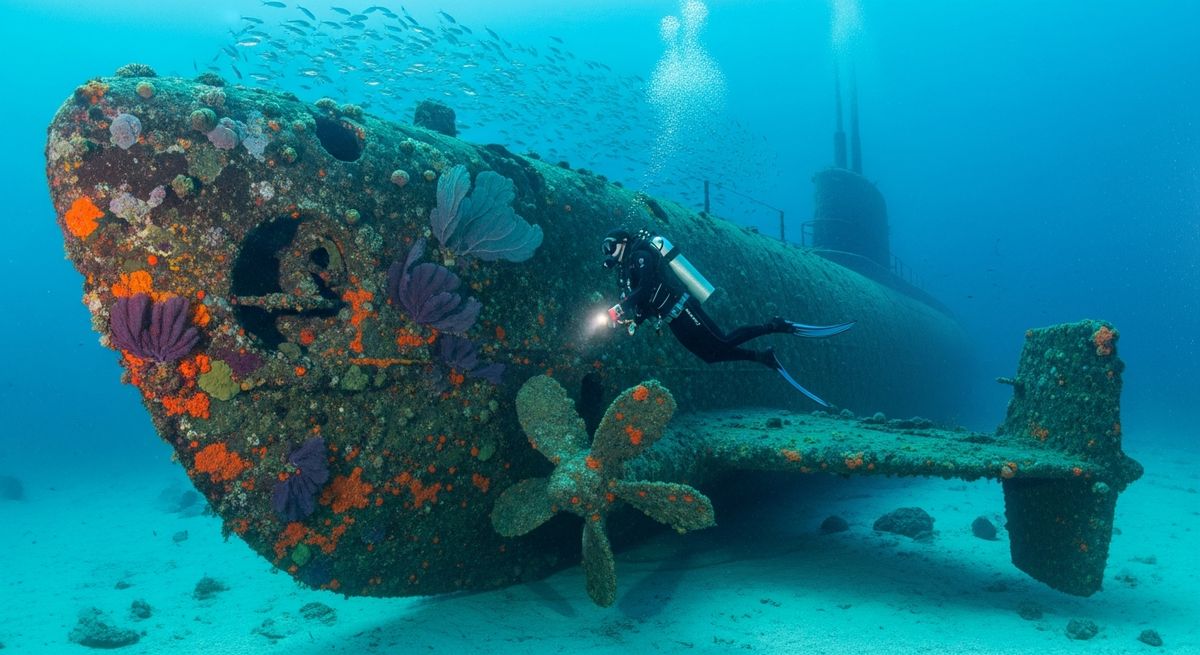
Blue Belt Wreck
Protected Area
Parc national marin de Sanganeb et parc national marin de la baie de Dungonab - île de Mukkawar
Why dive here
With 55+ marine species recorded in the area - including pufferfish - Blue Belt Wreck offers some of Port Sudan & Sanganeb's richest wreck diving. Water ranges 25-32°C, warmest July, August, September.
The Blue Belt Wreck, submerged at a comfortable 26 metres, holds a quiet fascination. It's not the biggest wreck in these waters, nor the most dramatic in its sinking, but we love its melancholic beauty. This cargo ship met its end in the late 1970s carrying a consignment of vehicles and spare parts, and you can still see the ghosts of its cargo. Imagine jeeps, trucks, and a surprising number of toilets, all fused into the surrounding reef over the decades. We always make a point of gliding over the deck, peering into the holds where the sediment glows with flashes of silver from schooling glassfish. The stern, in particular, is captivating. We’ve spent many a dive here, watching robust groupers patrol the shadowed corridors, while batfish fin idly above the superstructure. It's an intermediate dive, well within recreational limits, making it accessible to those with a good grasp of buoyancy control. The real draw is the atmosphere, that sense of suspended history, and the way the sea has effortlessly reclaimed it all.
Typical Blue Belt Wreck Dive Profile
Illustrative profile based on site depth and type. Actual dive profiles vary - always follow your dive computer and training.
Safety Notes
Depth of 26m - Advanced Open Water certification recommended.
Wreck site - avoid penetration without wreck diving certification. Watch for sharp metal and entanglement hazards.
Always perform a 3-minute safety stop at 5m before surfacing.
Blue Belt Wreck Wreck History
Year Sunk
1977
Vessel Type
cargo ship
Cause
grounding
Tonnage
3,842 GRT
The Blue Belt Wreck, a Saudi Arabian cargo vessel, was on its final voyage from Jeddah to Port Sudan in late 1977. Its holds were packed with a brand-new fleet of Toyota vehicles, including Hilux pickups, Landcruisers, and saloon cars, all destined for the Sudanese market. The ship was a common sight in the Red Sea, plying the busy trade routes of the region.
On the night of December 1, 1977, the ship was navigating near the treacherous Sha'ab Su'adi reef when it was caught in a fierce storm. Pushed off course by the heavy weather, the Blue Belt ran hard aground on the reef. It remained stranded on the reef top for a period before the relentless wave action caused it to slip back into deeper water, where it capsized and sank, coming to rest completely upside down on the sloping seabed.
Today, the Blue Belt is one of Sudan's most iconic and unique wreck dives. The vessel lies inverted with its stern in around 20m and its bow pointing down the slope. The main attraction is the surreal underwater car park scattered around the wreck. Divers can swim amongst the fleet of 1970s Toyotas, now transformed into artificial reefs encrusted with corals and home to a variety of fish. Exploring the cargo holds and the vehicle graveyard makes for an unforgettable dive and a fantastic photo opportunity.
Reviews for Blue Belt Wreck
Conditions
Ocean conditions, forecast and tides for Blue Belt Wreck
Blue Belt Wreck Ocean Conditions
Monthly averages for Blue Belt Wreck, sourced from Open-Meteo marine data + Copernicus Marine (EU) - nearest station: Open-Meteo marine grid (19.94, 37.4) (17km away)
October Averages
Sea Temperature
31°C
88°F · Range: 29.9–32.3°C
Current Speed
7.07 cm/s
Direction: S (171.9°)
Chlorophyll-a
0.088 mg/m³
Very clear (oligotrophic)
Salinity
37.37 PSU
Based on 4 years of monitoring data · Data sources: Open-Meteo marine data + Copernicus Marine (EU)
Plan & book
Ways to dive Port Sudan & Sanganeb, from day trips to liveaboards.
Day trips & courses
via GetYourGuideGuided dives, courses and snorkel trips with instant booking.
Find dive trips in Port Sudan & SanganebPlaces to stay
via Booking.comHotels and dive resorts near Port Sudan & Sanganeb.
Search stays in Port Sudan & SanganebDive insurance
Most travel insurance excludes or limits scuba. Check what you need before you go.
Dive insurance explainedPartner links: we may earn a commission if you book, at no extra cost to you. How we make money
Where to Stay near Blue Belt Wreck
Prices from Booking.com. We may earn a commission at no extra cost to you.