Diving in Port Sudan & Sanganeb
Why dive here
Port Sudan & Sanganeb offers some of Sudan's richest diving, with 55+ marine species recorded in the area - including pufferfish. Water ranges 25-32°C, warmest July, August, September.
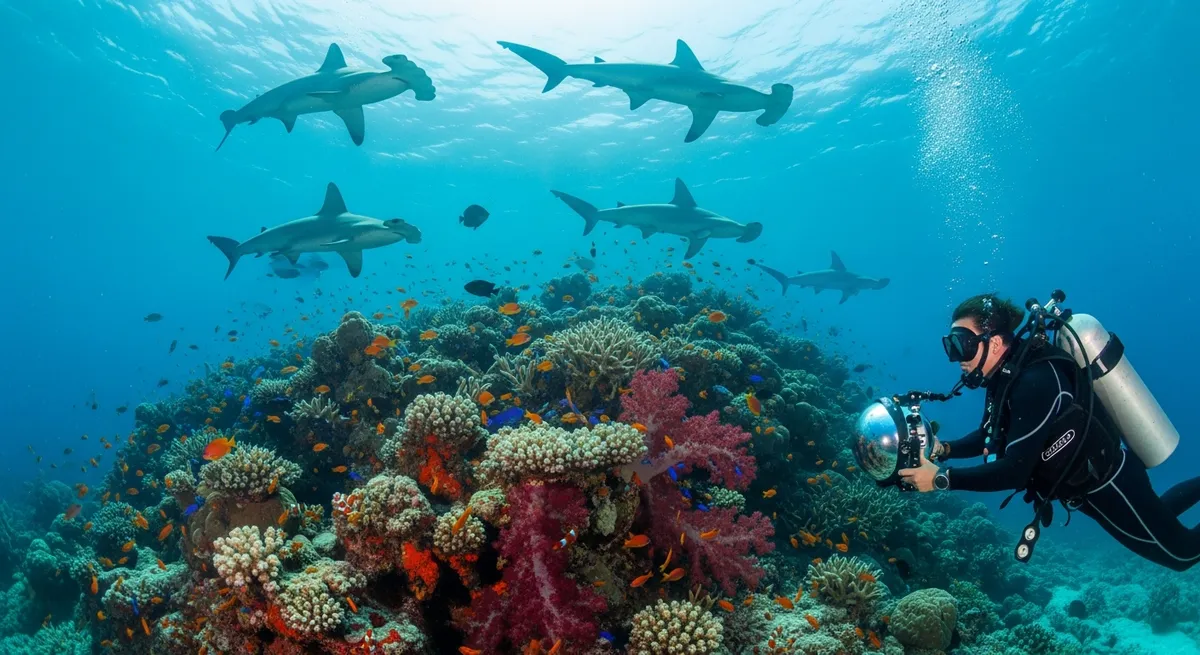
Dive Sudan, and you’re signing up for an adventure. This isn't your usual resort diving, and that's exactly why we love it. The sheer isolation means fewer boats, fewer divers, and frankly, a much wilder experience. The star of the show has to be Sanganeb Atoll, a UNESCO site that really delivers. We're talking proper dramatic walls here, dropping straight into the deep blue. Keep an eye out for hammerheads patrolling the edges; we’ve had some incredible encounters there, especially in the mornings. You'll also find Cousteau's Conshelf II habitat, a truly surreal sight as you fin past a piece of history. The hard corals here are some of the best preserved in the Red Sea, with huge staghorn formations that just teem with fusiliers. Currents around Sanganeb can be a bit lively, so this is definitely one for intermediate divers who are comfortable moving with the flow. Visibility is usually superb, often 30 metres plus, making those deep wall dives feel endless. Our favourite moments are drifting along, watching the reef unfold, and then spotting a massive argus grouper lurking under an overhang. It’s raw, it’s remote, and it’s absolutely worth the effort.
Port Sudan & Sanganeb Dive Site Map
Dive sites and dive centres in Port Sudan & Sanganeb
Port Sudan & Sanganeb Dive Sites
55 dive sites in Port Sudan & Sanganeb
Abington Reef
Abington Reef, way up north in Sudan, is one of those true Red Sea pinnacles that just screams "action." We usually drop in on the northern side, heading a bit deeper first, looking for the grey reefs and the occasional hammerhead cruising in the blue. As you slowly work your way shallower, the schools start to thicken – we're talking walls of jacks and fusiliers so dense you can barely see past them. The gorgonian fans on the wall are impressive, swaying in the currents, and it’s generally a good spot for pelagics, though the currents can be quite strong here. Definitely one for experienced divers who appreciate big fish action and don't mind a bit of a drift.
ABSIT OMEN
Absit Omen sits at zero metres. Not "zero to" some depth, just zero. This isn't a dive site in the traditional sense, but it’s one of our favourite spots to drop the anchor, stretch out, and maybe do a bit of snorkelling. This old motor vessel, grounded on Elba Reef back in '55 and declared a total loss, really feels like a permanent fixture of the reef now. Its skeletal remains poke out of the water, a stark reminder of the sea's power, yet below the surface, it’s a nursery. We love finning around the exposed sections, where waves have smoothed the metal and soft corals have started to fuzz the edges. You’ll spot juvenile parrotfish picking at algae, and small groups of damselfish darting between the rusty plates. It’s shallow enough that you can really take your time, watching the light play through the wreck’s shadows. Perfect for a calm afternoon, a long snorkel, or for buddy teams looking for an easy, relaxing drift over some history before dinner.
Abu Seif
Abu Seif offers a straightforward dive on a gently sloping reef. We often find good numbers of reef fish here, along with the occasional turtle gliding past. It's a relaxed site, excellent for a second dive of the day or for those looking for an easier, less demanding profile. Expect healthy coral formations and consistent visibility.
AFGHANISTAN
The Afghanistan wreck, north of Suakin, feels like a ghost ship. It’s an old steamer, built back in 1897, and you really get a sense of its history as you descend. At 50 metres, this is one for experienced divers only, and we love the challenge of getting down there to explore it properly. You're met with the vast, dark outline of the hull, stretched across the sandy bottom. The triple expansion engine is a highlight, impressive in its scale, and the bow section has some fantastic coral growth. We've seen schools of snapper congregating around the superstructure, and the occasional grey reef shark patrolling the perimeter. The visibility here is usually excellent, making the sheer size of the wreck even more impactful. It's a proper deep dive, so manage your bottom time, but for wreck enthusiasts, it's easily our favourite deep wreck in the area. The feeling of swimming through a piece of history, completely colonised by the sea, is quite something.
Al Badri 1
The Al Badri 1 is a site we keep coming back to. What makes it special? It’s a very shallow wreck, sitting upright in just 10 metres of water, so it’s perfect for extended bottom times and even snorkelling. The ship itself is a mangled mess, ripped apart by what we assume was an explosion, creating a chaotic landscape of twisted metal. You can swim right through the cargo holds, where the light plays off the rust and schools of fusiliers dart around the beams. We love watching the resident giant moray eels peek out from under the collapsed decks; they’re enormous here. Look closely at the hull for stonefish and scorpionfish, they blend in perfectly with the growth. Our favourite part is lingering over the stern, where the propeller is still intact, encrusted with soft corals and patrolled by bannerfish. It’s a great site for photographers, especially in the late morning when the sun penetrates the water at just the right angle, illuminating the interior of the wreck. Even if you’re not usually a wreck diver, Al Badri 1 is an experience you shouldn’t miss.
Angarosh
Angarosh offers a deep-diving experience that holds its own in the Sudanese Red Sea. We're talking about a site roughly 12 km east of Mukawwar Island, where visibility often pushes past 25m. The topography here is what gets your attention: deep plateaus and walls carved with impressive fissures, rising to about 10m at the shallowest point. Drop down onto the northern plateau and you’ll find distinct steps at 40, 30, and 18m. On the smaller southern plateau, the steps are at 20 and 45m. It’s a site for experienced divers comfortable with depth, perfect for those who appreciate dramatic structure and the chance to spot species like the Yellow Triplefin or a Shore crab in good conditions.
ANTONIO 111
The Antonio 111 isn't about deep dives or dramatic drop-offs; it’s about history you can touch, right on the surface. We love this site because it’s a tangible piece of Sudan’s past, a cargo ship that ran aground, its bow now a sun-baked monument breaching the Red Sea. You can snorkel around the exposed hull, watching needlefish dart through the reflections, or even clamber onto the deck itself. It’s a strange, beautiful feeling to stand on a wreck that’s still very much a part of the living ocean, with schools of fusiliers swirling around the submerged sections just below your feet. For photographers, it’s a dream – the interplay of light and shadow on the rusty superstructure is phenomenal, especially at sunrise or sunset. Our favourite shot is looking from the bow towards the shore, capturing the vastness of the Red Sea and the starkness of the desert beyond. Below the waterline, the wreck’s keel is home to a surprising array of creatures, small groupers, and moray eels peeking from the nooks. It’s not a challenging dive, making it perfect for those wanting a unique perspective on a wreck without the deep dive commitment. We’d suggest going early to avoid any wind chop, making the climb onto the deck much easier.
Blue Belt
Blue Belt typically offers a relaxed dive, good for shaking off the travel dust or getting back into the swing of things. We often find Highfin and Yellow Triplefins here, tucked into crevices. It's a comfortable spot, particularly suited for less experienced divers or those looking for a gentle afternoon.
BLUE BELT
The Blue Belt, for us, is one of those genuinely surprising wrecks. Not because it’s a “carrier vessel” in the modern sense, but because it’s an old freighter, built in 1905, that went down in ’77 with a load of trucks and spares. Imagine an old ship, 103 metres long, sitting upright at 40 metres. You descend, and suddenly the sheer size of it just looms out of the blue. What makes it special? It’s the cargo. We’ve finned through the hold, past the skeletal remains of old lorries, their chassis now part of the reef, covered in soft corals. The light filters down, catching the dust motes and illuminating the ghostly shapes of these vehicles. It’s a strange, almost eerie feeling. Outside, the superstructure is draped in gorgonian fans and the usual Red Sea suspects – parrotfish grazing, snapper schooling. We love the bridge area; it’s largely intact and you can still poke around the wheelhouse. Our favourite part has to be the stern, where the prop is still there, huge and green with growth. It’s a deeper dive, hitting 40m, so it’s definitely one for experienced divers comfortable with depth and perhaps a bit of current, though it’s usually mild here.
Blue Belt Wreck
The Blue Belt Wreck, submerged at a comfortable 26 metres, holds a quiet fascination. It's not the biggest wreck in these waters, nor the most dramatic in its sinking, but we love its melancholic beauty. This cargo ship met its end in the late 1970s carrying a consignment of vehicles and spare parts, and you can still see the ghosts of its cargo. Imagine jeeps, trucks, and a surprising number of toilets, all fused into the surrounding reef over the decades. We always make a point of gliding over the deck, peering into the holds where the sediment glows with flashes of silver from schooling glassfish. The stern, in particular, is captivating. We’ve spent many a dive here, watching robust groupers patrol the shadowed corridors, while batfish fin idly above the superstructure. It's an intermediate dive, well within recreational limits, making it accessible to those with a good grasp of buoyancy control. The real draw is the atmosphere, that sense of suspended history, and the way the sea has effortlessly reclaimed it all.
CAPTAIN SAALEM
The Captain Saalem is a fresh wreck, only having gone down in 2017. That means it still feels very much like a ship, not yet fully reclaimed by the sea. We love exploring the bridge and engine room, which are surprisingly intact and make for some atmospheric swim-throughs, particularly if you have a decent torch. Schools of barracuda often circle the mast, and we've regularly seen large trevally hunting around the bow. It’s a shallower dive, maxing out at 20m, which makes for long bottom times and plenty of light to really appreciate the structure. This site is perfect for newer wreck divers or those who enjoy seeing the early stages of a wreck’s transformation into an artificial reef. Our tip: go early in the morning for the best visibility before any boat traffic stirs things up.
CEDAR STAR
The Cedar Star, a 75-meter carrier, rests right on the edge of the Sudanese coast, a shallow-water playground that still holds stories. Sunk in 1978 with a contingent of Sudanese soldiers on board, the wreck sits broken but accessible, her stern mostly intact, while the bow section has seen better days. We love the way she’s taken on the Red Sea over the decades. You’ll find the bridge structure offering some fantastic swim-throughs, sunlight dappling through the openings, creating these ethereal shafts of light. Our favorite part is the engine room, surprisingly open and easy to navigate for a relatively intact wreck. We’ve seen everything from lionfish tucked into every crevice to big schools of yellowfin barracuda circling above the deck plates. It’s perfect for divers who enjoy historical wrecks without the pressure of deep technical dives, and the marine life here is really starting to get established.
Show all 55 dive sites in Port Sudan & Sanganeb
- Cousteau's Conshelf (aka Precontinent II)
- Daharat Abida
- Dahrat Abid
- Dahrat Qab
- DASMAN
- Dibsel Island
- Diving spot in Port Sudan
- Elba Reef
- Elba Reef East (Southplateau)
- Elba Reef, North Plateau
- Elba Reef, South Plateau
- Elba Reef, West-Plateau
- EMIL
- ESS MOBIL
- ESS NAKIL (POSSIBLY)
- ESTARIA
- Gota Mesharifa
- HASSANEIN
- Isar Island
- JASSIM
- Karam Marsmarit
- Levanzo
- Levanzo Wreck
- MANI
- Merlo Reef
- NAWRAS
- NIMOS
- Pfeiffer Reef
- PORTIA
- RAAD AL-BAKRY VIII (AFTERPART)
- Sanganeb Plauteua N
- Sanganeb Reef
- Shaab Jimna
- Shaab Rumi, Precontinent 2
- Shab Rumi, Plateau S
- SHAHEEN
- SHIBA
- SS Umbria
- SS Umbria, Wreck
- Sweet Potato
- The Toyota Wreck (aka the Blue Belt Wreck)
- The Umbria Wreck
- Umbria
Port Sudan & Sanganeb Dive Centres
No dive centres listed in Port Sudan & Sanganeb yet. Browse all dive centres.
Ocean Wildlife in Port Sudan & Sanganeb
55 species recorded in Port Sudan & Sanganeb
Port Sudan & Sanganeb Daylight & Sunrise/Sunset
Sunrise and sunset times for Port Sudan & Sanganeb, calculated from coordinates
Today - Sunday 11 October
Sunrise
05:25
Sunset
17:11
Daylight
11h 47m
Golden Hour
16:42
First light (dawn) at 05:02 · Last light (dusk) at 17:33
Monthly Averages
| Month | Sunrise | Sunset | Daylight |
|---|---|---|---|
| Jan | 06:09 | 17:11 | 11h 2m |
| Feb | 06:01 | 17:30 | 11h 29m |
| Mar | 05:40 | 17:41 | 12h 1m |
| Apr | 05:13 | 17:49 | 12h 36m |
| May | 04:55 | 18:00 | 13h 5m |
| JunLongest | 04:51 | 18:12 | 13h 21m |
| Jul | 05:00 | 18:14 | 13h 14m |
| Aug | 05:11 | 18:01 | 12h 50m |
| Sep | 05:19 | 17:35 | 12h 16m |
| OctNow | 05:26 | 17:08 | 11h 42m |
| Nov | 05:40 | 16:52 | 11h 11m |
| DecShortest | 05:59 | 16:54 | 10h 55m |
Times are approximate local times based on longitude. Actual times may vary slightly depending on the exact timezone observed in Port Sudan & Sanganeb.
Where to Stay near Port Sudan & Sanganeb
Prices from Booking.com. We may earn a commission at no extra cost to you.
Marine Protected Areas near Port Sudan & Sanganeb
4 protected areas near Port Sudan & Sanganeb - please respect local regulations when diving
Parc national marin de Sanganeb et parc national marin de la baie de Dungonab - île de Mukkawar
Sanganeb Atoll
Suakin Archipelago
Suakin-Gulf of Agig
Getting to Port Sudan & Sanganeb
Port Sudan
Jeddah
Taif
Plan & book
Ways to dive Port Sudan & Sanganeb, from day trips to liveaboards.
Day trips & courses
via GetYourGuideGuided dives, courses and snorkel trips with instant booking.
Find dive trips in Port Sudan & SanganebPlaces to stay
via Booking.comHotels and dive resorts near Port Sudan & Sanganeb.
Search stays in Port Sudan & SanganebDive insurance
Most travel insurance excludes or limits scuba. Check what you need before you go.
Dive insurance explainedPartner links: we may earn a commission if you book, at no extra cost to you. How we make money