BLUE BELT
Protected Area
Parc national marin de Sanganeb et parc national marin de la baie de Dungonab - île de Mukkawar
Why dive here
With 55+ marine species recorded in the area - including pufferfish - BLUE BELT offers some of Port Sudan & Sanganeb's richest wreck diving. Water ranges 25-32°C, warmest July, August, September.
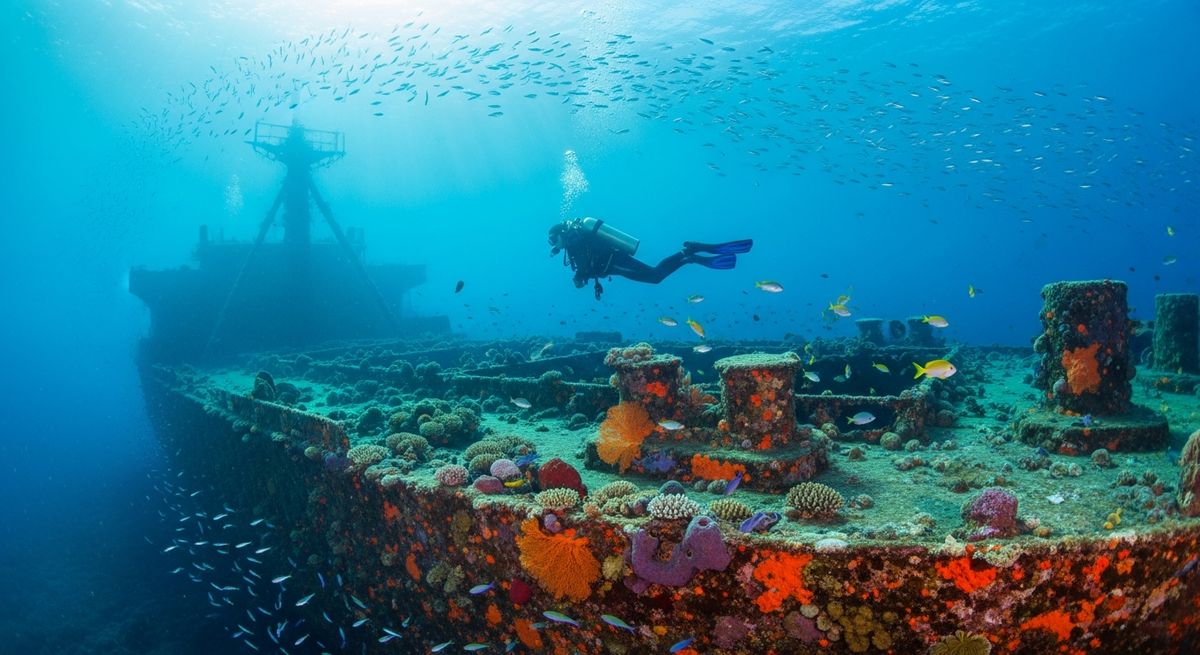
The Blue Belt, for us, is one of those genuinely surprising wrecks. Not because it’s a “carrier vessel” in the modern sense, but because it’s an old freighter, built in 1905, that went down in ’77 with a load of trucks and spares. Imagine an old ship, 103 metres long, sitting upright at 40 metres. You descend, and suddenly the sheer size of it just looms out of the blue. What makes it special? It’s the cargo. We’ve finned through the hold, past the skeletal remains of old lorries, their chassis now part of the reef, covered in soft corals. The light filters down, catching the dust motes and illuminating the ghostly shapes of these vehicles. It’s a strange, almost eerie feeling. Outside, the superstructure is draped in gorgonian fans and the usual Red Sea suspects – parrotfish grazing, snapper schooling. We love the bridge area; it’s largely intact and you can still poke around the wheelhouse. Our favourite part has to be the stern, where the prop is still there, huge and green with growth. It’s a deeper dive, hitting 40m, so it’s definitely one for experienced divers comfortable with depth and perhaps a bit of current, though it’s usually mild here.
Typical BLUE BELT Dive Profile
Illustrative profile based on site depth and type. Actual dive profiles vary - always follow your dive computer and training.
Safety Notes
Deep dive (40m) - monitor air consumption closely. Advanced certification recommended.
Wreck site - avoid penetration without wreck diving certification. Watch for sharp metal and entanglement hazards.
Always perform a 3-minute safety stop at 5m before surfacing.
BLUE BELT Wreck History
Year Sunk
1977
Vessel Type
cargo ship
Cause
fire
The Blue Belt had a long career, having been built in 1905 by Howaldtswerke AG in Hamburg. Her final voyage in December 1977 was from Jeddah to Port Sudan, carrying a full cargo of Toyota trucks, trailers, and spare parts. During the journey, a fire broke out on board and began to rage out of control.
To prevent the burning ship from sinking and blocking the vital shipping channel into Port Sudan, the captain made the decision to deliberately run her aground on the nearby reef. The vessel subsequently capsized and slid down the reef, coming to rest completely upside down. Today, she is famously known as the 'Upside-Down Wreck'.
Resting on a steep slope, the Blue Belt is a world-class dive for experienced divers. The stern lies at around 40 meters, with the rest of the ship plunging much deeper. The most iconic sight is the cargo of Toyota trucks, still chained to the deck and hanging eerily upside down in the blue. Exploring the inverted superstructure and holds provides a unique and disorienting thrill, making this one of the most memorable wrecks in the Red Sea.
Reviews for BLUE BELT
Conditions
Ocean conditions, forecast and tides for BLUE BELT
BLUE BELT Ocean Conditions
Monthly averages for BLUE BELT, sourced from Open-Meteo marine data + Copernicus Marine (EU) - nearest station: Open-Meteo marine grid (19.94, 37.4) (17km away)
October Averages
Sea Temperature
31°C
88°F · Range: 29.9–32.3°C
Current Speed
7.07 cm/s
Direction: S (171.9°)
Chlorophyll-a
0.088 mg/m³
Very clear (oligotrophic)
Salinity
37.37 PSU
Based on 4 years of monitoring data · Data sources: Open-Meteo marine data + Copernicus Marine (EU)
Plan & book
Ways to dive Port Sudan & Sanganeb, from day trips to liveaboards.
Day trips & courses
via GetYourGuideGuided dives, courses and snorkel trips with instant booking.
Find dive trips in Port Sudan & SanganebPlaces to stay
via Booking.comHotels and dive resorts near Port Sudan & Sanganeb.
Search stays in Port Sudan & SanganebDive insurance
Most travel insurance excludes or limits scuba. Check what you need before you go.
Dive insurance explainedPartner links: we may earn a commission if you book, at no extra cost to you. How we make money
Where to Stay near BLUE BELT
Prices from Booking.com. We may earn a commission at no extra cost to you.