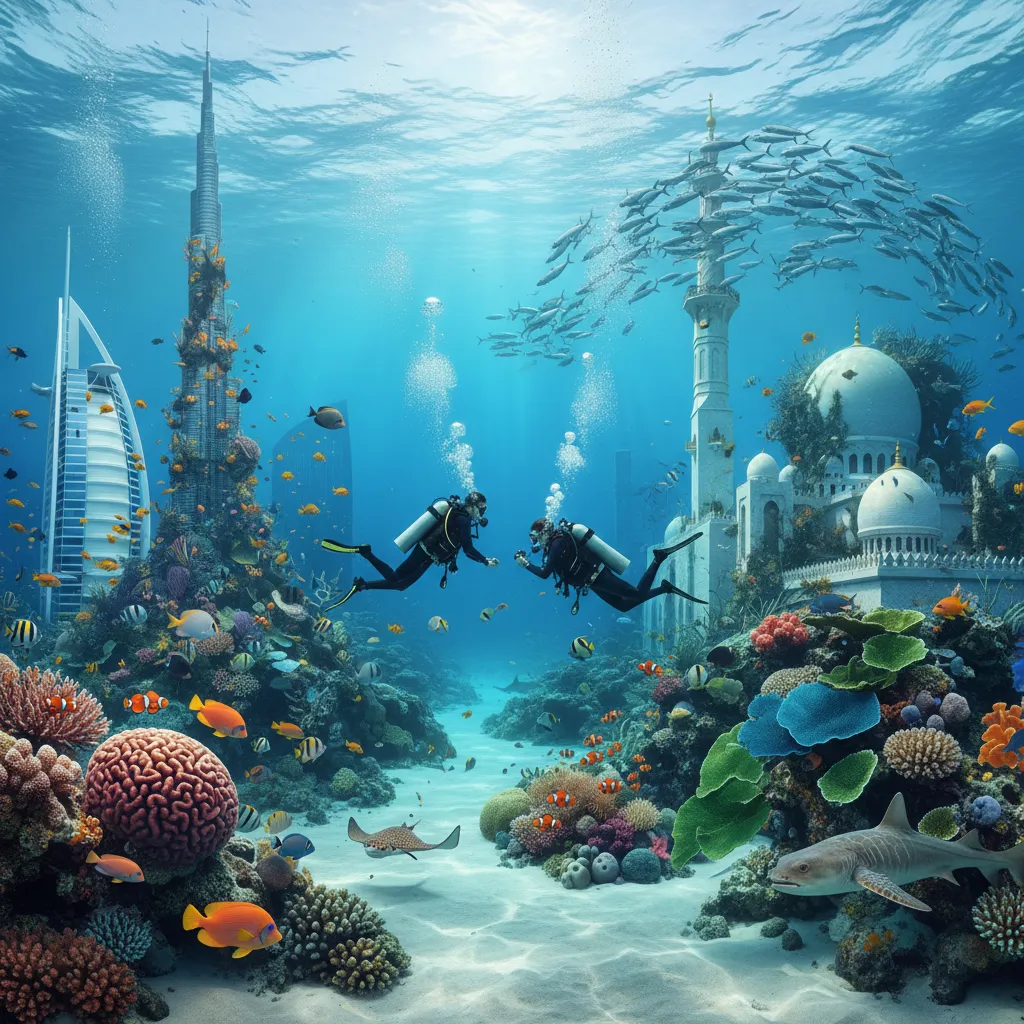
Diving in Dubai & Abu Dhabi
Why dive here
Dubai & Abu Dhabi is a diving destination where divers can encounter dolphins, sea turtles and whale sharks. Water sits around 23°C.
Diving Dubai and Abu Dhabi isn't about natural coral landscapes; it's about the grit and ingenuity of man-made reefs and forgotten wrecks. We love the sheer variety of artificial structures here, from purpose-sunk ships to fabricated habitats that have become surprising havens for marine life. You'll spend most of your time exploring wrecks, where schools of Indian scad and coastal trevally swirl around the superstructure, or cruising over artificial reefs thick with favites and turbinaria corals. Look closely for the supreme limu, a local nudibranch, and keep an eye out for longnose trevally patrolling the deeper sections. Visibility can vary quite a bit, but we’ve had some cracking dives with 15-20 meters, especially outside the busy summer months. Currents are generally manageable, making it a good spot for beginners on some of the shallower sites, but the wrecks definitely cater to the intermediate and advanced diver. Our favourite time to dive is definitely the cooler months, roughly October to April, when the water temperatures are pleasant and surface conditions tend to be calmer. Don’t expect vibrant coral gardens like the Red Sea, but do expect intriguing encounters and a unique perspective on how life adapts to new environments.
Dubai & Abu Dhabi Dive Site Map
Dive sites and dive centres in Dubai & Abu Dhabi
Dubai & Abu Dhabi Dive Sites
88 dive sites in Dubai & Abu Dhabi
A4-SI
The A4-SI site off Dubai and Abu Dhabi is a bit of a historical oddity, really. This isn't your typical purposely-sunk dive attraction. We're talking about a Gulf Aviation aircraft that went down back in 1976. It rests at a modest 20 metres, making it quite accessible, though its "dangerous wreck" classification suggests a respectful approach is wise. You'll find the remains pretty well broken up now, but it's fascinating to see how the sea reclaims things. Expect to spot plenty of small reef fish like damselfish and the occasional snapper sheltering in the fuselage pieces. It’s a good spot for a second dive, or for those who appreciate the story behind the metal.
A6.BBJ
The A6.BBJ isn't a long drift over a coral garden. It’s a purposeful dive, a quick descent onto a piece of history. This Bell 212 helicopter, lost off Abu Dhabi in 1978, sits at a shallow 10 metres. We love it because it’s so accessible, a perfect little wreck to spend a whole dive on, especially for those newer to wreck diving. We’ve seen divers of all levels enjoy poking around the remains. You can still make out the cockpit, though the years have started to melt away the sharp edges of the fuselage. The propellor blades are twisted, frozen mid-impact. Look closely and you'll spot small groups of snapper flitting in and out of the skeletal frame, and often a grumpy lionfish tucked into a corner. It’s a poignant site, a reminder of human endeavour and nature’s reclamation, all within easy reach.
ABDUL RAZAK
The Abdul Razak is easily one of our favourite wreck dives in the UAE. This old fishing vessel, sunk back in 1987, sits upright at 25 metres. We love how approachable she is; penetration is possible through the wheelhouse and cargo holds for those with the right training, but just circling the deck offers plenty to see. You'll fin past schools of yellowfin snapper, often so dense they dim the light filtering down from the surface. Look closely at the deck machinery and you'll spot resident moray eels peeking from crevices, their heads swaying gently in the slight current. The wreck has become an artificial reef over the decades, attracting barracuda and kingfish that patrol the perimeter, giving the whole site a real sense of wildness. It’s an excellent dive for anyone looking to combine a bit of history with solid marine life encounters, without needing extreme depth or conditions. Best visited on a calm morning before boat traffic picks up.
Abu dhabi Breakwater
The Abu Dhabi Breakwater offers a chance to explore an artificial reef environment. You'll likely find smaller reef fish sheltering in the nooks and crannies of the rock structures. It's a straightforward dive, good for getting wet and practising skills, particularly if you're local to the area or looking for a convenient, relaxed dip. Visibility can vary, but it’s generally calm.
ALAMINA
Okay, let's talk about the *Alamina*. It’s a shallow dive, barely 7m deep, but don't let that fool you into thinking it's boring. This isn't a coral spectacle; it's a piece of maritime history, sunk during heavy weather back in 1971 while on passage for Dubai. The *Alamina* lies broken, spread out across the seabed, and that’s precisely what makes it fascinating. We love how accessible it is. You can spend a good chunk of time just finning slowly over the scattered remains, imagining the vessel in her prime. What we really enjoy is watching the smaller reef fish darting in and out of the twisted metal, schools of snapper and barracuda often hang motionless just above the wreckage. It’s an easy dive, great for anyone who wants to get up close with a wreck without the pressure of depth or strong currents. Our favourite trick is to go during slack tide, often mid-morning, when the visibility tends to be at its best. You can really take your time exploring the nooks and crannies. It’s perfect for new wreck divers, or anyone who enjoys seeing how time and the sea reclaim man-made objects.
ALEXION HOPE
The Alexion Hope is a proper, meaty wreck dive, and we rate it as one of the best in the UAE. This isn't some purpose-sunk concrete block; it’s a genuine casualty, a large motor vessel built in '85 and then abandoned as a burned-out derelict. Descending onto the deck at 17 metres, you can still feel the history. The sheer size of it, over 140 metres long, is the first thing that hits you. We love tracing the superstructure, imagining the fire that ended its working life. What makes it standout for us is the penetration opportunities and the sense of exploration. You can get right inside the engine room, past twisted metal and through open doorways, with schools of snapper and fusiliers swirling in the gloom. Lionfish are always present, tucked into shadowy corners, and we’ve seen some surprisingly large groupers patrolling the deeper sections of the hull. It’s an ideal site for advanced open water divers who appreciate a substantial wreck with a story, especially those who enjoy a bit of interior exploration. Visibility can vary, so we'd suggest picking a calm day for the best experience.
AL JAZYA 1
Al Jazya 1 is a proper old-school wreck, the kind we love when we’re in this part of the world. This converted water tanker went down in rough weather back in 2000, and she’s settled neatly upright at a shallow 8 metres. That depth makes her ideal for longer bottom times and really soaking in the atmosphere. At 80 metres long, there’s plenty to explore. We particularly like finning along the deck, where the old tank structures create fascinating swim-throughs and overhangs. Keep an eye out for batfish congregating around the superstructure and moray eels peeking from the darker corners. The hull is coated in soft corals, a vibrant counterpoint to the rust, and we’ve often seen schools of snapper darting in and out of the holds. For photographers, the ambient light at this depth makes for some dramatic shots, especially mid-morning. We’d suggest going then before the sun gets too high. It’s an easy dive, perfect for anyone who enjoys a bit of history with their marine life, without the worry of strong currents or complex navigation.
ANNA XYLA
The Anna Xyla is a big one, a tanker that burned back in '81 after explosions ripped through her pump and engine rooms while loading crude. We're talking 206 metres long, sitting upright in 25 metres of water. It’s a proper wreck dive, not just a pile of rubble. You drop down onto the main deck, and the scale of it hits you; it's vast. The fire damage is still visible, giving the wreck a raw, almost violent character. We love exploring the bow section, where the anchor chains are still draped across the deck, now completely encrusted with corals. Schools of barracuda often patrol the deeper parts of the wreck, and we've seen honeycomb morays peering out from gaps in the hull plating. Our favourite spot is usually around the bridge structure, where the light plays through the skeletal remains, illuminating the resident batfish. It’s a dive for those who appreciate history and the way the sea reclaims what's lost, best enjoyed on a calm day when the visibility really opens up the view of the entire structure.
ARIADNE
The Ariadne, previously known by a handful of other names, is a seriously big tanker, sunk back in '87. At 263 metres long, this isn't a wreck you’ll see in a single dive, even at its shallowest points. We love how the sheer scale of it hits you as you descend; the hull stretches out into the gloom, often with barracuda hovering just off the superstructure. Given its size, we suggest focusing on different sections each time you visit. The stern is always a favourite of ours, with the giant propeller blades still largely intact and often circled by schools of trevally. Penetration isn't really an option here, but you can get some great swims over and through the open deck spaces. The wreck provides a home for plenty of reef fish now – we’ve seen everything from snapper to angelfish picking their way through the rusted metalwork. Visibility can be a bit variable, so pick your day, but when it’s good, the light reflecting off the sandy bottom makes for some moody wide-angle shots. It’s a site that really rewards repeat visits, letting you piece together its story bit by bit.
BARGE 201
Barge 201 sits deep, a proper technical dive at 43 metres, so it’s one for the experienced crowd, no doubt about it. We love this wreck not just for its depth, but for the way it lies mostly intact, a ghostly rectangle on the seabed. Dropping down, the first thing you notice is the sheer scale, 45 metres of dark steel emerging from the gloom. It’s a site that rewards multiple visits. On our last trip, we spent a good chunk of time exploring the hold, a vast open space now home to schools of snapper that swirl like silver confetti. Look closely at the deck machinery and you’ll spot nudibranchs, their colours surprisingly vivid against the rust. Our favourite spot is the bow, where a substantial resident grouper often lurks, unperturbed by divers. Current can be a factor here, so we always suggest checking conditions with local operators before heading out. The visibility can vary, but even on a slightly murkier day, the wreck itself provides enough structure and life to make it a worthwhile dive.
Beech Bank
Beech Bank isn't the flashiest site in the UAE, but we enjoy its genuine reef ecosystem. It's a good spot to just settle in and watch the local fish go about their day, often with schools of snapper and barracuda passing through. While we've never found anything truly massive here, it's reliable for smaller reef sharks and turtles gliding past. The visibility can be variable, sometimes a little murky, but on a good day, it offers a peaceful dive for those looking to escape the crowds of the more popular wrecks.
BH-19
The BH-19 wreck sits at 21 metres, a substantial drill vessel now colonised by the Arabian Gulf. It’s a good size, offering plenty of nooks and crannies to peer into, though penetration isn't really on the cards given its "dangerous wreck" classification. We’ve seen juvenile barracuda schooling around the superstructure, and occasionally a passing trevally uses it for cover. Currents can sometimes pick up here, making for a drift over the wreck, but it's generally a fairly calm dive, suited for divers comfortable with wrecks who want to see how quickly artificial reefs can attract life.
Show all 88 dive sites in Dubai & Abu Dhabi
- CHERRY DUKE (STERN PART)
- CITY OF GRAZ
- CLAUDINE
- COLENIA
- Dalma Island Hotel Reef
- Dama
- DAMMAM 28
- Deep Dive Dubai
- DERRICK BARGE NO 1
- DONG AH NO. 309
- Durban Queen
- Fasht ‘Azīzī
- Fasht Umm Jannah
- GEX ONE
- Ḩadd aţ Ţayr
- Ḩālat Idayy
- HANAN
- HB6
- HELOU IV
- JAMIL
- JARAMAC 33
- JASIM
- JEHAD
- Jumeirah 3- Sunset Beach
- Jumeirah Beach
- Karen 1
- KB 34
- KHOR ANN
- KNIDOS
- LIBRA L
- LION CITY
- LION CITY NO 2
- LUDWIG
- LUEN WAH 12
- MAN AND RAY
- MAQDEEM
- MARJAN
- MARJAN (PROBABLY)
- MARSOL-22
- MULTICAT M1
- MV Dara
- MV Dara Wreck
- NASSRIN
- NO 268
- NO. 301
- OBELIX
- ORIENTAL ALLIED
- OVERSEAS 6
- PAUL MCCOLLUM
- PERICLES G C
- PISCES
- QARNAIN
- QATHON
- RAHIM 3
- Ras Al Akhdar
- RUFFA
- Ruqq Musfayr
- SAFFA
- SARAF THREE
- SHARGI
- Sheikh Mohammed s Barge
- SINDABAD
- Snar Sund
- SOLE ANN
- Southern Crack
- TCS SUPREME
- The Outer Wall
- VR-BFS
- Walters Shoal
- W D KENT
- Wreck of Allah Mina
- YANKEE GAL
- Younani
- YVONNE
- ZAINAB
- Zainab Wreck
Dubai & Abu Dhabi Dive Centres
19 dive shops and operators in Dubai & Abu Dhabi
Ocean Wildlife in Dubai & Abu Dhabi
22 species recorded in Dubai & Abu Dhabi
Dubai & Abu Dhabi Daylight & Sunrise/Sunset
Sunrise and sunset times for Dubai & Abu Dhabi, calculated from coordinates
Today - Sunday 11 October
Sunrise
06:22
Sunset
18:04
Daylight
11h 41m
Golden Hour
17:33
First light (dawn) at 05:59 · Last light (dusk) at 18:27
Monthly Averages
| Month | Sunrise | Sunset | Daylight |
|---|---|---|---|
| Jan | 07:13 | 17:57 | 10h 44m |
| Feb | 07:01 | 18:20 | 11h 19m |
| Mar | 06:36 | 18:35 | 11h 59m |
| Apr | 06:04 | 18:48 | 12h 44m |
| May | 05:42 | 19:03 | 13h 22m |
| JunLongest | 05:36 | 19:17 | 13h 42m |
| Jul | 05:45 | 19:19 | 13h 34m |
| Aug | 06:00 | 19:02 | 13h 2m |
| Sep | 06:12 | 18:31 | 12h 19m |
| OctNow | 06:24 | 18:00 | 11h 36m |
| Nov | 06:43 | 17:39 | 10h 56m |
| DecShortest | 07:04 | 17:39 | 10h 35m |
Times are approximate local times based on longitude. Actual times may vary slightly depending on the exact timezone observed in Dubai & Abu Dhabi.
Where to Stay near Dubai & Abu Dhabi
Prices from Booking.com. We may earn a commission at no extra cost to you.
Marine Protected Areas near Dubai & Abu Dhabi
9 protected areas near Dubai & Abu Dhabi - please respect local regulations when diving
محمية مروح البحرية للمحيط الحيوي
محمية مروح البحرية للمحيط الحيوي
محمية بوالسياييف البحرية
محمية بوالسياييف البحرية
متنزه السعديات البحري الوطني
محمية راس غناضة البحرية
محمية جبل على الطبيعية
محمية جبل على الطبيعية
متنزه القرم البحري الوطني
Getting to Dubai & Abu Dhabi
Abu Dhabi
Abu Dhabi
Kish Island
Plan & book
Ways to dive Dubai & Abu Dhabi, from day trips to liveaboards.
Day trips & courses
via GetYourGuideGuided dives, courses and snorkel trips with instant booking.
Find dive trips in Dubai & Abu DhabiPlaces to stay
via Booking.comHotels and dive resorts near Dubai & Abu Dhabi.
Search stays in Dubai & Abu DhabiDive insurance
Most travel insurance excludes or limits scuba. Check what you need before you go.
Dive insurance explainedPartner links: we may earn a commission if you book, at no extra cost to you. How we make money