MINERAL STAR
Protected Area
Área De Proteção Ambiental Do Saco De Coroa Grande
Why dive here
With 55+ marine species recorded in the area - including humpback whales - MINERAL STAR offers some of Arraial do Cabo's richest wreck diving. Water ranges 22-28°C, warmest January, February, March.
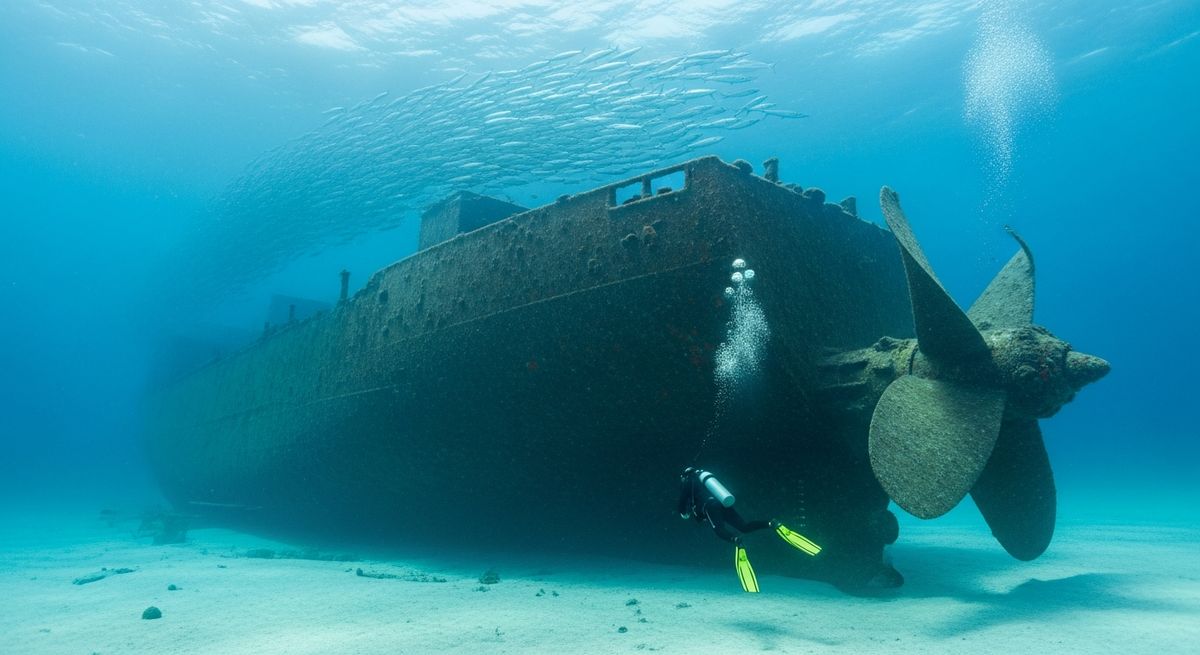
Look, the Mineral Star isn’t for everyone. It’s barely a dive, more of a snorkel or a free-dive, but for history buffs and those who love a good story, it's pretty special. We’re talking about a massive bulk carrier, over 200 metres long, that just… didn’t make it. She sank in 1990, a leak in the engine room, and now sits in a mere four metres of water, her huge hull broken into several pieces. Swimming over it, you feel the sheer scale of the ship. Sunlight penetrates everywhere, illuminating the colossal metal plates and twisted girders. You can see the dark shadows of the internal structures, now home to clouds of juvenile grunts and angelfish darting in and out. There's an eery silence down there, broken only by the gentle creak of the hull in the surge. We love exploring the shallower sections, finding old portholes and the occasional anchor chain draped in soft corals. It's a poignant reminder of human ambition meeting the ocean's power. Our tip? Go at high tide when the visibility is usually best, and keep an eye out for the resident moray eels peeking from crevices. It's a unique experience, feeling like you’re flying over a submerged city, with the ghost of a giant ship beneath you.
Typical MINERAL STAR Dive Profile
Illustrative profile based on site depth and type. Actual dive profiles vary - always follow your dive computer and training.
Safety Notes
Wreck site - avoid penetration without wreck diving certification. Watch for sharp metal and entanglement hazards.
Nearest Dive Centres to MINERAL STAR
Dive shops near MINERAL STAR
View all dive centres in Arraial do CaboReviews for MINERAL STAR
Conditions
Ocean conditions, forecast and tides for MINERAL STAR
MINERAL STAR Ocean Conditions
Monthly averages for MINERAL STAR, sourced from Open-Meteo marine data + Copernicus Marine (EU) - nearest station: Open-Meteo marine grid (-23.23, -44.16) (12km away)
October Averages
Sea Temperature
23°C
73°F · Range: 17.8–26.6°C
Current Speed
8.49 cm/s
Direction: SW (225°)
Salinity
35.38 PSU
Based on 4 years of monitoring data · Data sources: Open-Meteo marine data + Copernicus Marine (EU)
Plan & book
Ways to dive Arraial do Cabo, from day trips to liveaboards.
Day trips & courses
via GetYourGuideGuided dives, courses and snorkel trips with instant booking.
Find dive trips in Arraial do CaboPlaces to stay
via Booking.comHotels and dive resorts near Arraial do Cabo.
Search stays in Arraial do CaboDive insurance
Most travel insurance excludes or limits scuba. Check what you need before you go.
Dive insurance explainedPartner links: we may earn a commission if you book, at no extra cost to you. How we make money
Where to Stay near MINERAL STAR
Prices from Booking.com. We may earn a commission at no extra cost to you.