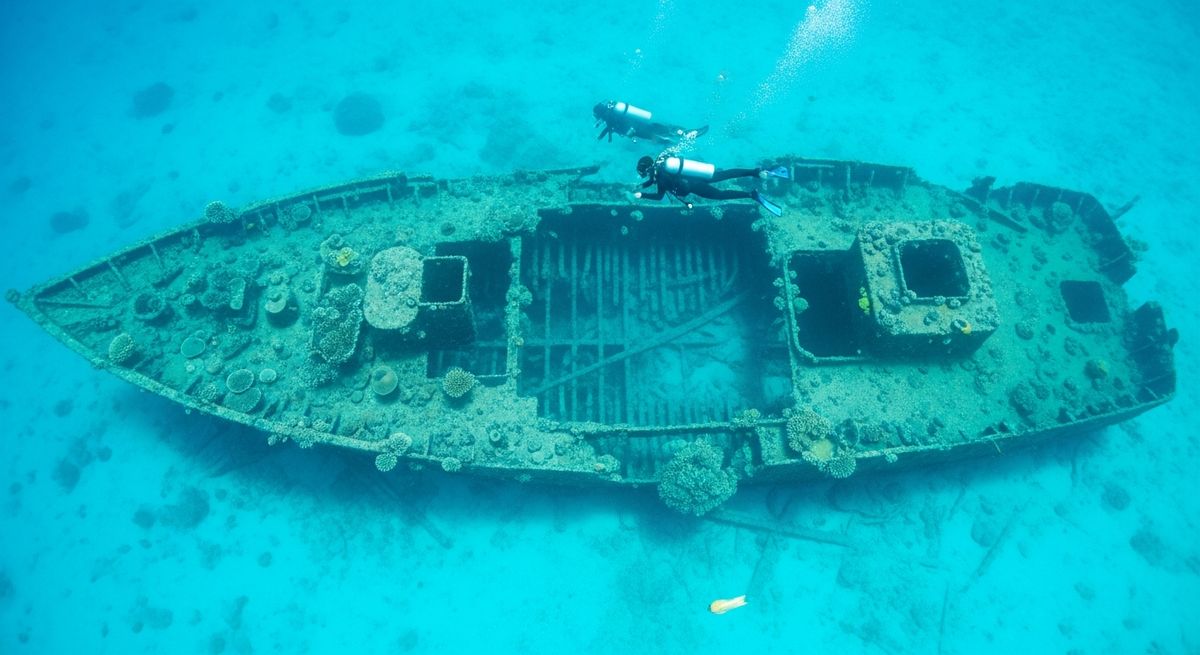
Barcazas
Protected Area
Tayrona
Why dive here
With 71+ marine species recorded in the area - including barracuda and pufferfish - Barcazas offers some of Malpelo Island's richest wreck diving. Water ranges 28-30°C, warmest September, October, November.
Barcazas. Ah, Barcazas. This isn't your usual Malpelo rush of sharks, though we've certainly seen them cruise by. We come here for the wreck itself, a ghostly silhouette of a landing craft, slowly dissolving into the Pacific. We love dropping down into the relative calm here, watching the schools of French grunt and glassy sweepers melt around the structure, using it for shelter from the deeper currents. What's special? The way the light filters through the rust-eaten hull, illuminating the nooks where you'll spot common octopus peeking out or a cheeky spotjaw blenny guarding its territory. It's an exploration dive, a chance to really slow down and appreciate how marine life reclaims man-made structures. Our favourite move is to circle the exterior, keeping an eye out for a passing whale shark in the blue, then slip inside to marvel at the sheer density of cardinalfish that now call the Barcazas home. It's a surprisingly gentle dive for Malpelo, a real change of pace, best enjoyed on a calm day when you can really take your time.
Safety Notes
Wreck site - avoid penetration without wreck diving certification. Watch for sharp metal and entanglement hazards.
Barcazas Wreck History
Vessel Type
barge
Cause
scuttled
In the world-renowned waters of Malpelo Island, the wrecks known simply as 'Las Barcazas' (The Barges) offer a curious man-made feature in an otherwise primal seascape. The exact origin of these sunken barges is murky, with theories suggesting they were either scuttled by the Colombian Navy for training or as artificial reefs, or perhaps were abandoned after being used in the construction of the island's remote research facilities and lighthouse. Whatever their story, they now lie on the rocky bottom, dwarfed by the grandeur of Malpelo's marine life.
Diving on these barges is less about the wrecks themselves and more about their location. They serve as a unique reference point and a temporary habitat for smaller reef fish, but the real show is always in the blue. As you explore the simple, decaying structures, remember to constantly scan your surroundings. Malpelo is a magnet for pelagic giants, and it's around these barges that divers often encounter the legendary schools of scalloped hammerheads, silky sharks, Galapagos sharks, and even the occasional whale shark passing through. The barges are a footnote in the epic logbook of a Malpelo dive.
Nearest Dive Centres to Barcazas
Dive shops near Barcazas
Caribbean Pro Dive Center
Santa marta dive
Aquantis Dive Center
Reef Shepherd
Ocean Lovers Taganga
Poseidon Dive Center
Reviews for Barcazas
Conditions
Ocean conditions, forecast and tides for Barcazas
Barcazas Ocean Conditions
Monthly averages for Barcazas, sourced from Open-Meteo marine data + Copernicus Marine (EU) - nearest station: Open-Meteo marine grid (12.4, -81.47) (108km away)
October Averages
Sea Temperature
30°C
86°F · Range: 29.3–31.3°C
Current Speed
13.42 cm/s
Direction: NE (63.4°)
Chlorophyll-a
0.094 mg/m³
Very clear (oligotrophic)
Salinity
34.38 PSU
Based on 4 years of monitoring data · Data sources: Open-Meteo marine data + Copernicus Marine (EU)
Plan & book
Ways to dive Malpelo Island, from day trips to liveaboards.
Day trips & courses
via GetYourGuideGuided dives, courses and snorkel trips with instant booking.
Find dive trips in Malpelo IslandPlaces to stay
via Booking.comHotels and dive resorts near Malpelo Island.
Search stays in Malpelo IslandDive insurance
Most travel insurance excludes or limits scuba. Check what you need before you go.
Dive insurance explainedPartner links: we may earn a commission if you book, at no extra cost to you. How we make money
Where to Stay near Barcazas
Prices from Booking.com. We may earn a commission at no extra cost to you.