Diving in Mancora & North Coast
Why dive here
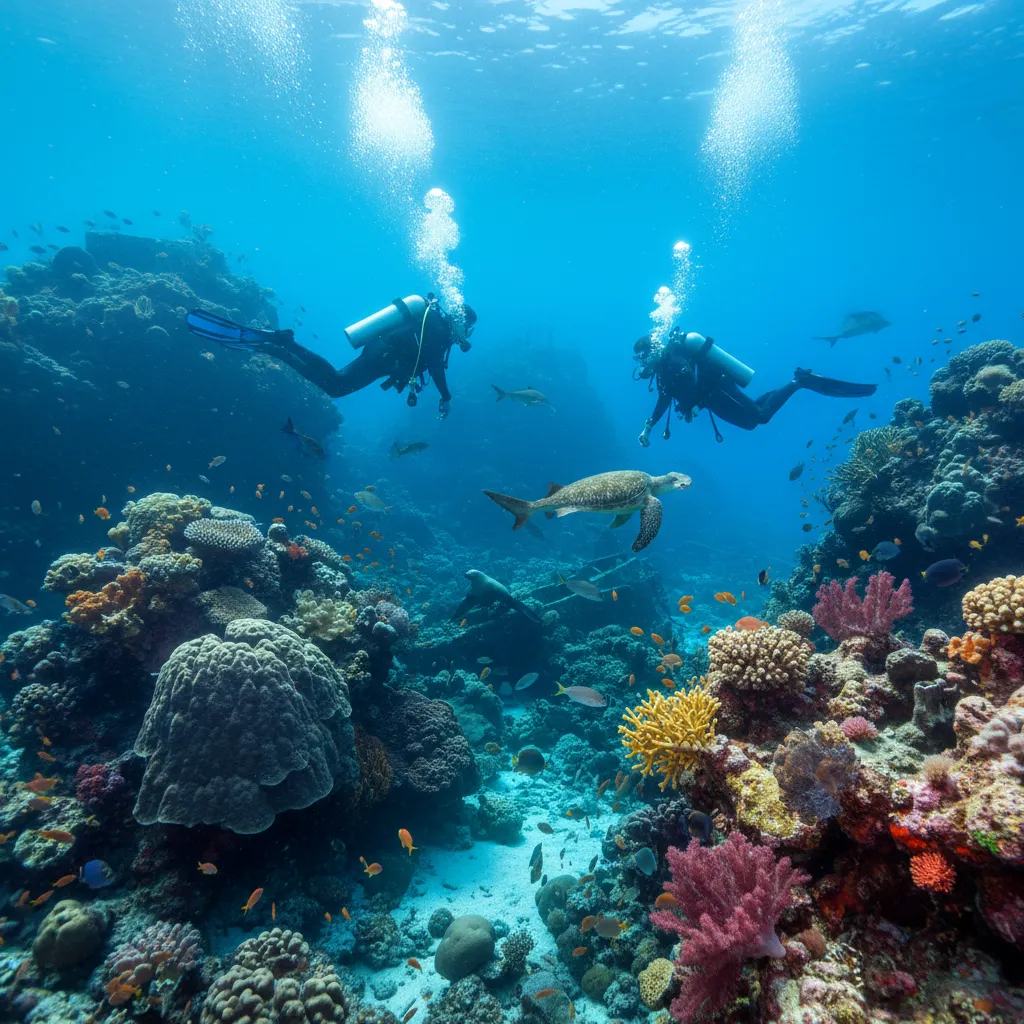
Mancora & North Coast offers some of Peru's richest diving, with 77+ marine species recorded in the area - including dolphins, hammerhead sharks, humpback whales, manta rays and mobula rays (devil rays). Water sits around 24°C.
Peru. Yeah, we know what you’re thinking: Nazca lines, Machu Picchu, ceviche. Diving? Most divers don’t even have it on their radar, and honestly, we love that about Mancora. This isn't the Caribbean, so ditch any expectations of postcard-perfect visibility every single day. What you get here, at the very tip of Peru’s tropical north, is something far more interesting: a collision of currents that brings big pelagic life close to shore. We’re talking about a real chance to spot blue whales migrating through, usually between June and October. That’s not a guaranteed sighting, of course, but just knowing they’re out there adds a buzz to every boat ride. Dive sites like “El Ñuro” are essentially rocky pinnacles, often with strong surge, but the pay-off can be huge. We’ve bumped into schools of jacks so thick you lose your buddy, and on a really good day, a Galapagos bullhead shark cruising the deeper ledges. Our favourite, though, has to be looking for the Bloody Frogfish and Fire Tentacle Anemones, tucked away in crevices on the reefs. It’s a completely different vibe than the usual tropical reef, a bit wilder, a bit more unpredictable, and that’s precisely why we keep coming back.
Mancora & North Coast Dive Site Map
Dive sites and dive centres in Mancora & North Coast
Mancora & North Coast Dive Sites
12 dive sites in Mancora & North Coast
3-4X3
The 3-4X3 site near Mancora offers a glimpse into the region’s industrial past, now softened by the sea. This isn't a grand liner, but rather a drill vessel, or perhaps a rig, sitting upright at 20 meters. We’ve found the mast sections are particularly interesting, providing plenty of nooks and crannies for exploration. The metalwork has become a canvas for various invertebrates, attracting the usual suspects of reef fish. It’s a straightforward wreck dive, generally calm, a good option for those new to wrecks or looking for something different from the typical reef.
ARRASTRERA DORINE
The Arrastrera Dorine is one of those wrecks we keep coming back to. Sunk back in ’89, this isn’t some sanitised, perfectly intact showpiece. No, this is a proper hulk, a working trawler that went down and has been settling into the seabed ever since. We love how the metal has softened over the decades, becoming a canvas for encrusting sponges and those deep purple gorgonians. It’s a dark dive, hitting 50 metres, so you’ll want your good lights to really pick out the details – the twisted davits, the remains of the bridge, the way the deck has buckled. Our favourite part is the engine room, if you’re comfortable with a penetration or just want to peer into the gloom. That’s where we’ve often seen big grouper lurking, sometimes a sleepy nurse shark tucked right in a corner. Out on the deck, schools of jacks swirl around the mast, and it’s common to spot giant moray eels poking their heads from every crevice. Visibility can be a bit variable here, so we’d suggest aiming for slack tide if you can, to minimise the current and maximise your bottom time admiring this old girl. It’s a site for experienced divers, no question, but utterly rewarding for those who appreciate a wreck with real character.
AUDAZ
The Audaz, a fishing vessel, rests upright at 27 metres off Mancora. It’s a good, solid wreck dive, nothing too dramatic, but with enough structure to keep things interesting. Penetration isn't really an option here, not safely anyway, but you can explore the wheelhouse and deck from the outside. Look for the resident scorpionfish camouflaged on the hull and plenty of small schooling fish darting around the superstructure. It's a dive that suits divers comfortable with depth and a bit of current, offering a nice change of pace from reef dives in the area.
BEATITA DE HUMAY
Dive the Beatita de Humay and you're dropping onto the remains of an old fishing vessel, sitting upright in about 10 meters of water. It's not a massive wreck, but the hull is still largely intact, and you can swim through a few open sections, peeking into what used to be the engine room. Over time, the metal has become a home for small groups of fish, with a good number of grunt and snapper schooling around the stern. We’ve even spotted a few moray eels tucked into the darker crevices. It’s a straightforward dive, well-suited for newer wreck divers or anyone looking for a relaxed exploration of a shallow artificial reef.
DON JAVO (POSSIBLY)
Don Javo, off Peru’s northern coast, isn't your typical Caribbean wreck dive. Forget pristine, purpose-sunk ships. This is a working fishing vessel, capsized with a full hold of fish in 1982, and it feels like it. It’s sitting upright in 45m, a bit of a deep one, so save this for when you’re comfortable with your deco obligations. The visibility here can be… Peruvian. Think 10-15m on a good day, but that just adds to the atmosphere as the outline of the stern slowly emerges from the murk. We love the raw, untamed feel of it. The fishing nets are still there, draped over the structure, now heavily encrusted and providing shelter for a surprising amount of life. We've seen big schools of jacks circling the mast, and the deckhouse is usually home to some hefty groupers. Exploring the hold is tricky, but rewarding if you’re comfortable with overhead environments and have excellent buoyancy. The ambient light filtering through the fish hatches gives it an eerie glow. This site is for experienced wreck divers who appreciate a wreck with a story and don't mind a bit of a challenge.
DON PANCHO
Don Pancho, off Peru’s northern coast, isn’t your typical Caribbean postcard wreck. This isn't a pristine ship sitting upright for Instagram, but it’s still one of our favourite dives in the area. What we found was a fishing vessel, sunk back in ‘75 near Paita, now broken up and spread across the sandy bottom at 27 metres. It feels more like an archaeological site than a single, coherent wreck. The real draw here is the way the ocean has completely reclaimed it. Metal plates lie scattered, creating nooks and crannies where we’ve spotted giant morays peering out, their heads swaying. Schools of grunts and snappers hang thick around the larger sections, often so dense you have to fin through them. The visibility can be variable, sometimes a bit murky, but that just adds to the atmospheric gloom of the wreck. Look closely among the debris for nudibranchs, especially around the remaining structure of the stern. It's a dive for those who enjoy exploration, picking apart the story of a wreck that's long past its prime. Not for new divers, but experienced wreck enthusiasts will appreciate the hunt for marine life within the scattered remains.
El Ñuro
El Ñuro is where we go when we absolutely, positively want to see turtles. It’s a shallow spot, maxing out at about 12 meters, and it’s a cleaning station, so the green sea turtles are practically guaranteed to be there. We’ve drifted along, watching them patiently queue up for a scrub, often quite close, without a care in the world. You’ll also spot plenty of jacks, anchovies, and maybe even a spotted snake eel poking out from the sandy patches. It’s an easy, relaxed dive, perfect for beginners or anyone looking for a chill afternoon in the water with some friendly reptiles.
FOKA
The FOKA wreck, resting at a shallow 5 meters in Mancora's waters, is an interesting change of pace from reef diving. This old fishing vessel, grounded in Paita Bay back in '83, is a substantial wreck at over 87 meters long. You'll spend your time exploring its massive, broken hull, which now provides shelter for various schooling fish and the occasional patrolling reef shark. It's an easy dive, perfect for photographers wanting to capture the light playing on the metal, or anyone looking for a relaxed wreck swim-through without the depth. Just keep an eye on the surge; a big swell can really get the wreck moving.
GOLONDRINA
The Golondrina, a fishing vessel that went down just off Paita in 1990, gives us a real sense of history here. We love how it’s settled upright at 24 metres, almost as if it’s still sailing the seabed. You can see the stern, bow, and wheelhouse, all fairly intact, and the current has done a good job of stripping away the superstructure, making it easy to see inside. Our favourite part is the engine room, which is still accessible if you’re a confident wreck diver and the conditions are calm. We’d suggest going in the morning; the light penetration through the open deck is beautiful then, illuminating the schools of glassfish that shimmer inside the hull. Keep an eye out for resident scorpionfish camouflaged on the deck, and we've often seen octopus tucked into the crevices. The Golondrina is a fantastic site for photographers, especially those looking for atmospheric wreck shots with that classic South American feel.
LAZARELLA
Lazarella is our pick for a shallow wreck dive up on Peru’s north coast, a fishing boat that ran aground back in 1983. It’s sitting upright in about eight meters, just off the beach, making it ideal for a relaxed dive, especially if you’re looking to extend your bottom time or get back in the water after a break. We love how the structure has become a home. You can still make out the wheelhouse, the bow, and the stern, though time and the ocean have started to blur the edges. Small schools of grunts and snappers hang out in the shadows, and you’ll spot a surprising number of scorpionfish camouflaged against the hull, so keep those eyes peeled. Look closely, and you might see the subtle shift of a frogfish’s sway on the decks. The visibility here can vary, but on a good day, with a bit of sunlight filtering through the swells, it’s a peaceful, somewhat eerie experience. It’s certainly not a deep, dramatic wreck, but it’s full of character and life, a real pleasure for photography or just a gentle exploration.
Los Organos Bank
Los Organos Bank is where the Peruvian current meets the equatorial, and you can feel it. It’s a seamount that attracts the big stuff, but make no mistake, this is for advanced divers. The currents here can be fierce, an exhilarating ride one minute, a serious workout the next. We love Los Organos for its sheer unpredictability. One dive, you're hanging onto a rock, watching schools of jacks flash silver against the blue, the next you're drifting past immense barrel sponges, hoping for a manta ray to glide into view. Whale sharks are a seasonal lottery, usually between November and April, and if you hit it right, that's an experience that stays with you. We’ve also had incredible encounters with humpback whales passing through, their songs vibrating through your chest. Visibility can vary, sometimes it’s 20 metres and glorious, other times it’s a murky blue, but the life is always there. Keep an eye out for the odd Chilean Angel Shark tucked into the sand, they’re masters of disguise. This site suits divers who are comfortable in strong currents and are chasing big pelagic encounters. It’s not a coral garden, but the sheer volume of fish and the potential for giants makes it special.
SIRENELLA
The Sirenella, a fishing vessel grounded back in '83, sits in surprisingly shallow water, making it a decent introductory wreck dive. It’s barely seven metres deep, so your bottom time is generous, perfect for poking around the remnants of the hull. You'll find plenty of small reef fish darting in and out of the rusted metalwork, and we've seen moray eels peeking from crevices. It’s not a dramatic wreck, but for a chilled-out exploration and a glimpse into Mancora's fishing past, it’s a solid pick.
Mancora & North Coast Dive Centres
2 dive shops and operators in Mancora & North Coast
Ocean Wildlife in Mancora & North Coast
77 species recorded in Mancora & North Coast
Mancora & North Coast Daylight & Sunrise/Sunset
Sunrise and sunset times for Mancora & North Coast, calculated from coordinates
Today - Sunday 11 October
Sunrise
06:07
Sunset
18:18
Daylight
12h 11m
Golden Hour
17:50
First light (dawn) at 05:46 · Last light (dusk) at 18:39
Monthly Averages
| Month | Sunrise | Sunset | Daylight |
|---|---|---|---|
| Jan | 06:23 | 18:46 | 12h 23m |
| Feb | 06:32 | 18:48 | 12h 16m |
| Mar | 06:31 | 18:39 | 12h 8m |
| Apr | 06:25 | 18:26 | 12h 0m |
| May | 06:25 | 18:19 | 11h 54m |
| JunShortest | 06:31 | 18:21 | 11h 50m |
| Jul | 06:35 | 18:27 | 11h 51m |
| Aug | 06:32 | 18:29 | 11h 57m |
| Sep | 06:19 | 18:23 | 12h 4m |
| OctNow | 06:05 | 18:18 | 12h 12m |
| Nov | 06:00 | 18:20 | 12h 20m |
| DecLongest | 06:08 | 18:32 | 12h 24m |
Times are approximate local times based on longitude. Actual times may vary slightly depending on the exact timezone observed in Mancora & North Coast.
Where to Stay near Mancora & North Coast
Prices from Booking.com. We may earn a commission at no extra cost to you.
Marine Protected Areas near Mancora & North Coast
4 protected areas near Mancora & North Coast - please respect local regulations when diving
Mar Tropical de Grau - Sector Banco Máncora
Estuario de Virrilá
Manglares de Tumbes
Santuario Nacional Los Manglares de Tumbes
Getting to Mancora & North Coast
Talara
Chiclayo
Salinas/La Libertad
Plan & book
Ways to dive Mancora & North Coast, from day trips to liveaboards.
Day trips & courses
via GetYourGuideGuided dives, courses and snorkel trips with instant booking.
Find dive trips in Mancora & North CoastPlaces to stay
via Booking.comHotels and dive resorts near Mancora & North Coast.
Search stays in Mancora & North CoastDive insurance
Most travel insurance excludes or limits scuba. Check what you need before you go.
Dive insurance explainedPartner links: we may earn a commission if you book, at no extra cost to you. How we make money