Eagle Nest - Raja Ampat

Jan Thiel baai feels different from a lot of Curaçao's shore dives. You're right off a busy beach, which means easy entry but also more activity topside. Below the surface, it’s a surprisingly good spot for a relaxed dive, especially if you've got family waiting. The star here is definitely the wreck, a small tugboat we think, sitting upright on the sandy bottom at about 10-12m. It’s got an open wheelhouse you can poke your head into, and we always find a good few Orangespotted Filefish darting around its superstructure. What we really love about Jan Thiel is the sandy bottom around the wreck. It's not just barren; spend some time looking closely and you’ll spot movement. We’ve had excellent luck finding gobies, particularly the Bridled and Smallmouth, peering out from their little burrows. Keep an eye out for Green Razorfish burying themselves in the sand with a flick of a tail if you get too close. There’s also an artificial platform nearby that acts as another little habitat, attracting everything from Slippery Dicks to juvenile Doctorfish. This site suits divers looking for an easy, no-fuss wreck dive, with a focus on smaller, sand-dwelling critters that often get overlooked on the big reef dives.

Location
Raja Ampat, Indonesia, Southeast Asia
Coordinates
-2.252600, 130.624600
Type
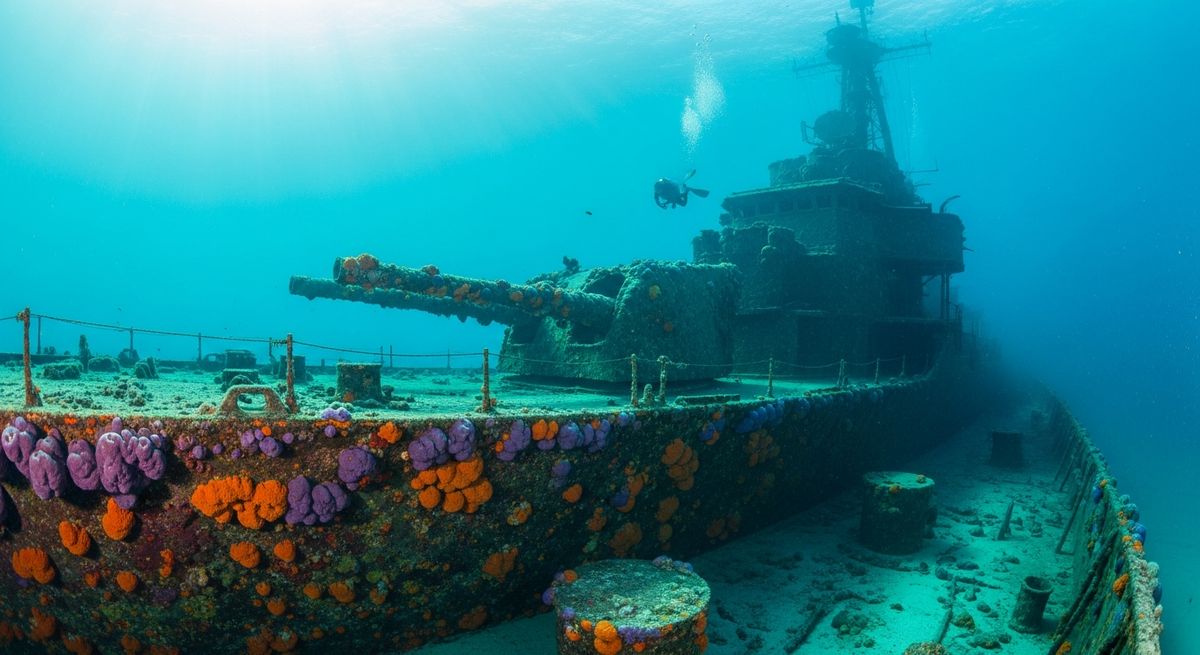
wreck

Marine Protected Area: Teluk Lelintah

Best Time to Dive in Raja Ampat

The warmest water temperatures in Raja Ampat occur in November, averaging 30.3°C. The coolest conditions are in July at 29.3°C.

Monthly Water Temperatures

  • January: 29.7°C
  • February: 29.4°C
  • March: 29.6°C
  • April: 29.9°C
  • May: 29.9°C
  • June: 29.7°C
  • July: 29.3°C
  • August: 29.4°C
  • September: 29.6°C
  • October: 30.0°C
  • November: 30.3°C
  • December: 30.1°C

Nearby Dive Sites in Raja Ampat

Nearest Dive Centres to Eagle Nest

Marine Life in Raja Ampat

Home to 250 recorded species including 176 reef fish, 43 hard corals, 8 seagrass & algae, 5 sea cucumbers, 4 clams & mussels, 4 other.

Notable Species

Recommended Packing List for Eagle Nest

Based on average water temperature of 29.7°C, currents 20 cm/s.

  • Shorty or Rashguard - warm 30°C water needs minimal exposure protection
  • Mask - essential for every dive
  • Fins
  • BCD - buoyancy compensator
  • Regulator - your most safety-critical piece of gear
  • Dive Computer - tracks depth, time, and NDL
  • Surface Marker Buoy (SMB) - essential for boat pickups
  • Dive Torch - useful for crevices and colour at depth
  • Underwater Camera - capture your diving memories

Frequently Asked Questions

What is the maximum depth divers can reach at the Eagle's Nest dive site?
The maximum depth divers can reach at the Eagle Nest dive site is 25m. This site, located in Raja Ampat, Indonesia, offers a diverse underwater experience within these limits.
What unique geological formations and marine life can be observed while diving in Eagle's Nest?
At Eagle Nest, divers can explore unique geological formations including a cleaning station at 22m, a long ridge, a plateau between 12-15m, and wall drops extending to 25-30m. The site is teeming with diverse marine life such as moray eels, sting rays, and nudibranchs. You'll also encounter various fish species like lion fish, spade fish, and clown fish, with sporadic sightings of majestic manta rays.
How difficult is the Eagle's Nest dive site, and what are the main challenges for divers?
The Eagle Nest dive site is rated as intermediate difficulty. The primary challenge for divers is the potential for strong currents, which can make navigation more demanding. Fortunately, the plateau offers multiple places for hook diving, providing a practical solution for managing these conditions.
What are the typical visibility conditions at Eagle's Nest, and is there a best time of year to dive for optimal conditions?
The typical visibility conditions at the Eagle Nest dive site average around 16m, offering good clarity for observing marine life and formations. While this provides a general idea, specific information regarding the best time of year for optimal visibility or other conditions is not available in our current data. For general guidance on dive seasons, you can visit our When to Dive section.
What specific certifications and level of experience are mandatory for diving at Eagle's Nest?
The Eagle Nest dive site is classified as intermediate difficulty, suggesting that divers should possess a corresponding level of experience. While specific certification requirements are not explicitly stated in our data, it is generally recommended that divers are comfortable with varying conditions and potentially strong currents. Always consult with your dive operator for their specific requirements.
Are there any significant currents or other environmental conditions, such as temperature or silt, that divers should be aware of at Eagle's Nest?
Divers planning to visit the Eagle Nest dive site should be aware that it can present strong currents, which may require advanced diving skills or the use of a reef hook. However, specific information regarding other environmental conditions such as water temperature or the presence of silt is not available in the provided data. Always check local conditions with your dive guide before entering the water.