AOI MARU
Protected Area
Labrador Nature Reserve
Why dive here
With 263+ marine species recorded in the area - including blue-spotted stingrays, dugongs, giant moray eels, seahorses and sea turtles - AOI MARU offers some of Southern Islands's richest wreck diving. Water ranges 28-31°C, warmest May, June, November.
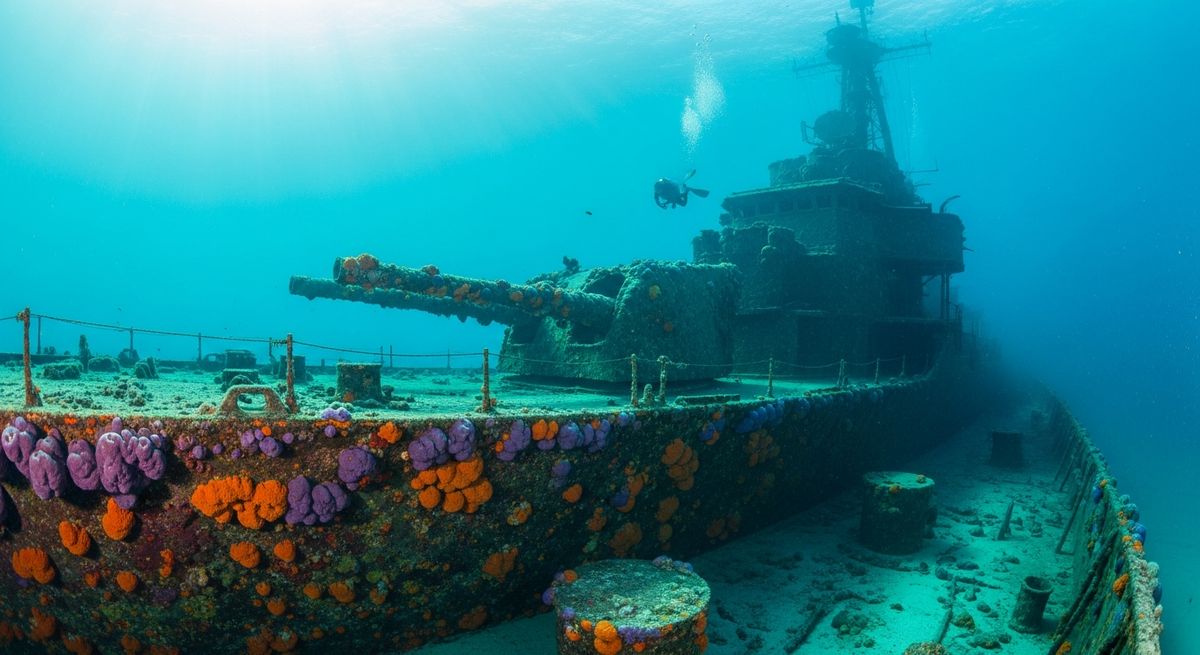
The *Aoi Maru* isn’t the deepest wreck we dive in Singapore, topping out at a respectable 22 metres. But what it lacks in sheer depth, it makes up for in character. Sunk in 1975, this old motor vessel now lies on its side, a dark, hulking shape against the silty bottom. We love the way the light filters down, creating these dramatic shafts through the particles, especially on a sunny morning. You can still make out the superstructure, and there are plenty of entry points if you’re comfortable with overhead environments and have the right training. As you get closer, the wreck hums with activity. Look for lionfish tucked into shadowy crevices, their spines fanned out like feathered capes. We’ve spotted bamboo sharks resting in the sand nearby, almost perfectly camouflaged. Our favourite moments here are spent hovering over the deck, watching schools of fusiliers dart and swirl, occasionally parting to reveal a lone batfish inspecting you. It’s a proper historical dive, feeling a little like you’re exploring a forgotten time capsule rather than just a dive site. Best to hit this one on an incoming tide, before the current picks up too much. It’s ideal for wreck enthusiasts who appreciate the history as much as the marine life it now supports.
Typical AOI MARU Dive Profile
Illustrative profile based on site depth and type. Actual dive profiles vary - always follow your dive computer and training.
Safety Notes
Depth of 22m - Advanced Open Water certification recommended.
Wreck site - avoid penetration without wreck diving certification. Watch for sharp metal and entanglement hazards.
Always perform a 3-minute safety stop at 5m before surfacing.
AOI MARU Wreck History
Year Sunk
1975
Vessel Type
cargo ship
Cause
capsized
The Aoi Maru was a small motor vessel that met its end not in a storm or collision, but within the sheltered waters of Singapore's Eastern Anchorage. On November 23, 1975, while fully laden with cargo destined for Indonesia, the vessel suddenly became unstable, capsized, and sank. The exact cause remains unclear, but a rapid shift in its cargo is the most likely culprit for such a sudden and catastrophic event in calm conditions.
Resting at a comfortable depth of 22 metres, the Aoi Maru is an accessible wreck for recreational divers exploring Singapore's waters. While visibility can be limited, the wreck provides an excellent artificial reef structure. Divers can explore the small cargo holds and superstructure, which are now home to a variety of local marine life, including schooling fish, nudibranchs, and crustaceans. It's a fascinating example of a modern wreck that demonstrates how quickly nature reclaims what the sea has taken.
Nearest Dive Centres to AOI MARU
Dive shops near AOI MARU
Dugong Divers
Waikiki Dive
Penguin Swim School
Gill Divers
Jolly Swim School
The Dive Company
Reviews for AOI MARU
Conditions
Ocean conditions, forecast and tides for AOI MARU
AOI MARU Ocean Conditions
Monthly averages for AOI MARU, sourced from Open-Meteo marine data - nearest station: Open-Meteo marine grid (1.18, 103.96) (8km away)
October Averages
Sea Temperature
30°C
86°F · Range: 29.5–31.1°C
Air Temperature
27°C
81°F
Wind Speed
4.07 m/s
7.9 knots
Atmospheric Pressure
1009.8 hPa
Based on 4 years of monitoring data · Data sources: Open-Meteo marine data
Plan & book
Ways to dive Southern Islands, from day trips to liveaboards.
Day trips & courses
via GetYourGuideGuided dives, courses and snorkel trips with instant booking.
Find dive trips in Southern IslandsPlaces to stay
via Booking.comHotels and dive resorts near Southern Islands.
Search stays in Southern IslandsDive insurance
Most travel insurance excludes or limits scuba. Check what you need before you go.
Dive insurance explainedPartner links: we may earn a commission if you book, at no extra cost to you. How we make money
Where to Stay near AOI MARU
Prices from Booking.com. We may earn a commission at no extra cost to you.