ASSIMI III
Why dive here
With 263+ marine species recorded in the area - including blue-spotted stingrays, dugongs, giant moray eels, seahorses and sea turtles - ASSIMI III offers some of Southern Islands's richest wreck diving. Water ranges 28-31°C, warmest May, June, November.
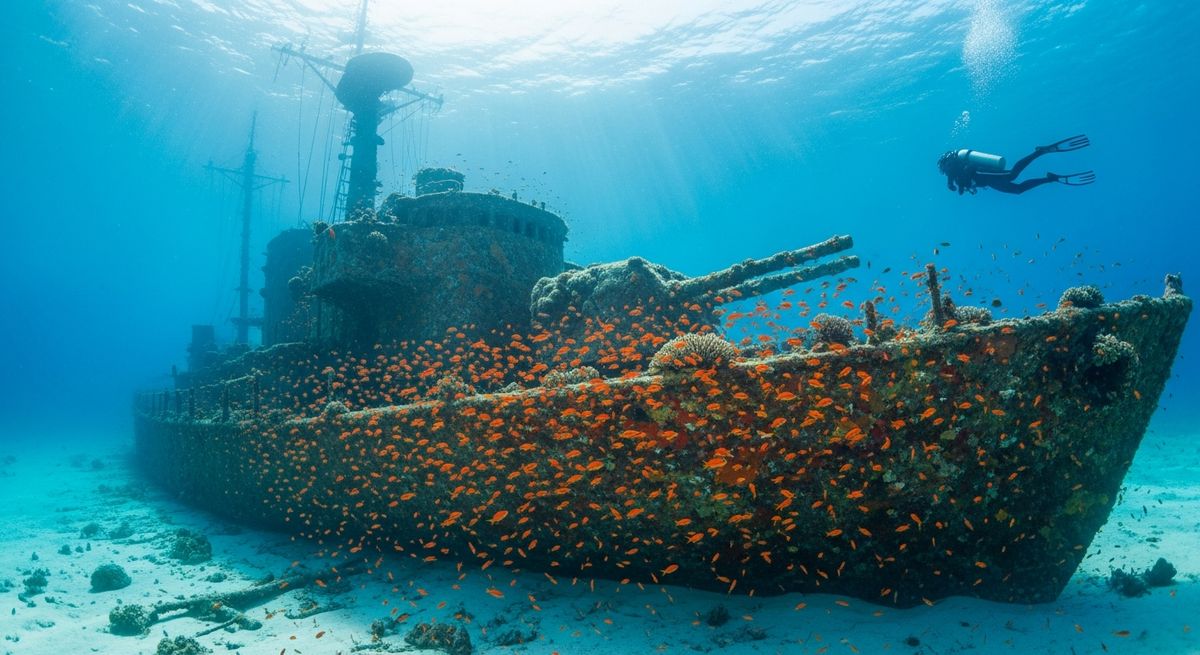
Assimi III, for us, is hands down the best wreck dive in Singapore. It’s a proper ship, not just a collection of scattered metal, and its history adds a layer of intrigue. We love dropping down onto the massive tanker, its sheer scale impressive even after all these years underwater. You can really feel the cold thermocline at 20-25 meters on the descent, a stark contrast to the warmer surface, before the wreck gradually emerges from the gloom. The fire in the engine room back in '68 left a dramatic mark, and exploring that area is our favourite part. It’s completely stripped, open to the elements, and light filters through in eerie shafts. We’ve found huge schools of fusiliers here, so thick they almost block out the light, darting around the superstructure. Look out for the resident batfish and emperor snappers, often lurking in the deeper, darker sections. Be mindful of the currents; they can pick up quickly, especially around the bow and stern, so good buoyancy control is key. This is a dive for experienced wreck enthusiasts who appreciate a bit of mystery and a tangible piece of maritime history.
Typical ASSIMI III Dive Profile
Illustrative profile based on site depth and type. Actual dive profiles vary - always follow your dive computer and training.
Safety Notes
Deep dive (33m) - monitor air consumption closely. Advanced certification recommended.
Wreck site - avoid penetration without wreck diving certification. Watch for sharp metal and entanglement hazards.
Always perform a 3-minute safety stop at 5m before surfacing.
ASSIMI III Wreck History
Year Sunk
1968
Vessel Type
tanker
Cause
fire
The ASSIMI III was a tanker built in 1955 at the Framnaes Mekaniske Verksted in Sandefjord, Norway, a shipyard known for its robust whaling ships and tankers. For thirteen years, she served her commercial duties, eventually coming under the ownership of the St. Grigorusa Maritime Co. In April 1968, while on a passage from Tandjung Uban, Indonesia, to Saigon, Vietnam, disaster struck. A fire erupted in the engine room, quickly growing beyond the crew's control.
Despite efforts to extinguish the blaze, the ship was lost and sank on April 29, 1968. Today, the ASSIMI III rests at a depth of 33 meters in the busy shipping lanes south of Singapore. Dives on this wreck are subject to strong currents and variable visibility, making it a challenging but rewarding experience for advanced divers. The vessel is largely intact, offering opportunities for penetration for those with the proper training, and its structure has become an artificial reef for a variety of local marine species.
Nearest Dive Centres to ASSIMI III
Dive shops near ASSIMI III
PT Meimo Toronta Sera
CHANGE LIFESTYLE
Dugong Divers
SWIMCRAFT SG PTE LTD
Turtle Buddy Divers
Scuba Warehouse
Reviews for ASSIMI III
Conditions
Ocean conditions, forecast and tides for ASSIMI III
ASSIMI III Ocean Conditions
Monthly averages for ASSIMI III, sourced from Open-Meteo marine data - nearest station: Open-Meteo marine grid (1.18, 103.96) (8km away)
October Averages
Sea Temperature
30°C
86°F · Range: 29.5–31.1°C
Air Temperature
27°C
81°F
Wind Speed
4.07 m/s
7.9 knots
Atmospheric Pressure
1009.8 hPa
Based on 4 years of monitoring data · Data sources: Open-Meteo marine data
Plan & book
Ways to dive Southern Islands, from day trips to liveaboards.
Day trips & courses
via GetYourGuideGuided dives, courses and snorkel trips with instant booking.
Find dive trips in Southern IslandsPlaces to stay
via Booking.comHotels and dive resorts near Southern Islands.
Search stays in Southern IslandsDive insurance
Most travel insurance excludes or limits scuba. Check what you need before you go.
Dive insurance explainedPartner links: we may earn a commission if you book, at no extra cost to you. How we make money
Where to Stay near ASSIMI III
Prices from Booking.com. We may earn a commission at no extra cost to you.