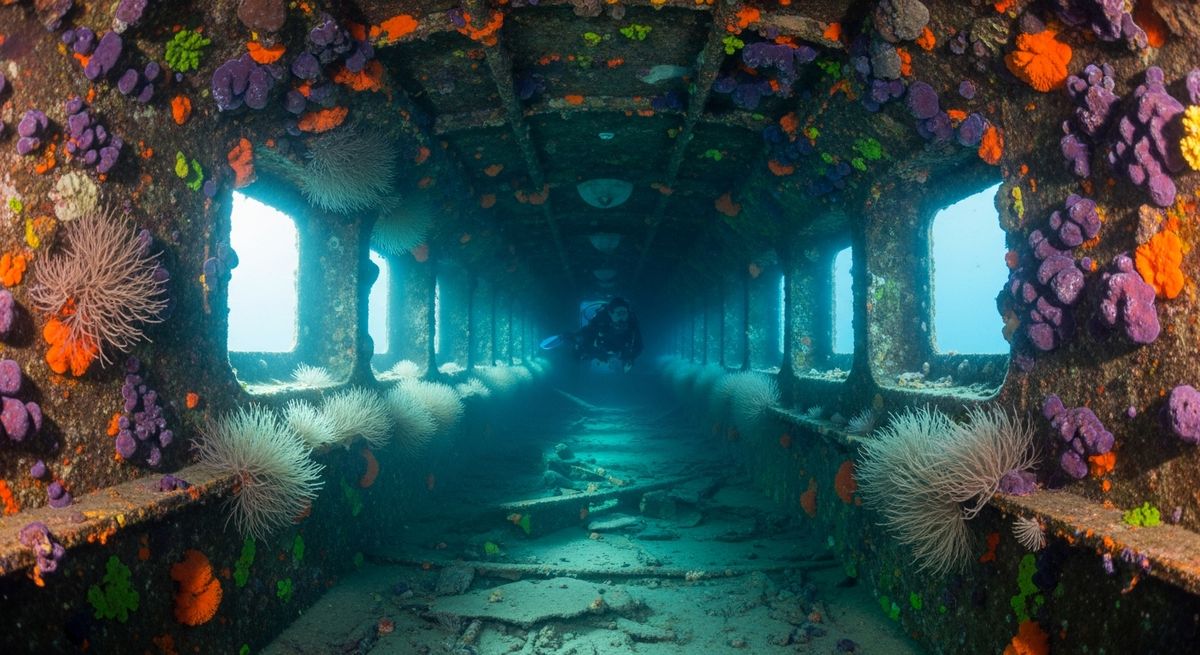
HMS GIANG BEE (PROBABLY)
Why dive here
With 263+ marine species recorded in the area - including blue-spotted stingrays, dugongs, giant moray eels, seahorses and sea turtles - HMS GIANG BEE (PROBABLY) offers some of Southern Islands's richest wreck diving. Water ranges 28-31°C, warmest May, June, November.
Dropping onto the HMS Giang Bee feels like stepping back into a specific, grim moment in history. This isn't a colourful reef dive, it’s a sombre, powerful wreck. We’re talking about a steamship bombed by the Japanese in 1942, lying upright at 25m, its masts still reaching skyward from the seabed. Our favourite part is the sheer scale, especially considering it’s Singapore. The 82-meter length means there's a lot to explore; swim-throughs are abundant where bulkheads have collapsed, opening up passageways. Inside, the light filters eerily, illuminating schools of fusiliers darting between the metal ribs. Look closely, and you’ll spot scorpionfish camouflaged on the deck plates and nudibranchs grazing on the encrusting sponges. Visibility can be a bit hit or miss, typical for Singapore, but on a good day, the outline of the entire ship emerges from the gloom. It’s a dive for those who appreciate maritime history and the beauty of decay, rather than pristine corals. We’d suggest going early on a weekday to avoid any boat traffic.
Typical HMS GIANG BEE (PROBABLY) Dive Profile
Illustrative profile based on site depth and type. Actual dive profiles vary - always follow your dive computer and training.
Safety Notes
Depth of 25m - Advanced Open Water certification recommended.
Wreck site - avoid penetration without wreck diving certification. Watch for sharp metal and entanglement hazards.
Always perform a 3-minute safety stop at 5m before surfacing.
Reviews for HMS GIANG BEE (PROBABLY)
Conditions
Ocean conditions, forecast and tides for HMS GIANG BEE (PROBABLY)
HMS GIANG BEE (PROBABLY) Ocean Conditions
Monthly averages for HMS GIANG BEE (PROBABLY), sourced from Open-Meteo marine data - nearest station: Open-Meteo marine grid (1.18, 103.96) (8km away)
October Averages
Sea Temperature
30°C
86°F · Range: 29.5–31.1°C
Air Temperature
27°C
81°F
Wind Speed
4.07 m/s
7.9 knots
Atmospheric Pressure
1009.8 hPa
Based on 4 years of monitoring data · Data sources: Open-Meteo marine data
Plan & book
Ways to dive Southern Islands, from day trips to liveaboards.
Day trips & courses
via GetYourGuideGuided dives, courses and snorkel trips with instant booking.
Find dive trips in Southern IslandsPlaces to stay
via Booking.comHotels and dive resorts near Southern Islands.
Search stays in Southern IslandsDive insurance
Most travel insurance excludes or limits scuba. Check what you need before you go.
Dive insurance explainedPartner links: we may earn a commission if you book, at no extra cost to you. How we make money
Where to Stay near HMS GIANG BEE (PROBABLY)
Prices from Booking.com. We may earn a commission at no extra cost to you.