EASTERN PROGRESS
Why dive here
With 54+ marine species recorded in the area - including sea turtles, tiger sharks and pufferfish - EASTERN PROGRESS offers some of Koh Tao's richest wreck diving. Water ranges 29-31°C, warmest April, May, June.
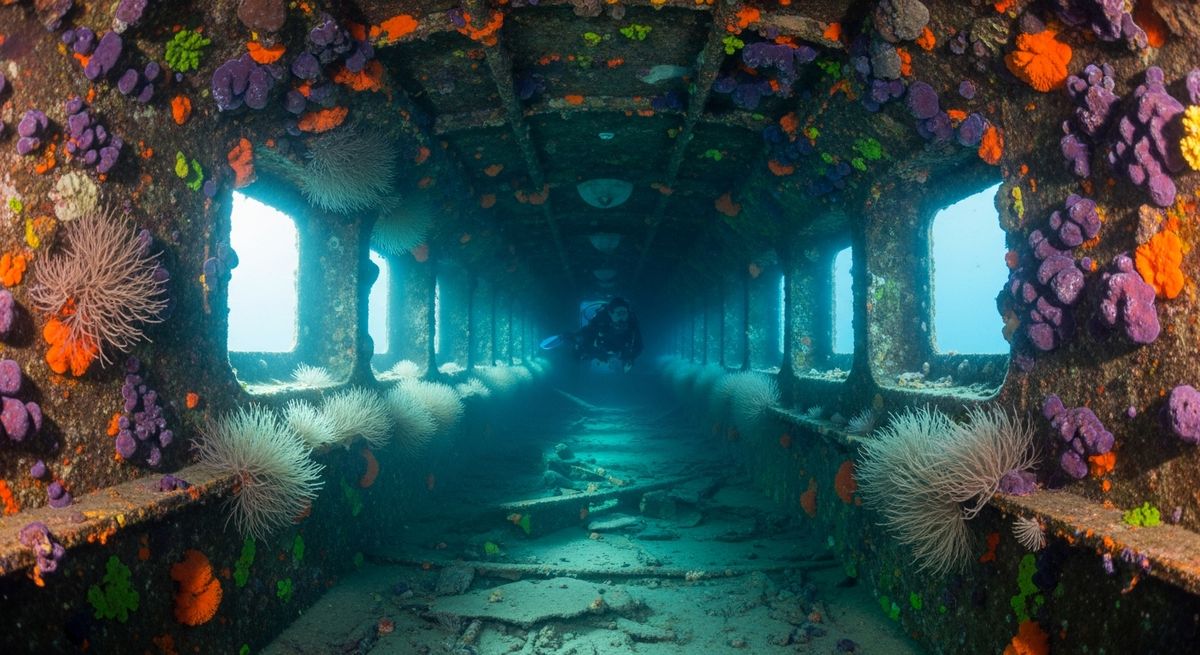
The Eastern Progress. Now, this is a wreck we actually love. Not just because it’s deep, which it is, hitting 60 metres, but because it feels like a proper piece of history down there. She was a carrier vessel, built in Germany in the 50s, and went down in '80 on her way to Singapore. You can really sense that industrial past as you descend onto her. We usually try to hit this one early, before the thermocline settles in too hard, if we can help it. Dropping onto the bow is our favourite approach. You’ll see the enormous anchor chain still snaking away, then the bridge structure looms into view. The scale of her is impressive, almost 100 metres long, and you can swim through various compartments, though penetration requires proper training and gas. Look out for the resident barracuda, often hanging motionless near the mast, and we’ve seen some hefty groupers tucked into the holds. The swim-throughs are dark, but the ambient light filtering through occasional openings creates these beautiful, silhouetted scenes. It’s a site for experienced divers, definitely, those comfortable with depth and a bit of current, but for wreck lovers, it’s a real treat.
Typical EASTERN PROGRESS Dive Profile
Illustrative profile based on site depth and type. Actual dive profiles vary - always follow your dive computer and training.
Safety Notes
Maximum depth 60m exceeds recreational limits (40m). Technical diving certification and equipment required.
Wreck site - avoid penetration without wreck diving certification. Watch for sharp metal and entanglement hazards.
Always perform a 3-minute safety stop at 5m before surfacing.
Reviews for EASTERN PROGRESS
Conditions
Ocean conditions, forecast and tides for EASTERN PROGRESS
EASTERN PROGRESS Ocean Conditions
Monthly averages for EASTERN PROGRESS, sourced from Open-Meteo marine data + Copernicus Marine (EU) - nearest station: Open-Meteo marine grid (11.17, 101.33) (40km away)
October Averages
Sea Temperature
30°C
86°F · Range: 29.1–31.1°C
Current Speed
7.07 cm/s
Direction: E (98.1°)
Salinity
31.67 PSU
Based on 4 years of monitoring data · Data sources: Open-Meteo marine data + Copernicus Marine (EU)
Plan & book
Ways to dive Koh Tao, from day trips to liveaboards.
Day trips & courses
via GetYourGuideGuided dives, courses and snorkel trips with instant booking.
Find dive trips in Koh TaoPlaces to stay
via Booking.comHotels and dive resorts near Koh Tao.
Search stays in Koh TaoDive insurance
Most travel insurance excludes or limits scuba. Check what you need before you go.
Dive insurance explainedPartner links: we may earn a commission if you book, at no extra cost to you. How we make money
Where to Stay near EASTERN PROGRESS
Prices from Booking.com. We may earn a commission at no extra cost to you.