Diving in Fiordland
Why dive here
Fiordland offers some of New Zealand's richest diving, with 46+ marine species recorded in the area - including blue sharks, great white sharks, seahorses and southern right whales. Water ranges 10-16°C, warmest January, February, March.
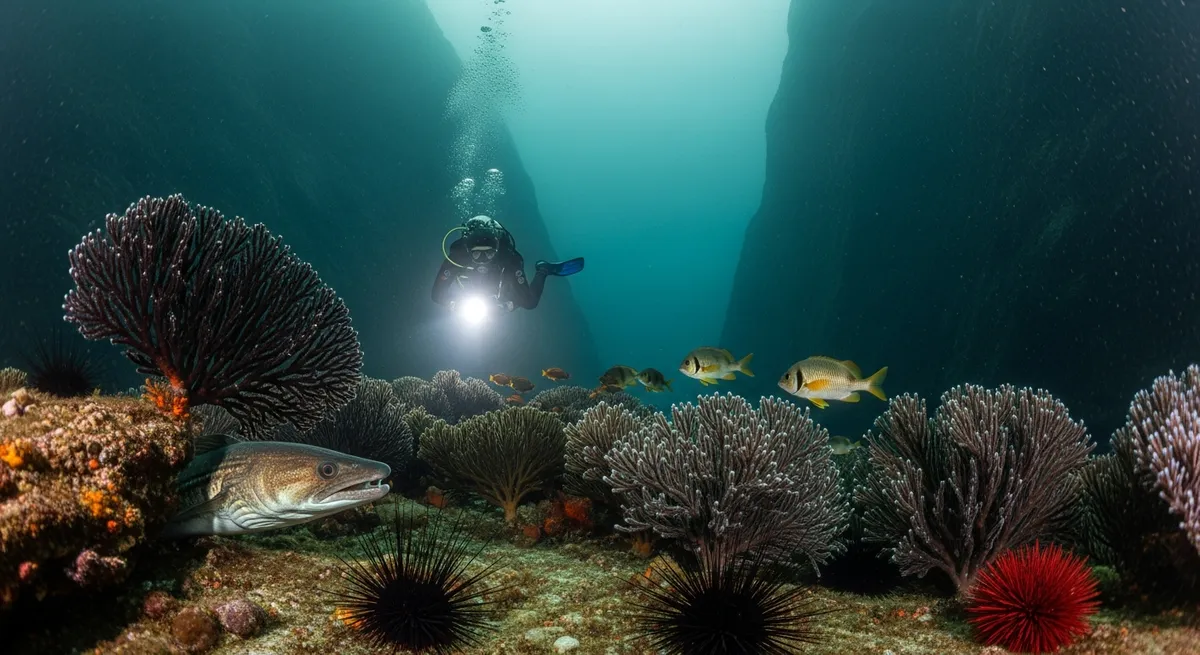
Fiordland diving isn't like anything else. We're talking about a landscape that feels ancient, above and below the surface. The real draw here is the layer of freshwater runoff, stained with tannins from the surrounding rainforest, that sits on top of the denser saltwater. This phenomenon, often called the 'halo layer', blocks out sunlight, tricking deepwater species into growing in surprisingly shallow depths. It's wild to see black coral colonies, normally found hundreds of metres down, thriving at a mere 10 or 15 metres. This isn’t warm, clear tropical diving. Expect cooler temperatures and often limited visibility, especially after heavy rain. But what you sacrifice in sunshine, you gain in sheer uniqueness. We've seen fat New Zealand sea tulips the size of your fist, and countless tiny, glowing light-bulb sea squirts clinging to the walls, creating an almost bioluminescent effect. Keep an eye out for curious New Zealand sole darting across the silty bottom, and the occasional Bentnose Rabbitfish peeking from crevices. Our favourite dives here are the deep walls, where the black coral forests are at their densest. It's a surreal experience, almost like diving at night, but in daylight. You'll need to be comfortable with colder water and drysuits are highly recommended. Go in late spring or early summer for slightly better weather, though the tannin layer is always present.
Fiordland Dive Site Map
Dive sites and dive centres in Fiordland
Fiordland Dive Sites
22 dive sites in Fiordland
Aramoana Mole
Aramoana Mole, on the edge of Fiordland, feels like a secret handshake among South Island divers. We love it for its sheer accessibility, especially when the weather decides to be Fiordland-ish. It's a man-made wall, sure, but it's completely encrusted, a tapestry of sponges in electric yellows and purples, mixed with the reds of sea squirts. You'll find yourself searching the nooks and crannies for nudibranchs, and we've spotted some absolute crackers here. Visibility averages around 5 meters, which isn't Bali, but it's often better than that depending on the tide and recent rain. The deepest parts are off the very end, hitting maybe 10 meters, but most of our dives stay comfortably around 6-8 meters. We often see Lemon Sole pressed into the sand, and the occasional Bluefin Gurnard kicking up sediment. It's an excellent spot for newer divers, or anyone who appreciates the smaller, intricate details of temperate diving without needing to chase pelagics.
Aramoana Mole
Aramoana Mole, on the edge of Fiordland, feels like a secret handshake among South Island divers. We love it for its sheer accessibility, especially when the weather decides to be Fiordland-ish. It's a man-made wall, sure, but it's completely encrusted, a tapestry of sponges in electric yellows and purples, mixed with the reds of sea squirts. You'll find yourself searching the nooks and crannies for nudibranchs, and we've spotted some absolute crackers here. Visibility averages around 5 meters, which isn't Bali, but it's often better than that depending on the tide and recent rain. The deepest parts are off the very end, hitting maybe 10 meters, but most of our dives stay comfortably around 6-8 meters. We often see Lemon Sole pressed into the sand, and the occasional Bluefin Gurnard kicking up sediment. It's an excellent spot for newer divers, or anyone who appreciates the smaller, intricate details of temperate diving without needing to chase pelagics.
Bridal Veil
Bridal Veil in Fiordland offers a mellow dive, perfect for stretching out the dive season without too much drama. It’s a shallow wall that gently slopes from Bridal Veil beach, topping out around 15 metres. We often find it quite sheltered, especially in the shallower sections, making it a good spot for a relaxed exploratory dive. Keep an eye out for the yellow-and-black triplefins darting through the kelp, and you might spot a crumb-of-bread sponge clinging to the rock. Visibility typically hovers around 10 metres, which is decent for Fiordland, letting you appreciate the smaller black coral trees peppered across the reef. It’s a comfortable dive for anyone looking for an easy morning under the surface.
Bridal Veil
Bridal Veil in Fiordland offers a mellow dive, perfect for stretching out the dive season without too much drama. It’s a shallow wall that gently slopes from Bridal Veil beach, topping out around 15 metres. We often find it quite sheltered, especially in the shallower sections, making it a good spot for a relaxed exploratory dive. Keep an eye out for the yellow-and-black triplefins darting through the kelp, and you might spot a crumb-of-bread sponge clinging to the rock. Visibility typically hovers around 10 metres, which is decent for Fiordland, letting you appreciate the smaller black coral trees peppered across the reef. It’s a comfortable dive for anyone looking for an easy morning under the surface.
Butterfly Wall
Butterfly Wall, nestled deep in the fiords, has a real sense of being somewhere wild and untouched. We usually drop into a calm cove, the stony sand gradually giving way to rock, and from there, the wall just drops away. It's not a deep dive, maxing out at about 19m, but that’s plenty to explore the dense kelp forests and the big schools of butterfly perch that give the place its name. They truly are everywhere, shimmering orange and yellow, often so thick they dim the light filtering down from the surface. Visibility here averages around 11m, which might not sound like much, but in Fiordland's green-blue light, it feels perfectly clear. As you cruise along the wall, keep an eye out for the small, delicate black corals clinging to the darker overhangs – a real treat to spot. We often find red rock lobster tucked into crevices, their antennae waving gently. It’s a site that really makes you feel like you’re exploring, perfect for divers who appreciate the unique, cooler water ecosystems and don’t mind a bit of a journey to get there.
Butterfly Wall
Butterfly Wall, nestled deep in the fiords, has a real sense of being somewhere wild and untouched. We usually drop into a calm cove, the stony sand gradually giving way to rock, and from there, the wall just drops away. It's not a deep dive, maxing out at about 19m, but that’s plenty to explore the dense kelp forests and the big schools of butterfly perch that give the place its name. They truly are everywhere, shimmering orange and yellow, often so thick they dim the light filtering down from the surface. Visibility here averages around 11m, which might not sound like much, but in Fiordland's green-blue light, it feels perfectly clear. As you cruise along the wall, keep an eye out for the small, delicate black corals clinging to the darker overhangs – a real treat to spot. We often find red rock lobster tucked into crevices, their antennae waving gently. It’s a site that really makes you feel like you’re exploring, perfect for divers who appreciate the unique, cooler water ecosystems and don’t mind a bit of a journey to get there.
Cray’s Crack
Cray’s Crack in Fiordland, it’s a site that really delivers on that true New Zealand vibe. We love dropping into the cool, dark water, the kelp stalks swaying above like a curtain. The real show starts at about 10 meters, where the rocky slope transforms into a proper wall. This isn't your vibrant tropical reef, but the colours here are subtler, deeper – the glow of orange zoanthids, the deep purple of kina, and of course, the famed black coral. We’ve found the best time to visit is often on an overcast day; the ambient light filtering through makes the black coral truly pop. Keep an eye out for those big crayfish tucked into crevices – they’re everywhere here, giving the site its name. Our favourite moments have been spotting schools of butterfly perch flitting amongst the coral branches and watching lazy dogsharks cruise by. The visibility can be hit or miss, usually around 10-12m, but it only adds to the moody, mysterious feel. It’s a straightforward dive to about 18m, making it a great pick for intermediate divers looking for that classic Fiordland experience without extreme depths or currents.
Dale Green
Dale Green, for us, is classic Fiordland. We’re talking about those sheer walls that just disappear into the dark, cold water. You descend, and it’s like dropping into a twilight zone. The light filters through the tannin-stained surface, giving everything this eerie, green glow. We’ve always been drawn to the black coral trees here, some of them are huge, spreading out from the rock face like ancient, gnarled sculptures. Look closely, and you’ll often spot butterfly perch and soldierfish darting amongst the branches. It’s not just the black coral that makes it special though. Peer into the overhangs, and you’ll find splashes of red coral, a real contrast against the dark rock. And don’t forget the smaller stuff – we’ve seen some brilliant nudibranchs here, often tucked away on hydroids or sponges. Visibility can vary, averaging around 13 metres, but on a good day, it stretches further, allowing you to appreciate the sheer scale of the wall. This site is best for experienced divers comfortable with deep wall diving, who appreciate unique ecosystems over brightly coloured tropical reefs. Keep an eye out for inquisitive seals too; they often pop by to check you out.
Dale Point
Dale Point. This is one of those Fiordland spots where you just drop in and feel the place wrap around you. We love a wall dive, and here it’s an absolute stunner, plunging down to 21 meters, thick with those ancient black corals. They’re everywhere, some branching like skeletal trees, others just a solid mass, draped in yellow zoanthids that look like someone splashed luminous paint all over the place. Visibility averages 11 meters, which in Fiordland terms, is perfectly good for soaking in the details. Keep an eye out for the smaller stuff; we’ve spotted Swarming Squat Lobsters clinging to the black coral branches and nudibranchs grazing the walls. Butterfly perch drift in schools, and you’ll inevitably find kina (sea urchins) and Red Rock Lobsters tucked into crevices. It’s a site that really shows off the density of life in the fiords, suiting divers who appreciate a slow, deliberate exploration of a vibrant temperate reef.
Dive Otago
Diving Fiordland is a different beast entirely. Forget your warm water corals; here we’re talking about an ecosystem shaped by glacial melt and tannin-stained fresh water sitting atop the salt. It creates this perpetual twilight zone, even at shallower depths. Dive Otago, one of the accessible sites, gives you a real taste of that unique environment. We love the strange, almost alien feel of the place, especially when you encounter the deep-water species that thrive in the gloom. You’ll see things like ghost sharks gliding past, their eyes reflecting what little light penetrates. Keep an eye out for the twisters, a type of large anemone, waving gently in the current. It’s a macro photographer’s dream with all the chitons – the snakeskin and blue green varieties are particularly striking. Honestly, the water itself often feels thick with the tannin, a sensory experience in its own right. We’d suggest going in the drier months, typically late autumn to winter, for the best chance of decent visibility, though "decent" is a relative term here. This site truly suits divers who are over tropical reefs and craving something genuinely unique, a dive that feels more like an exploration than a swim.
Fox Cove
Fox Cove, out in the northern reaches of the fiord, offers a completely different vibe from some of the deeper, darker walls. We love it for the sheer variety of life you’ll spot in relatively shallow water, around 10 to 18 metres. It’s a rocky reef sloping down to sand, draped in thick kelp. We've often found cowfish weaving through the stalks, and the colourful butterfly perch flit about like, well, butterflies. Look closely and you’ll find giant eleven-armed seastars clinging to rocks and the strange sea potatoes dotting the sand. We’d always suggest this site for those days when the inner fiord feels a bit too... enclosed. It’s exposed to north and northwest winds, so pick a calm day or one with a southerly breeze. Visibility usually sits around 10 metres, but sometimes it just pops. Keep an eye out for the red rock lobsters tucked into crevices. It’s a great spot for an easy, relaxed dive, full of smaller critters and vibrant colours you might miss elsewhere.
Greenstone Beach
We’re big fans of a site that feels genuinely remote, and Greenstone Beach absolutely delivers. Tucked away in Fiordland, it’s a proper expedition to get here, and that’s part of the appeal. The shoreline drops quickly, hitting 5 meters almost straight away, then a 45-degree slope takes you down to 20m. It’s all solid rock and big boulders, draped in thick kelp. Visibility sits around 15m, sometimes a little less, sometimes a little more, but always with that deep, emerald Fiordland hue. Our pick for what to look for here are the smaller things hiding amongst the kelp and rocks – we’ve had cracking encounters with octopus, the shy Jasons nudibranch, and plenty of marblefish peeking out. You’ll definitely spot wrasses and eels, too. We’ve been lucky enough to see small black coral colonies, which are always a treat. Keep an eye out into the gloom for school sharks or dogsharks gliding past. If you’re a diver who appreciates rugged, wild scenery and the thrill of discovery, Greenstone Beach is a true Fiordland experience. It’s not about vibrant colours, but about the raw, untamed beauty of New Zealand’s underwater world.
Show all 22 dive sites in Fiordland
Fiordland Dive Centres
No dive centres listed in Fiordland yet. Browse all dive centres.
Ocean Wildlife in Fiordland
46 species recorded in Fiordland
Fiordland Daylight & Sunrise/Sunset
Sunrise and sunset times for Fiordland, calculated from coordinates
Today - Sunday 11 October
Sunrise
05:02
Sunset
18:06
Daylight
13h 4m
Golden Hour
17:27
First light (dawn) at 04:32 · Last light (dusk) at 18:36
Monthly Averages
| Month | Sunrise | Sunset | Daylight |
|---|---|---|---|
| Jan | 04:20 | 19:33 | 15h 13m |
| Feb | 05:04 | 18:59 | 13h 55m |
| Mar | 05:42 | 18:11 | 12h 28m |
| Apr | 06:21 | 17:14 | 10h 53m |
| May | 06:57 | 16:30 | 9h 33m |
| JunShortest | 07:24 | 16:12 | 8h 48m |
| Jul | 07:20 | 16:25 | 9h 5m |
| Aug | 06:46 | 16:58 | 10h 13m |
| Sep | 05:51 | 17:35 | 11h 43m |
| OctNow | 04:55 | 18:11 | 13h 16m |
| Nov | 04:10 | 18:54 | 14h 45m |
| DecLongest | 03:55 | 19:29 | 15h 34m |
Times are approximate local times based on longitude. Actual times may vary slightly depending on the exact timezone observed in Fiordland.
Where to Stay near Fiordland
Prices from Booking.com. We may earn a commission at no extra cost to you.
Marine Protected Areas near Fiordland
20 protected areas near Fiordland - please respect local regulations when diving
Te Tapuwae o Hua (Long Sound)
Moana Uta (Wet Jacket Arm)
Taumoana (Five Fingers Peninsula)
Breaksea Island
Hautai
Piopiotahi
Waituna Wetlands
Taipari Roa (Elizabeth Island)
Kahukura (Gold Arm)
Hawea (Clio Rocks)
Kutu Parera (Gaer Arm)
Te Awaatu Channel
Showing 12 largest of 20
Getting to Fiordland
Queenstown
Christchurch
Wanaka
Plan & book
Ways to dive Fiordland, from day trips to liveaboards.
Day trips & courses
via GetYourGuideGuided dives, courses and snorkel trips with instant booking.
Find dive trips in FiordlandPlaces to stay
via Booking.comHotels and dive resorts near Fiordland.
Search stays in FiordlandDive insurance
Most travel insurance excludes or limits scuba. Check what you need before you go.
Dive insurance explainedPartner links: we may earn a commission if you book, at no extra cost to you. How we make money