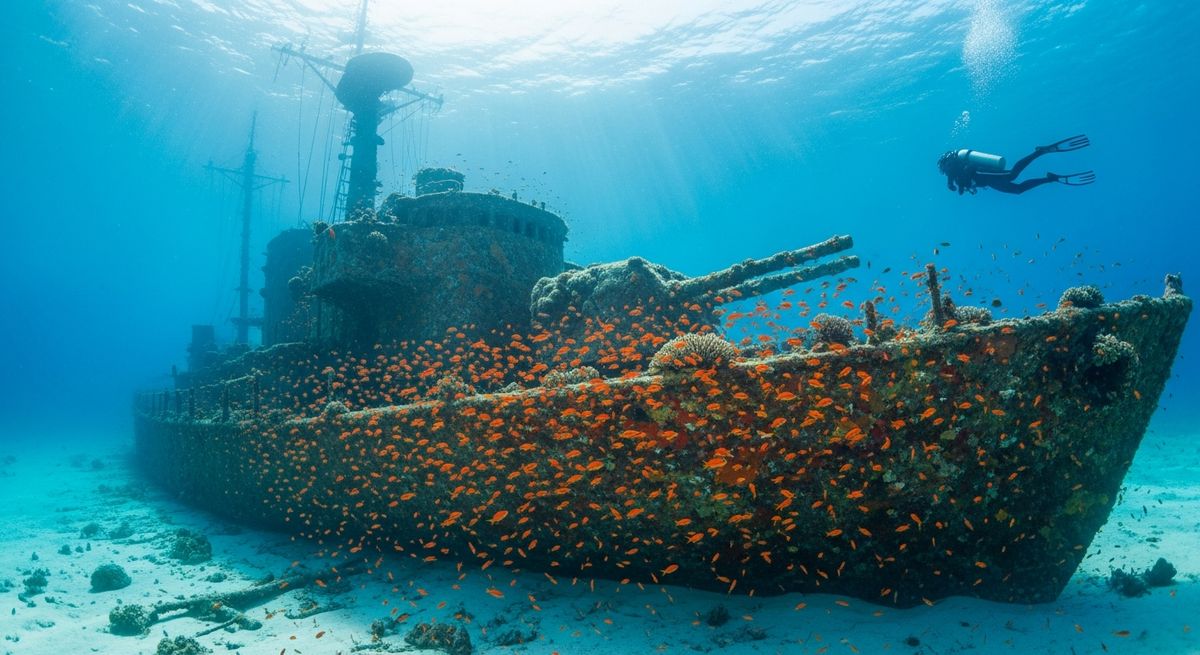
Pallas
Protected Area
Grand Cayman West
Why dive here
With 327+ marine species recorded in the area - including barracuda, bull sharks, oceanic whitetip sharks, orcas and sea turtles - Pallas offers some of Grand Cayman's richest wreck diving. Water ranges 27-31°C, warmest August, September, October.
Pallas is a site we keep coming back to on Grand Cayman’s south side, and for good reason. It’s got this great mix of wide, canyon-like finger corals that slope gently down into sandy patches, all dotted with little swim-throughs and arches. The reef crest itself is shallow, often around 5-8 metres, and we love spending the tail end of a dive just hovering there. You’ll find soft corals swaying, and it’s a nursery for so many juvenile fish – little yellowtail damselfish flitting about, slender filefish trying to blend in. We’ve even spotted the elusive sea pea, a tiny juvenile trunkfish, tucked away. Down deeper, around 15-18 metres, is where you really get into the larger coral formations. Look into the shadows of the overhangs for belt cardinalfish or shy brotulas. Visibility averages 22 metres here, so the sunlight really penetrates, giving the corals a rich glow. It’s a pretty relaxed dive, suitable for anyone comfortable finning around a coral garden, and a perfect spot if you're keen on finding those smaller, often overlooked critters like blennies and gobies.
Safety Notes
Wreck site - avoid penetration without wreck diving certification. Watch for sharp metal and entanglement hazards.
Nearest Dive Centres to Pallas
Dive shops near Pallas
SUNSET DIVERS
Don Foster's Dive Cayman, Ltd.
Atlantis Dive Center
Divers Down
Divers Supply
OCTOPUS
Reviews for Pallas
Conditions
Ocean conditions, forecast and tides for Pallas
Pallas Ocean Conditions
Monthly averages for Pallas, sourced from Open-Meteo marine data + Copernicus Marine (EU) - nearest station: Open-Meteo marine grid (19.38, -81.32) (5km away)
October Averages
Sea Temperature
30°C
87°F · Range: 29.1–31.8°C
Current Speed
4.47 cm/s
Direction: NW (296.6°)
Chlorophyll-a
0.045 mg/m³
Very clear (oligotrophic)
Salinity
36.14 PSU
Based on 4 years of monitoring data · Data sources: Open-Meteo marine data + Copernicus Marine (EU)
Plan & book
Ways to dive Grand Cayman, from day trips to liveaboards.
Day trips & courses
via GetYourGuideGuided dives, courses and snorkel trips with instant booking.
Find dive trips in Grand CaymanPlaces to stay
via Booking.comHotels and dive resorts near Grand Cayman.
Search stays in Grand CaymanDive insurance
Most travel insurance excludes or limits scuba. Check what you need before you go.
Dive insurance explainedPartner links: we may earn a commission if you book, at no extra cost to you. How we make money
Where to Stay near Pallas
Prices from Booking.com. We may earn a commission at no extra cost to you.