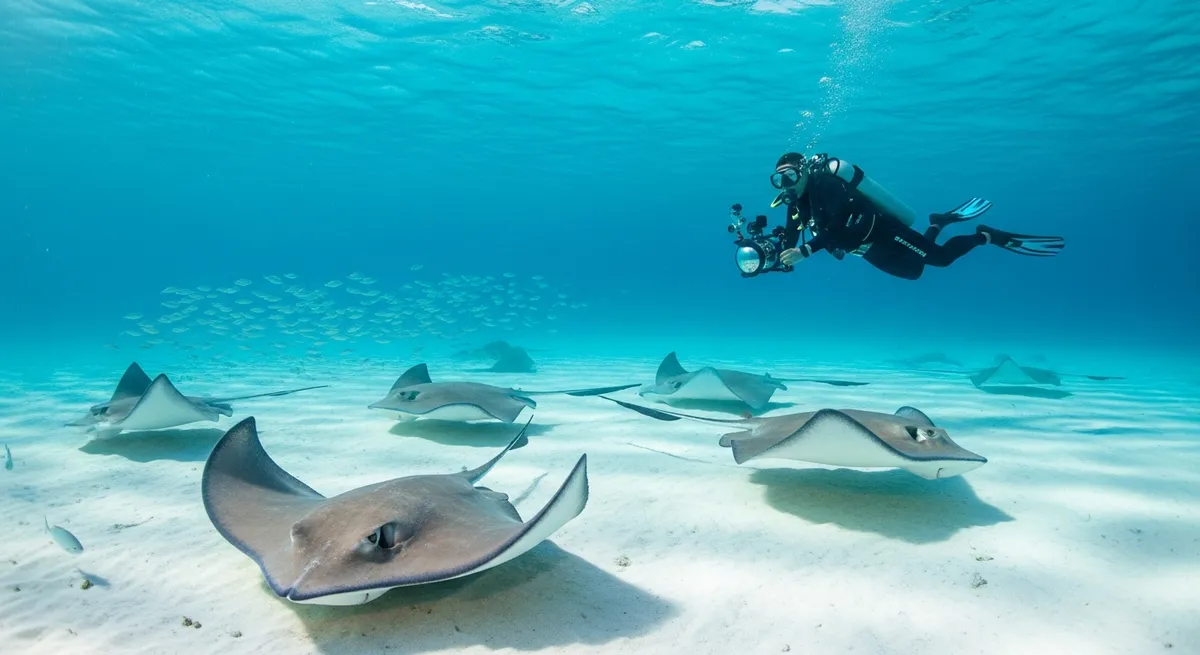
Diving in Grand Cayman
Why dive here
Grand Cayman offers some of Cayman Islands's richest diving, with 327+ marine species recorded in the area - including barracuda, bull sharks, oceanic whitetip sharks, orcas and sea turtles. Water ranges 27-31°C, warmest August, September, October.
Grand Cayman diving often gets pigeonholed for the Kittiwake wreck, and while we love a good wreck, the island offers so much more. Our favourite dives here are definitely along the North Wall. Dropping down into that blue abyss, you feel the depth instantly. Visibility is usually superb, letting you pick out little gobies on the sponges and morays tucked deep into crevices. On the shallower west side, spots like Eden Rock and Devil's Grotto are surprisingly good shore dives. Slip in with just your gear, and you're surrounded by schools of French grunts and horse-eye jacks. Come in late summer, and you might hit the silverside run, a shimmering, swirling mass of fish attracting tarpon and barracuda. It’s chaotic and thrilling, feeling like a scene straight out of a nature documentary. The currents generally stay mild, especially on the west, making it pretty easy for most divers. We always suggest hitting the sandbar at Stingray City for a snorkel too, just to round out the experience.
Grand Cayman Dive Site Map
Dive sites and dive centres in Grand Cayman
Grand Cayman Dive Sites
95 dive sites in Grand Cayman
Anchor Point
Anchor Point is one of those spots where Grand Cayman really shows off its wall diving. We’re talking a proper, dramatic drop-off, the kind that makes you feel like you’re flying over an abyss. The mooring itself is right there on the wall, pin depth around 17 metres, which means you’re immediately into the good stuff. We love dropping down and just drifting along the edge, watching for oceanic triggerfish patrol the blue. Visibility here is usually excellent, around 20 metres on an average day, giving you a clear view of the deep. Keep an eye out for the Stippled Clingfish, they're tiny but fascinating to watch as they hold on tight to the corals. We’ve also spotted some chunky Hogfish picking their way through the reef, and the Black Morays often peek out from their crevices. There’s a neat little swim-through just off the mooring, forward and towards the wall – it’s a quick dart through but adds a bit of fun. Current can be mild to moderate, so be prepared for a drift, it just means less finning for you. This site is a solid pick for anyone who loves a good wall dive with plenty of nooks and crannies to explore.
Anchor Point
Anchor Point is one of those spots where Grand Cayman really shows off its wall diving. We’re talking a proper, dramatic drop-off, the kind that makes you feel like you’re flying over an abyss. The mooring itself is right there on the wall, pin depth around 17 metres, which means you’re immediately into the good stuff. We love dropping down and just drifting along the edge, watching for oceanic triggerfish patrol the blue. Visibility here is usually excellent, around 20 metres on an average day, giving you a clear view of the deep. Keep an eye out for the Stippled Clingfish, they're tiny but fascinating to watch as they hold on tight to the corals. We’ve also spotted some chunky Hogfish picking their way through the reef, and the Black Morays often peek out from their crevices. There’s a neat little swim-through just off the mooring, forward and towards the wall – it’s a quick dart through but adds a bit of fun. Current can be mild to moderate, so be prepared for a drift, it just means less finning for you. This site is a solid pick for anyone who loves a good wall dive with plenty of nooks and crannies to explore.
Angelfish Reef - Grand Cayman
Angelfish Reef is one of those sites we always come back to when we need a relaxed dive, especially if we’re bringing newer divers along. It's an easy drift over a series of coral fingers and sandy patches, maxing out around 17 meters, which makes for plenty of bottom time. Visibility generally hovers around 20-25 meters, so you can really soak it all in. We love dropping in and letting the gentle current carry us over the reef, past big brain corals and star corals. Keep an eye out for the goatfish sifting through the sand – they always seem to kick up a few buried blennies or gobies. We’ve found Dusky Cardinalfish tucked into crevices and, on a couple of lucky occasions, even spotted a Long-snout Seahorse clinging to a gorgonian, which is always a treat. The name isn't just for show, either; you'll see Queen, French, and Gray angels cruising by, often in pairs, looking quite regal against the blue. It’s a reliable spot for a calm, critter-focused dive, perfect for photographers or anyone who enjoys moving slowly and observing.
Angelfish Reef - Grand Cayman
Angelfish Reef is one of those sites we always come back to when we need a relaxed dive, especially if we’re bringing newer divers along. It's an easy drift over a series of coral fingers and sandy patches, maxing out around 17 meters, which makes for plenty of bottom time. Visibility generally hovers around 20-25 meters, so you can really soak it all in. We love dropping in and letting the gentle current carry us over the reef, past big brain corals and star corals. Keep an eye out for the goatfish sifting through the sand – they always seem to kick up a few buried blennies or gobies. We’ve found Dusky Cardinalfish tucked into crevices and, on a couple of lucky occasions, even spotted a Long-snout Seahorse clinging to a gorgonian, which is always a treat. The name isn't just for show, either; you'll see Queen, French, and Gray angels cruising by, often in pairs, looking quite regal against the blue. It’s a reliable spot for a calm, critter-focused dive, perfect for photographers or anyone who enjoys moving slowly and observing.
Aquarium - Grand Cayman
If you’re after a gentle drift over a shallow reef with some serious fish action, Aquarium is a solid pick. We love this site for its sheer density of schooling fish, particularly the grunts and snappers that hang out in the spur and groove formations. It truly feels like swimming through a massive, natural fish tank. The reef here rolls down to about 16 metres, a relaxed depth where the light still penetrates beautifully, illuminating the sand channels between the coral fingers. Keep an eye out for yellowhead wrasse darting between the coral heads and the occasional flounder trying its best to disappear into the sand. Our favourite memory is often drifting past a school of hundreds of grunts, their silvery scales catching the sun, barely parting for us. Visibility here averages a comfortable 24 metres, often more on a good day. It’s perfect for new divers or anyone wanting a relaxed second dive, offering plenty to see without needing to go deep. Look for the long-snout seahorse in the gorgonians, a true treat if you can spot one.
Aquarium - Grand Cayman
If you’re after a gentle drift over a shallow reef with some serious fish action, Aquarium is a solid pick. We love this site for its sheer density of schooling fish, particularly the grunts and snappers that hang out in the spur and groove formations. It truly feels like swimming through a massive, natural fish tank. The reef here rolls down to about 16 metres, a relaxed depth where the light still penetrates beautifully, illuminating the sand channels between the coral fingers. Keep an eye out for yellowhead wrasse darting between the coral heads and the occasional flounder trying its best to disappear into the sand. Our favourite memory is often drifting past a school of hundreds of grunts, their silvery scales catching the sun, barely parting for us. Visibility here averages a comfortable 24 metres, often more on a good day. It’s perfect for new divers or anyone wanting a relaxed second dive, offering plenty to see without needing to go deep. Look for the long-snout seahorse in the gorgonians, a true treat if you can spot one.
Armchair Reef
Armchair Reef gives you that classic Grand Cayman wall feel without the vertigo. We love it for its accessibility, the top of the mini-wall sits around 11 meters, so you get plenty of bottom time exploring the ledges and overhangs. Drop down to 19 meters and the sand flat stretches out, often with a few southern stingrays buried, just their eyes peeking out. This site is a critter hunter's dream. We've spent entire dives here poking into every crack, finding everything from a shy Roughhead Blenny to a pair of mating Frecklefin Gobies. Keep an eye out for the odd Blackfin Cardinalfish tucked deep in the corals, their eyes shining in your torch beam. The big barrel sponges are impressive too, often home to a Greater Soapfish or a curious Trumpetfish lurking nearby. It’s a great choice for divers who appreciate the smaller stuff and prefer a relaxed pace, perfect for photographers or those just wanting to unwind.
Armchair Reef
Armchair Reef gives you that classic Grand Cayman wall feel without the vertigo. We love it for its accessibility, the top of the mini-wall sits around 11 meters, so you get plenty of bottom time exploring the ledges and overhangs. Drop down to 19 meters and the sand flat stretches out, often with a few southern stingrays buried, just their eyes peeking out. This site is a critter hunter's dream. We've spent entire dives here poking into every crack, finding everything from a shy Roughhead Blenny to a pair of mating Frecklefin Gobies. Keep an eye out for the odd Blackfin Cardinalfish tucked deep in the corals, their eyes shining in your torch beam. The big barrel sponges are impressive too, often home to a Greater Soapfish or a curious Trumpetfish lurking nearby. It’s a great choice for divers who appreciate the smaller stuff and prefer a relaxed pace, perfect for photographers or those just wanting to unwind.
Babylon, Cayman
Babylon is a site we keep coming back to, and it’s always a good call, especially if you get it to yourselves. We love dropping onto that massive pinnacle, a proper natural skyscraper rising from the deep. You’ll feel the slight sway of the current as you descend, the water surprisingly warm for the depth, and then the reef just explodes with colour. Think huge barrel sponges and a riot of soft corals clinging to the walls, just thriving. The passage itself is a narrow canyon, almost like swimming through a secret garden, and you’ll often find us hovering, watching the schooling snapper and barracuda that glide through with an almost indifferent air. When the sun hits just right, those coral fingers in the shallows practically glow, with schools of fusiliers so thick they almost block the light. It’s a site for divers who appreciate dramatic topography and a lively reef, and we’d suggest going early to beat any crowds.
Babylon, Cayman
Babylon is a site we keep coming back to, and it’s always a good call, especially if you get it to yourselves. We love dropping onto that massive pinnacle, a proper natural skyscraper rising from the deep. You’ll feel the slight sway of the current as you descend, the water surprisingly warm for the depth, and then the reef just explodes with colour. Think huge barrel sponges and a riot of soft corals clinging to the walls, just thriving. The passage itself is a narrow canyon, almost like swimming through a secret garden, and you’ll often find us hovering, watching the schooling snapper and barracuda that glide through with an almost indifferent air. When the sun hits just right, those coral fingers in the shallows practically glow, with schools of fusiliers so thick they almost block the light. It’s a site for divers who appreciate dramatic topography and a lively reef, and we’d suggest going early to beat any crowds.
Balboa (Wreck)
The Balboa wreck often gets overlooked for Grand Cayman’s flashier deep walls, but we think that’s a mistake. This isn't a pristine vessel to penetrate; it’s a scattered skeleton, blown apart in the 1930s to clear the shipping channel. What you get instead is a surprisingly vibrant artificial reef, spread across the seabed in a jumble of planks and twisted metal. Dropping down, the first thing that hits you is the sheer scale of the debris field. Beams lie askew, and you can still trace the ghost of the ship's outline in the sand. We’ve spent hours here, meticulously combing the smaller fragments. Look closely, and you’ll find Spotlight Gobies darting into crevices, and we’ve spotted more Arrow Blennies here than anywhere else on the island. Blushing Star Coral patches cling to the larger sections, providing miniature cities for juvenile parrotfish. It’s a shallow dive, maxing out at 15m, which means plenty of bottom time to appreciate the macro life and the way the natural light filters down through the pieces. Visibility here averages a comfortable 24m, and because it’s so close to Georgetown, we’d suggest going early in the morning before any potential boat traffic kicks up the sand. Just remember, you need permission from Port Security to dive this spot.
Balboa (Wreck)
The Balboa wreck often gets overlooked for Grand Cayman’s flashier deep walls, but we think that’s a mistake. This isn't a pristine vessel to penetrate; it’s a scattered skeleton, blown apart in the 1930s to clear the shipping channel. What you get instead is a surprisingly vibrant artificial reef, spread across the seabed in a jumble of planks and twisted metal. Dropping down, the first thing that hits you is the sheer scale of the debris field. Beams lie askew, and you can still trace the ghost of the ship's outline in the sand. We’ve spent hours here, meticulously combing the smaller fragments. Look closely, and you’ll find Spotlight Gobies darting into crevices, and we’ve spotted more Arrow Blennies here than anywhere else on the island. Blushing Star Coral patches cling to the larger sections, providing miniature cities for juvenile parrotfish. It’s a shallow dive, maxing out at 15m, which means plenty of bottom time to appreciate the macro life and the way the natural light filters down through the pieces. Visibility here averages a comfortable 24m, and because it’s so close to Georgetown, we’d suggest going early in the morning before any potential boat traffic kicks up the sand. Just remember, you need permission from Port Security to dive this spot.
Show all 95 dive sites in Grand Cayman
- Bear’s Paw
- Bear’s Paw
- Big Dipper
- Big Dipper
- Black Forest - Grand Cayman
- Black Forest - Grand Cayman
- Black Rock Reef
- Black Rock Reef
- Blue Pinnacles
- Blue Pinnacles
- Bonnie's Arch
- Bonnie's Arch
- Breaker’s Cutback
- Breaker’s Cutback
- Bullwinkle East
- Bullwinkle East
- Cali Ship Wreck
- Caribbean Club Sand Chute
- CARRIE LEE
- Castle Wall
- Christina's Wall
- Chub Hole
- Cobalt Ridge
- Devil’s Grotto North
- Disneyworld
- Doc Poulson (Wreck)
- Eagle Ray Pass
- Eagle Ray Rock
- Eagles Nest
- Easy Street
- Gary’s Wall
- Grand Cayman
- Grouper Grotto
- GULFSTAR
- Hepp’s Pipeline
- Jax Dax
- Kathleen’s Reef
- Kelly’s Caverns
- Killer Pillar
- KIRK PRIDE
- Laura's Reef
- Lighthouse Wall
- Little Bluff Reef
- Little House on the Prairie
- Lone Star Reef
- Maggie’s Maze
- McCurly’s Wall
- Meridian Drop
- Mermaid Reef
- NEWTON
- North West Point
- Old Issac’s
- Orange Canyon
- ORO VERDE
- Oro Verde (Wreck)
- Pallas
- Paradise Reef
- Pat’s Wall
- Playing Field
- Rainbow Reef
- RHAPSODY
- RIDGEFIELD
- RIMANDI MIBAJU
- River of Sands
- Schoolhouse Reef
- Smith Cove
- Snapper Hole
- Spanish Bay Reef
- Split Rock
- Stingray City
- Stingray City
- Stingray City - Grand Cayman
- Sunset House Reef
- Sunset Reef
- The Maze
- Three Sisters Cayman
- Trinity Caves
- Turtle Farm Wall
- Turtle Reef / Macabuca - Grand Cayman
- USS KITTIWAKE
- USS Kittiwake Shipwreck
- Wild Hammer
- Wildlife Reef
Grand Cayman Dive Centres
13 dive shops and operators in Grand Cayman
Atlantis Dive Center
Divers Down
Divers Supply
Divetech
Diving Center
Don Foster's Dive Cayman, Ltd.
Indepth Watersports Ltd
Living the Dream Divers
Show all 13 dive centres in Grand Cayman
Ocean Wildlife in Grand Cayman
327 species recorded in Grand Cayman
Grand Cayman Daylight & Sunrise/Sunset
Sunrise and sunset times for Grand Cayman, calculated from coordinates
Today - Sunday 11 October
Sunrise
06:19
Sunset
18:07
Daylight
11h 48m
Golden Hour
17:38
First light (dawn) at 05:57 · Last light (dusk) at 18:29
Monthly Averages
| Month | Sunrise | Sunset | Daylight |
|---|---|---|---|
| Jan | 07:02 | 18:07 | 11h 5m |
| Feb | 06:55 | 18:25 | 11h 30m |
| Mar | 06:35 | 18:35 | 12h 0m |
| Apr | 06:09 | 18:43 | 12h 34m |
| May | 05:51 | 18:53 | 13h 2m |
| JunLongest | 05:48 | 19:05 | 13h 17m |
| Jul | 05:56 | 19:07 | 13h 12m |
| Aug | 06:07 | 18:55 | 12h 48m |
| Sep | 06:13 | 18:30 | 12h 17m |
| OctNow | 06:20 | 18:04 | 11h 44m |
| Nov | 06:33 | 17:48 | 11h 14m |
| DecShortest | 06:51 | 17:50 | 10h 59m |
Times are approximate local times based on longitude. Actual times may vary slightly depending on the exact timezone observed in Grand Cayman.
Where to Stay near Grand Cayman
Prices from Booking.com. We may earn a commission at no extra cost to you.
Marine Protected Areas near Grand Cayman
39 protected areas near Grand Cayman - please respect local regulations when diving
North Sound (Grand Cayman)
Little Sound (Grand Cayman)
Sandbar Wildlife Interaction Zone
Victoria House- Treasure Island Resort (Grand Cayman)
South Hole Sound (Little Cayman)
Head of Barkers - Flats (Grand Cayman)
Mary's Bay - East Point (Little Cayman)
12 - Mile Bank West
Little Cayman East
South Sound (Grand Cayman)
Grand Cayman West
12 - Mile Bank East
Showing 12 largest of 39
Getting to Grand Cayman
George Town
Montego Bay
Santa Clara
Plan & book
Ways to dive Grand Cayman, from day trips to liveaboards.
Day trips & courses
via GetYourGuideGuided dives, courses and snorkel trips with instant booking.
Find dive trips in Grand CaymanPlaces to stay
via Booking.comHotels and dive resorts near Grand Cayman.
Search stays in Grand CaymanDive insurance
Most travel insurance excludes or limits scuba. Check what you need before you go.
Dive insurance explainedPartner links: we may earn a commission if you book, at no extra cost to you. How we make money