Diving in Kimbe Bay
Why dive here
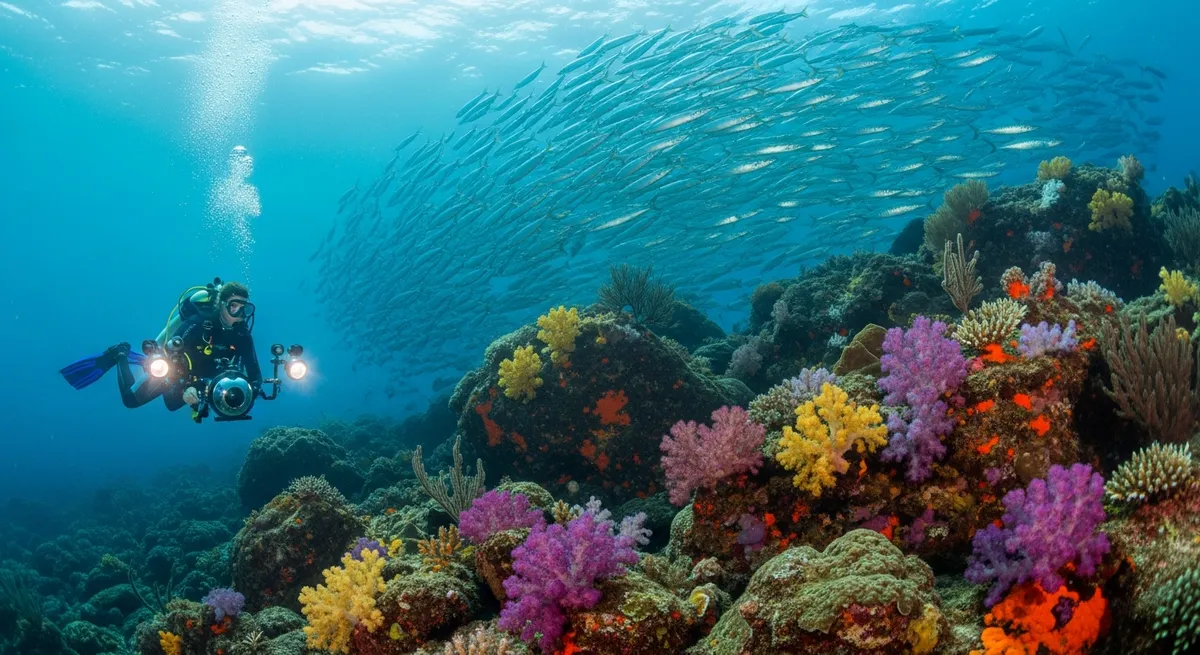
Kimbe Bay offers some of Papua New Guinea's richest diving, with 375+ marine species recorded in the area - including barracuda, blue-spotted stingrays, eagle rays, giant moray eels and grey reef sharks. Water sits around 31°C.
Kimbe Bay, for us, is one of those places that just gets under your skin. We love it because it’s a dive where you can truly relax and just soak it all in. The reefs here are sheltered, which means you’re not battling strong currents, and it’s a fantastic spot for spotting those smaller, often overlooked creatures. We’ve spent hours just drifting, watching Oriental flying gurnards fan their iridescent fins and trying to spot the elusive Sand-dusted Cone. Our favourite dives are often those quieter muck sites, where the real treasures hide. Keep an eye out for the adorable Polkadot Cod and the bizarre Snakehead Gudgeon - they’re masters of camouflage. The seamounts are a different vibe entirely, suddenly you’re in the blue, surrounded by schooling barracuda and trevally. The visibility is generally excellent, and the sheer density of fish, over 860 species, is remarkable. We’d suggest going in the dry season, roughly May to November, for the calmest surface conditions and the best chance of clear water. It’s not about grand pelagics every dive, but rather the cumulative effect of so much healthy reef life, from the tiniest Grammistes Blenny to the sprawling Staghorn corals.
Kimbe Bay Dive Site Map
Dive sites and dive centres in Kimbe Bay
Kimbe Bay Dive Sites
28 dive sites in Kimbe Bay
Agu Reef
Agu Reef sits right in the middle of Kimbe Bay, making it a hotspot for bigger fish. We’ve drifted along its slopes, often spotting grey reef sharks cruising in the blue. Keep an eye out for schooling barracuda too. This site is definitely one for divers keen on pelagics and happy with a drift.
Albatross Muck
Albatross Muck, in Kimbe Bay, delivers on its name. It’s a silty bottom, prime for spotting the small, the strange, and the camouflaged. Think nudibranchs, pipefish, and perhaps the odd flamboyant cuttlefish if you’re lucky and your guide has a good eye. This site is for patient divers who love slow searching and macro photography.
Big Bank
Big Bank, one of Kimbe Bay's submerged seamounts, offers a true blue water experience. We’ve found barracuda and trevally schools patrolling the deeper sections, often with reef sharks cruising by. It’s an exposed site, so expect currents and aim for slack tide if you prefer less drift. This spot is best for experienced divers comfortable in open water.
Bradford & Inglis Shoals
Bradford & Inglis Shoals are where you go in Kimbe Bay when you want to look for the bigger stuff. We’ve seen schools of barracuda here, sometimes big tuna hunting, and the occasional grey reef shark cruising by. It’s a blue water dive, more about the pelagics than the macro. Best for divers comfortable with potential currents and open water.
Bradford Shoals
Bradford Shoals sits out in the deeper waters of Kimbe Bay, a reliable spot for pelagics. We've often encountered various reef sharks patrolling the drop-off, and the occasional silvertip comes in for a look. It’s a site for divers comfortable in open water, looking for those bigger encounters rather than macro details. Currents can be present here, so some experience helps.
Christine’s Reef
Christine's Reef in Kimbe Bay is one of those spots that just makes you smile. It's a shallow dive, maxing out at about 12 meters, and the coral gardens really are something else. We're talking plate corals, staghorns, and brain corals all packed together, forming these intricate structures that just glow in the sunlight. You'll find a steady stream of reef fish darting amongst them, and it’s a site where macro life thrives too; nudibranchs and flatworms are regulars if you slow down and look closely. It's a great spot for photographers, especially those who appreciate a vibrant, healthy reef without needing extreme depth.
Fathers reef
Fathers Reef, in Kimbe Bay, offers some genuinely impressive coral formations. We’ve drifted along walls draped in gorgonian fans and seen resident reef sharks patrol the deeper sections. It’s a site for divers who appreciate pristine hard and soft corals, with visibility often stretching past 25 metres. Best for those comfortable with occasional mild currents.
Fathers Reefs
Fathers Reefs sits off the northern coast of New Britain, a collection of reefs rising from a long-extinct volcanic caldera. Drop in and you’ll find dramatic reefscapes, sometimes with arches and swim-throughs inviting exploration. The real draw here is the pelagic action; we’ve often encountered sharks patrolling the blue, rays cruising by, and turtles making their way to the surface for air. Schools of barracuda hang in formation, their scales flashing. It's a spot that rewards divers who appreciate a lively outer reef with a bit of a current, usually in that 5-30m range.
Grabo Reef
Grabo Reef offers a real feel for Kimbe Bay’s quieter side. We often find the staghorn corals here in excellent condition, forming thickets that shelter plenty of smaller reef fish – think wrasse darting between the branches. The Sand-dusted Cone snails are a neat find, tucked away if you know where to look. It’s a good spot for a relaxed dive, maybe a second dive of the day, when you want to soak up the reef without battling a strong current. This site suits divers who appreciate healthy coral formations and a calm pace.
Heckford Bank
Heckford Bank, one of Kimbe Bay's submerged seamounts, usually gives us a good shot at pelagics. We often see schooling barracuda and trevally here, with the occasional grey reef shark cruising by in the deeper water. It's an exposed site, so currents can be strong, making it better suited for experienced divers comfortable with drift diving. If you're looking for bigger fish action, this is one to consider.
Inglis Shoals
Inglis Shoals in Kimbe Bay is where we go when we’re looking for action in the blue. It’s an exposed site and that usually means currents, which draw in the bigger fish. We’ve had some good encounters here with grey reef sharks, the occasional hammerhead, and schools of barracuda. It’s a site best suited for divers comfortable with drift diving and keeping an eye on their buddies.
Josie’s Reef
Josie’s Reef is a relatively new find for many divers, and it’s a good one. Dropping to around 30 metres, the reef here feels like an underwater forest, thick with sponges, sea whips, and a fantastic variety of corals. We’ve found the real highlight to be a truly enormous sea fan, genuinely bigger than a local bus, which makes for a pretty incredible photo opportunity. It’s a site that rewards slower diving, letting you really appreciate the density of life, and it’s generally pretty relaxed, making it suitable for most experience levels in Kimbe Bay.
Kimbe Bay Dive Centres
9 dive shops and operators in Kimbe Bay
Dive Hoskins
Febrina
Febrina Liveaboard
Rabaul Dive Centre
Walindi Diving & TSMV “FeBrina”
Walindi Plantation
Walindi Plantation Dive Resort
Walindi Plantation Resort
Show all 9 dive centres in Kimbe Bay
Ocean Wildlife in Kimbe Bay
375 species recorded in Kimbe Bay
Kimbe Bay Daylight & Sunrise/Sunset
Sunrise and sunset times for Kimbe Bay, calculated from coordinates
Today - Sunday 11 October
Sunrise
05:41
Sunset
17:53
Daylight
12h 12m
Golden Hour
17:25
First light (dawn) at 05:20 · Last light (dusk) at 18:14
Monthly Averages
| Month | Sunrise | Sunset | Daylight |
|---|---|---|---|
| Jan | 05:57 | 18:21 | 12h 24m |
| Feb | 06:06 | 18:23 | 12h 17m |
| Mar | 06:05 | 18:14 | 12h 8m |
| Apr | 06:01 | 18:00 | 12h 0m |
| May | 06:00 | 17:53 | 11h 53m |
| JunShortest | 06:06 | 17:55 | 11h 49m |
| Jul | 06:11 | 18:01 | 11h 50m |
| Aug | 06:07 | 18:03 | 11h 56m |
| Sep | 05:54 | 17:58 | 12h 4m |
| OctNow | 05:40 | 17:53 | 12h 13m |
| Nov | 05:34 | 17:56 | 12h 21m |
| DecLongest | 05:42 | 18:08 | 12h 26m |
Times are approximate local times based on longitude. Actual times may vary slightly depending on the exact timezone observed in Kimbe Bay.
Where to Stay near Kimbe Bay
Prices from Booking.com. We may earn a commission at no extra cost to you.
Marine Protected Areas near Kimbe Bay
1 protected area near Kimbe Bay - please respect local regulations when diving
Tavalo
Getting to Kimbe Bay
Kimbe
Lae
Kokopo
Plan & book
Ways to dive Kimbe Bay, from day trips to liveaboards.
Day trips & courses
via GetYourGuideGuided dives, courses and snorkel trips with instant booking.
Find dive trips in Kimbe BayPlaces to stay
via Booking.comHotels and dive resorts near Kimbe Bay.
Search stays in Kimbe BayDive insurance
Most travel insurance excludes or limits scuba. Check what you need before you go.
Dive insurance explainedPartner links: we may earn a commission if you book, at no extra cost to you. How we make money