KINUGAWA MARU
Protected Area
Komarindi
Why dive here
With 391+ marine species recorded in the area - including barracuda, blacktip reef sharks, grey reef sharks, humpback whales and orcas - KINUGAWA MARU offers some of Iron Bottom Sound's richest wreck diving. Water ranges 29-31°C, warmest January, April, December.
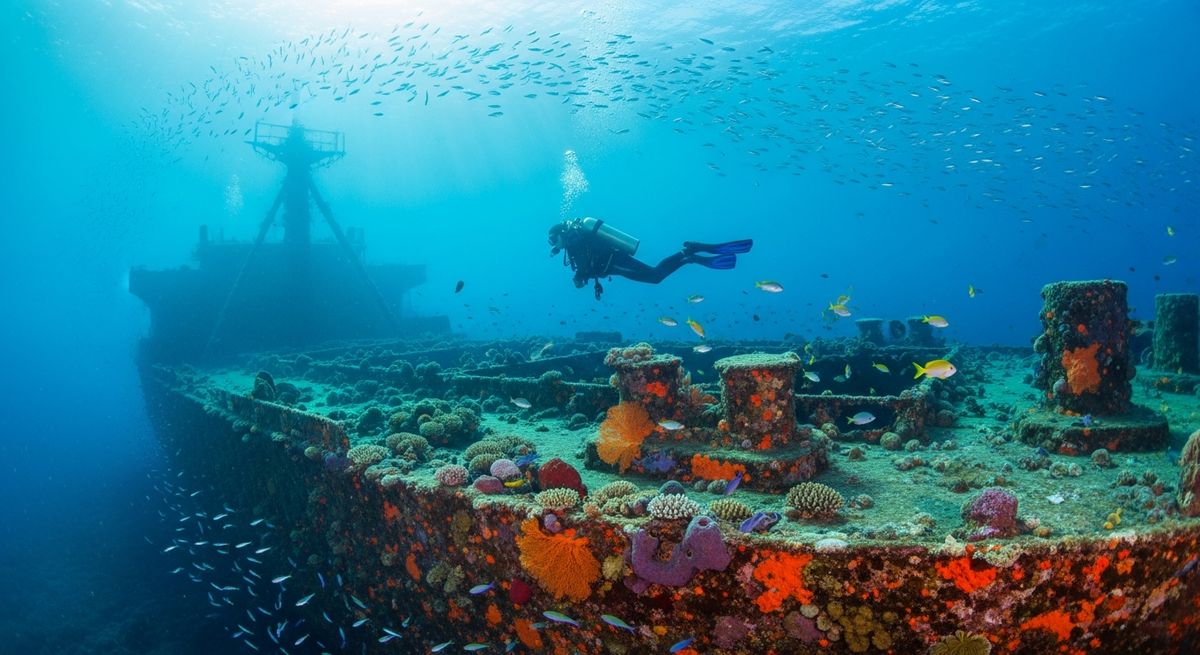
Diving the Kinugawa Maru is a raw, visceral experience. We love this wreck precisely because it’s still so recognisably a ship, broken but not disintegrated, lying on its side in 45m. The bow is an absolute mess, a twisted knot of steel where the torpedo hit, but the stern is surprisingly intact. That’s where you’ll find the two Type 95 Ha-Go tanks, their barrels still pointing out into the blue. It’s an eerie feeling, seeing them there, completely out of context. We always make a point of looking for the ship’s bell, though it’s pretty well encrusted now. Inside, the holds are open, revealing stacks of sake bottles and scattered pottery – incredible to think they’ve been there since 1942. The resident sweetlips are bold, swimming right up to your mask, and we’ve seen barracuda circling high above the superstructure. It’s a dive for experienced wreck enthusiasts who appreciate history and don't mind a deeper profile. Come prepared for limited visibility if there’s been a lot of rain, but honestly, it just adds to the atmosphere here.
Typical KINUGAWA MARU Dive Profile
Illustrative profile based on site depth and type. Actual dive profiles vary - always follow your dive computer and training.
Safety Notes
Maximum depth 45m exceeds recreational limits (40m). Technical diving certification and equipment required.
Wreck site - avoid penetration without wreck diving certification. Watch for sharp metal and entanglement hazards.
Always perform a 3-minute safety stop at 5m before surfacing.
Nearest Dive Centres to KINUGAWA MARU
Dive shops near KINUGAWA MARU
View all dive centres in Iron Bottom SoundReviews for KINUGAWA MARU
Conditions
Ocean conditions, forecast and tides for KINUGAWA MARU
KINUGAWA MARU Ocean Conditions
Monthly averages for KINUGAWA MARU, sourced from Open-Meteo marine data - nearest station: Open-Meteo marine grid (-9.03, 159.16) (58km away)
October Averages
Sea Temperature
30°C
85°F · Range: 28.7–30.5°C
Air Temperature
27°C
80°F
Wind Speed
3.74 m/s
7.3 knots
Atmospheric Pressure
1010.5 hPa
Based on 4 years of monitoring data · Data sources: Open-Meteo marine data
Plan & book
Ways to dive Iron Bottom Sound, from day trips to liveaboards.
Day trips & courses
via GetYourGuideGuided dives, courses and snorkel trips with instant booking.
Find dive trips in Iron Bottom SoundPlaces to stay
via Booking.comHotels and dive resorts near Iron Bottom Sound.
Search stays in Iron Bottom SoundDive insurance
Most travel insurance excludes or limits scuba. Check what you need before you go.
Dive insurance explainedPartner links: we may earn a commission if you book, at no extra cost to you. How we make money
Where to Stay near KINUGAWA MARU
Prices from Booking.com. We may earn a commission at no extra cost to you.