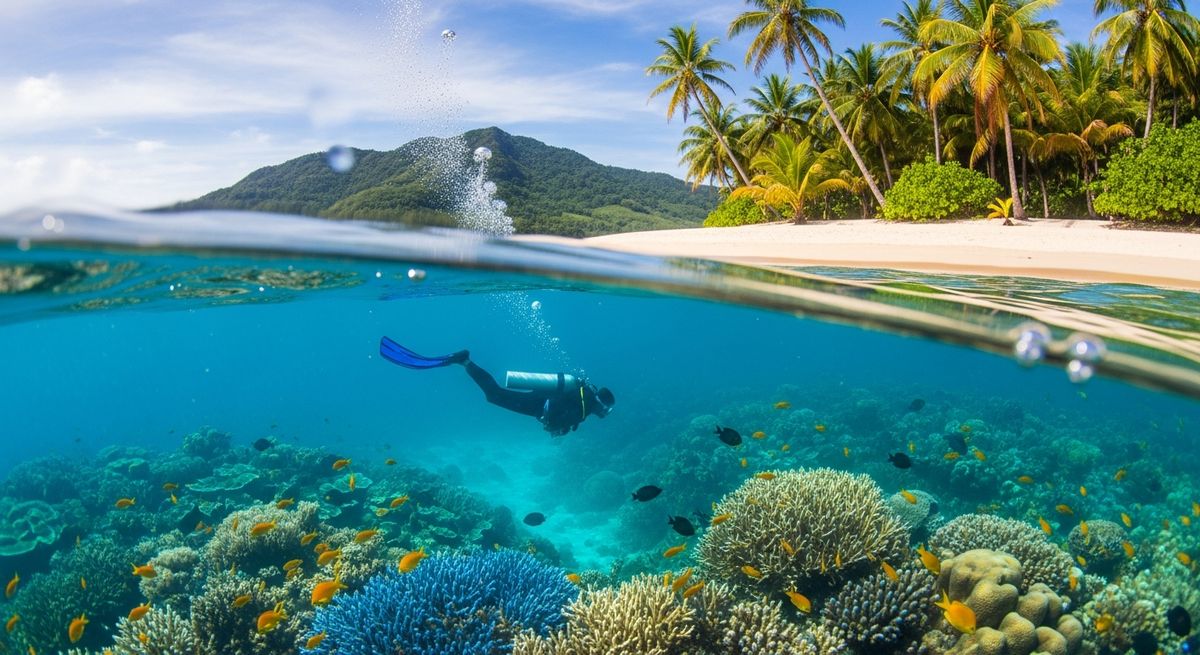
Tombatuni Point - Iron Bottom Sound

Medes Islands. Now this place, it’s special. We’re talking about Spain’s premier marine reserve, and it really shows. You drop down and immediately notice the sheer density of fish. It’s not just a few stragglers; we’re talking about massive groupers, the kind that don’t even flinch when you swim past. They’ve grown accustomed to divers over decades of protection, which is a rare treat in the Med. Our favourite spot here has to be one of the walls, just thick with gorgonians, reds and yellows popping against the blue. You’ll find moray eels peeking out from every crevice and barracuda schools cruising by in formation. We even spotted a few butterfly blennies darting around the Devonshire cup corals. The visibility can be variable, but even on an average day, the sheer volume of life makes up for it. It suits divers who appreciate a healthy, protected ecosystem and aren’t afraid of a bit of current now and then. Go early to beat the crowds; it gets busy, but for good reason.

Location
Iron Bottom Sound, Solomon Islands, Central & South Pacific
Coordinates
-8.339300, 157.383000
Type
reef

Marine Protected Area: Sasavele/NB

Best Time to Dive in Iron Bottom Sound

The warmest water temperatures in Iron Bottom Sound occur in January, averaging 30.5°C. The coolest conditions are in December at 30.5°C.

Monthly Water Temperatures

  • January: 30.5°C (air: 26.9°C)
  • February: 30.5°C (air: 26.7°C)
  • March: 30.5°C (air: 26.7°C)
  • April: 30.5°C (air: 26.8°C)
  • May: 30.5°C (air: 26.9°C)
  • June: 30.5°C (air: 26.5°C)
  • July: 30.5°C (air: 26.5°C)
  • August: 30.5°C (air: 26.3°C)
  • September: 30.5°C (air: 26.5°C)
  • October: 30.5°C (air: 26.7°C)
  • November: 30.5°C (air: 26.7°C)
  • December: 30.5°C (air: 26.9°C)

Nearby Dive Sites in Iron Bottom Sound

Nearest Dive Centres to Tombatuni Point

Marine Life in Iron Bottom Sound

Home to 415 recorded species including 320 reef fish, 29 hard corals, 18 sea snails & nudibranchs, 16 sea cucumbers, 7 seagrass & algae, 5 clams & mussels.

Notable Species

Recommended Packing List for Tombatuni Point

Based on average water temperature of 30.5°C.

  • Shorty or Rashguard - warm 30°C water needs minimal exposure protection
  • Mask - essential for every dive
  • Fins
  • BCD - buoyancy compensator
  • Regulator - your most safety-critical piece of gear
  • Dive Computer - tracks depth, time, and NDL
  • Surface Marker Buoy (SMB) - essential for boat pickups
  • Dive Torch - useful for crevices and colour at depth
  • Underwater Camera - capture your diving memories

Frequently Asked Questions

What is the typical maximum depth for recreational diving at Tombatuni Point?
Tombatuni Point offers recreational diving to a maximum depth of 24 meters. This depth allows divers to explore the vibrant wall, which drops off over 500 meters into the Blanche Channel. Divers can enjoy the rich marine life within these limits at Tombatuni Point.
What kind of marine life and underwater topography can divers expect to encounter at Tombatuni Point?
Divers at Tombatuni Point can expect to encounter stunning underwater topography featuring sheer drop-offs over 500 meters into the Blanche Channel. The wall is adorned with masses of barrel sponges, beautiful soft corals, and fans. Marine life includes an array of colourful and hard-to-find critters, big schools of fish, turtles, rays, and sharks, with the exciting possibility of spotting migrating Hammerheads and other passing pelagics.
What is the difficulty level for diving at Tombatuni Point, and is it suitable for beginner or advanced divers?
Diving at Tombatuni Point is rated as intermediate difficulty. This makes it suitable for divers with some experience, rather than absolute beginners. While not exclusively for advanced divers, experienced divers will certainly appreciate the unique features and marine encounters.
What is the best time of year to dive at Tombatuni Point for optimal weather and underwater conditions?
The provided data does not specify the best time of year to dive at Tombatuni Point for optimal weather and underwater conditions. We recommend checking our When to Dive section for general information on the Solomon Islands.
Are there any specific diving certifications required or highly recommended to dive at Tombatuni Point?
The provided data does not specify any particular diving certifications required or highly recommended for Tombatuni Point. However, as it is an intermediate dive site, divers should ensure they have the appropriate training and experience for such conditions. Always consult with your local dive operator in the Solomon Islands for specific requirements.
What are the prevailing current conditions and average visibility at the Tombatuni Point dive site?
At Tombatuni Point, divers can expect an average visibility of 19 meters, offering clear views of the stunning wall and marine life. The provided data does not specify the prevailing current conditions, so divers should be prepared for potential currents typical of a point dive site. Always check with your dive guide on the day for real-time conditions.