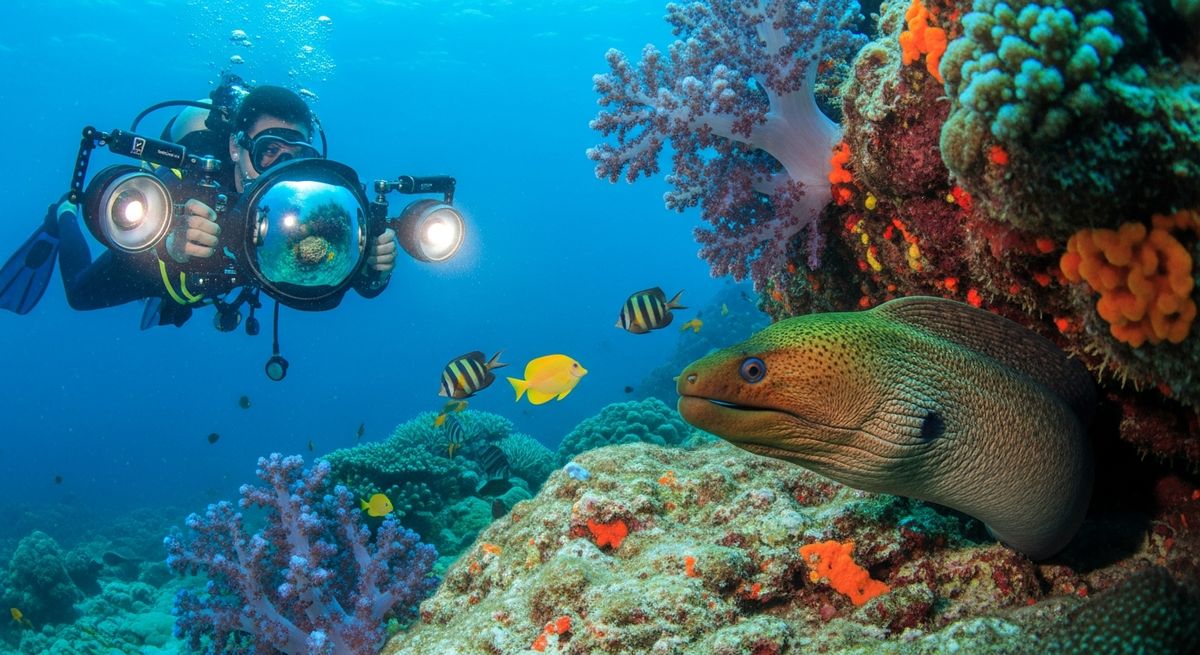
Far North Atolls - Baa Atoll

Venture to Baa Atoll’s far northern reaches, and you’re really getting off the beaten path. This isn't a quick hop from Malé; you’ll be on a seaplane, heading for Haa Alifu and Haa Dhaalu. The payoff? We’ve found reefs here that feel genuinely untouched, full of hard and soft corals painted in surprising colours. Keep an eye out for leopard sharks lounging on the sand, or whitetips patrolling the deeper sections. We’ve also had some lovely encounters with manta rays gliding by, and the occasional giant trevally makes for a thrilling pass. It's a trip for those who value solitude and the feeling of discovery over a bustling dive scene.

Location
Baa Atoll, Maldives, Indian Ocean & East Africa
Coordinates
6.800000, 73.100000

Marine Protected Area: HDh.Finey Thila

Best Time to Dive in Baa Atoll

The warmest water temperatures in Baa Atoll occur in April, averaging 30.4°C. The coolest conditions are in January at 28.5°C.

Monthly Water Temperatures

  • January: 28.5°C
  • February: 28.8°C
  • March: 29.4°C
  • April: 30.4°C
  • May: 30.0°C
  • June: 29.4°C
  • July: 29.4°C
  • August: 29.2°C
  • September: 29.1°C
  • October: 29.1°C
  • November: 29.2°C
  • December: 29.0°C

Nearby Dive Sites in Baa Atoll

Nearest Dive Centres to Far North Atolls

Marine Life in Baa Atoll

Home to 23 recorded species including 12 hard corals, 4 seagrass & algae, 3 reef fish, 1 sharks & rays, 1 whales & dolphins, 1 sea snails & nudibranchs.

Notable Species

Recommended Packing List for Far North Atolls

Based on average water temperature of 29.3°C, currents 24 cm/s.

  • Shorty or Rashguard - warm 29°C water needs minimal exposure protection
  • Mask - essential for every dive
  • Fins
  • BCD - buoyancy compensator
  • Regulator - your most safety-critical piece of gear
  • Dive Computer - tracks depth, time, and NDL
  • Surface Marker Buoy (SMB) - essential for boat pickups
  • Dive Torch - useful for crevices and colour at depth
  • Underwater Camera - capture your diving memories

Frequently Asked Questions

What are the typical diving depths and maximum depths encountered when diving in the Far North Atolls?
The specific typical and maximum diving depths for the Far North Atolls are not detailed in the available information. However, as a reef diving area, depths can vary significantly depending on the specific dive site and profile.
What kind of marine life and coral formations can divers expect to see in the Far North Atolls?
Divers exploring the Far North Atolls can expect to encounter fantastic colourful reefs boasting pristine hard and soft corals. The area is also home to diverse marine life, including shark species like leopard sharks, whitetips, and blacktips, alongside majestic manta rays and impressive giant trevallies.
How challenging are the dive sites in the Far North Atolls, and are they suitable for advanced divers only?
The dive sites in the Far North Atolls are classified as intermediate difficulty. This means they are suitable for divers with some experience beyond entry-level, but not exclusively for advanced divers. Divers should possess good buoyancy control and comfort with varying conditions.
What is the best time of year to dive the Far North Atolls for optimal conditions and marine life sightings?
Information regarding the best time of year to dive the Far North Atolls for optimal conditions and marine life sightings is not provided in the current data. For general guidance on diving in the Maldives, you may consult our When to Dive section.
What scuba diving certifications are required or highly recommended for diving in the Far North Atolls?
Given the intermediate difficulty of diving in the Far North Atolls, a basic open water certification is a prerequisite for all divers. To enhance your experience and comfort with potential currents or deeper sections, an Advanced Open Water certification or equivalent is highly recommended. Always consult with your dive operator for specific requirements.
What are the typical current strengths and surface conditions divers can expect in the Far North Atolls?
The provided data does not specify the typical current strengths or surface conditions divers can expect in the Far North Atolls. However, as an intermediate dive area in the Maldives, divers should generally be prepared for varying conditions, including potential currents.