Klondike - Flic en Flac & West Coast

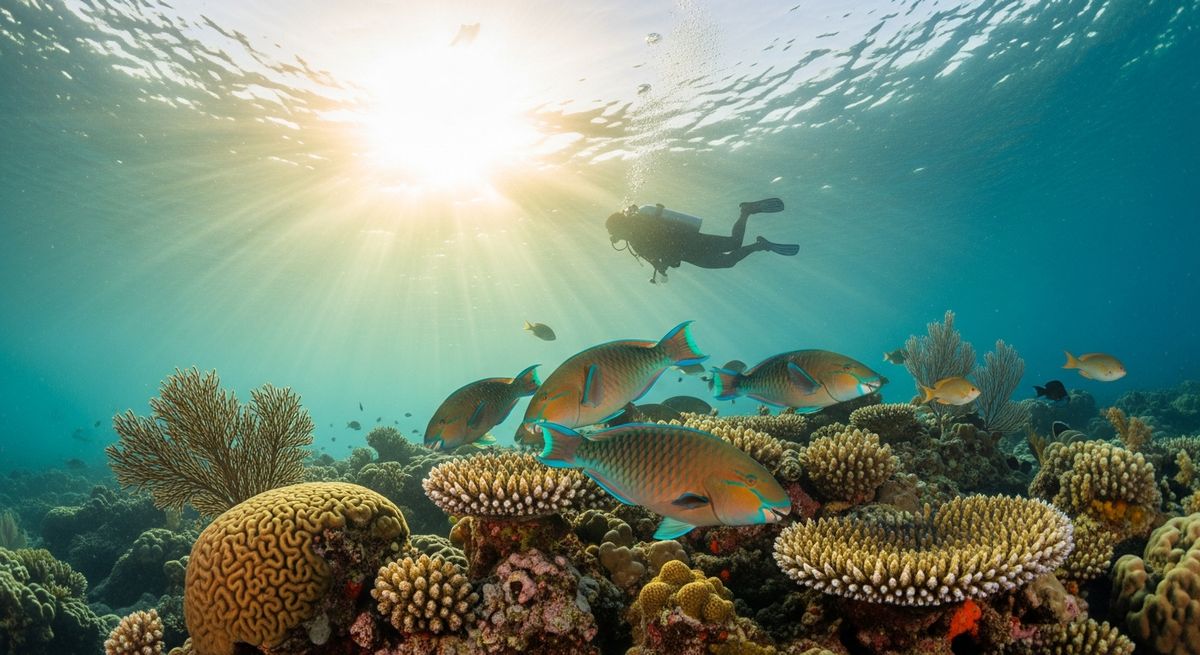
Monkey Head is one of our go-to spots on the Caribbean side, a solid pinnacle dive that rarely disappoints. We love how the topography shifts here, from the deeper sandy channels where you’ll often find reef sharks just chilling, to the shallower coral-encrusted ledges absolutely swarming with fish. Maximum depth is a comfortable 19m, making it a great dive for most skill levels, though you’ll want to keep an eye on the current – it can pick up here. Our favourite part is cruising along the wall, keeping an eye out for the Speckled Scorpionfish, which are masters of disguise against the rock. You'll also see schools of Bumphead Parrotfish munching on the coral, their colours just popping against the blue. Visibility averages around 10m, sometimes better, so it's not a wide-angle dream, but it's perfect for focusing on the details. Look for the Spotted Snake-eels poking their heads out of the sand, or if you’re lucky, a Haller's Round Ray gliding past. It's a busy, lively dive, a real slice of the Caribbean reef.

Location
Flic en Flac & West Coast, Mauritius, Indian Ocean & East Africa
Coordinates
-20.274100, 57.368300
Type
reef

Marine Protected Area: Black River Fishing Reserve

Best Time to Dive in Flic en Flac & West Coast

The warmest water temperatures in Flic en Flac & West Coast occur in January, averaging 28.0°C. The coolest conditions are in December at 28.0°C.

Monthly Water Temperatures

  • January: 28.0°C (air: 27.0°C)
  • February: 28.0°C (air: 27.2°C)
  • March: 28.0°C (air: 27.0°C)
  • April: 28.0°C (air: 26.3°C)
  • May: 28.0°C (air: 25.0°C)
  • June: 28.0°C (air: 23.2°C)
  • July: 28.0°C (air: 22.5°C)
  • August: 28.0°C (air: 22.5°C)
  • September: 28.0°C (air: 23.2°C)
  • October: 28.0°C (air: 24.3°C)
  • November: 28.0°C (air: 25.4°C)
  • December: 28.0°C (air: 26.7°C)

Nearby Dive Sites in Flic en Flac & West Coast

Nearest Dive Centres to Klondike

Marine Life in Flic en Flac & West Coast

Home to 453 recorded species including 314 reef fish, 71 hard corals, 14 sea snails & nudibranchs, 12 sharks & rays, 11 seagrass & algae, 8 whales & dolphins.

Notable Species

Recommended Packing List for Klondike

Based on average water temperature of 28.0°C.

  • Shorty or Rashguard - warm 28°C water needs minimal exposure protection
  • Mask - essential for every dive
  • Fins
  • BCD - buoyancy compensator
  • Regulator - your most safety-critical piece of gear
  • Dive Computer - tracks depth, time, and NDL
  • Surface Marker Buoy (SMB) - essential for boat pickups
  • Dive Torch - useful for crevices and colour at depth
  • Underwater Camera - capture your diving memories

Frequently Asked Questions

What is the typical depth range for diving at Klondike Rocks?
The Klondike dive site features an average depth of 9 meters, making it ideal for various skill levels. Divers can explore down to a maximum depth of 12 meters, which is perfect for beginner divers. You can find more details about this site at Klondike.
What kind of marine life and underwater features can divers expect to see at Klondike Rocks?
Klondike offers a diverse underwater landscape, including fascinating ledges, swim-throughs, and large sand gullies to explore. Divers can also discover shoals of sweepers seeking refuge under rocky outcrops and within small caves. This marine life and varied topography make for an engaging dive at Klondike.
How challenging is diving at Klondike Rocks, especially regarding navigation?
Klondike is widely regarded as an excellent site for students and beginner divers, making it a very accessible experience. While the site description lists the difficulty as intermediate, its average depth of 9 meters and maximum depth of 12 meters are perfect for those new to diving. The varied topography with ledges, swim-throughs, and sand gullies offers interesting exploration without being overly complex at Klondike.
When is the best time of year to dive Klondike Rocks for optimal visibility?
The Klondike dive site typically boasts an excellent average visibility of 18 meters, offering clear views of its underwater features. Unfortunately, specific data regarding the best time of year for optimal visibility at Klondike Rocks is not provided in the available information. For general information on dive seasons, you can visit DivePlnr's When to Dive section.
What scuba diving certifications are recommended or required to dive at Klondike Rocks?
Given that Klondike is popular for students and perfect for all beginner divers, an Open Water Diver certification would be recommended to fully enjoy this site. Its average depth of 9 meters and maximum depth of 12 meters fall well within the limits for entry-level certifications. This makes it an ideal location for those just starting their diving journey in Flic en Flac.
What are the typical current and visibility conditions like at the Klondike Rocks dive site?
Divers at Klondike Rocks can generally expect excellent visibility, with an average of 18 meters, providing clear views of the reef and marine life. However, specific information regarding typical current conditions at this dive site is not available in the provided data. It's always advisable to check local conditions before diving.