WILLIAM HULME
Why dive here
With 46+ marine species recorded in the area - including dolphins, sea turtles and cuttlefish - WILLIAM HULME offers some of Istria Peninsula's richest wreck diving. Water ranges 12-26°C, warmest July, August, September.
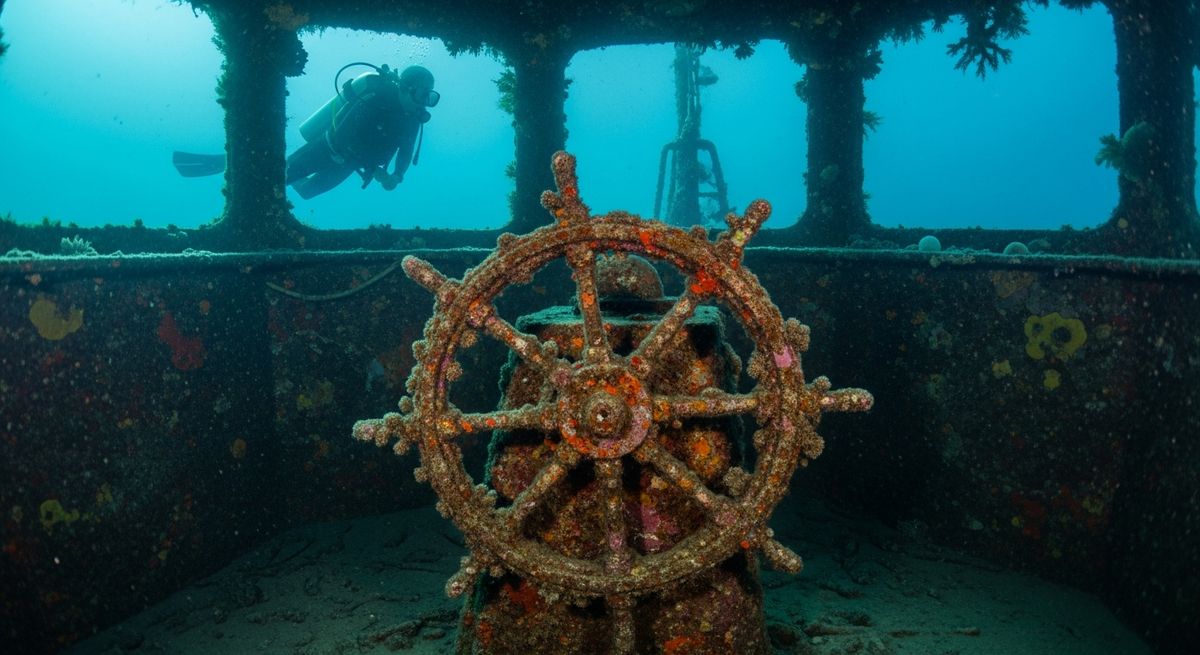
The *William Hulme* is a personal favourite of ours when we're diving Istria, a big Liberty ship lying in such shallow water. We love a wreck where you can really get a sense of its size without having to worry about decompression. She's broken into a few large sections, scattered over a sandy bottom at just 11 metres. You'll spend your dive exploring huge cargo holds, now open to the sun, where schools of damselfish hover in the filtered light. Look closer and you'll spot scorpionfish tucked into the plating and nudibranchs grazing on the abundant hydroids. The bow section, with its distinctive anchor chains and capstans, is particularly photogenic, especially early morning before any dive boat traffic stirs up the visibility. We always find ourselves returning to the stern, where the propeller shaft is still visible, encrusted with colourful sponges. It’s a superb dive for new wreck divers or anyone who just wants a long, relaxed bottom time soaking in the history.
Typical WILLIAM HULME Dive Profile
Illustrative profile based on site depth and type. Actual dive profiles vary - always follow your dive computer and training.
Safety Notes
Wreck site - avoid penetration without wreck diving certification. Watch for sharp metal and entanglement hazards.
Always perform a 3-minute safety stop at 5m before surfacing.
Nearest Dive Centres to WILLIAM HULME
Dive shops near WILLIAM HULME
SCUBA TORTUGA S.S.D. A R.L.
Manta d.o.o., Izola
PLK Koper
Potapljasko drustvo Tiburon
DC DiveStrong
Nemo diving center
Reviews for WILLIAM HULME
Conditions
Ocean conditions, forecast and tides for WILLIAM HULME
WILLIAM HULME Ocean Conditions
Monthly averages for WILLIAM HULME, sourced from Open-Meteo marine data + Copernicus Marine (EU) - nearest station: Open-Meteo marine grid (45.08, 14.15) (21km away)
October Averages
Sea Temperature
20°C
68°F · Range: 18.4–22.3°C
Current Speed
3.16 cm/s
Direction: W (288.4°)
Salinity
37.74 PSU
Based on 4 years of monitoring data · Data sources: Open-Meteo marine data + Copernicus Marine (EU)
Plan & book
Ways to dive Istria Peninsula, from day trips to liveaboards.
Day trips & courses
via GetYourGuideGuided dives, courses and snorkel trips with instant booking.
Find dive trips in Istria PeninsulaPlaces to stay
via Booking.comHotels and dive resorts near Istria Peninsula.
Search stays in Istria PeninsulaDive insurance
Most travel insurance excludes or limits scuba. Check what you need before you go.
Dive insurance explainedPartner links: we may earn a commission if you book, at no extra cost to you. How we make money
Where to Stay near WILLIAM HULME
Prices from Booking.com. We may earn a commission at no extra cost to you.