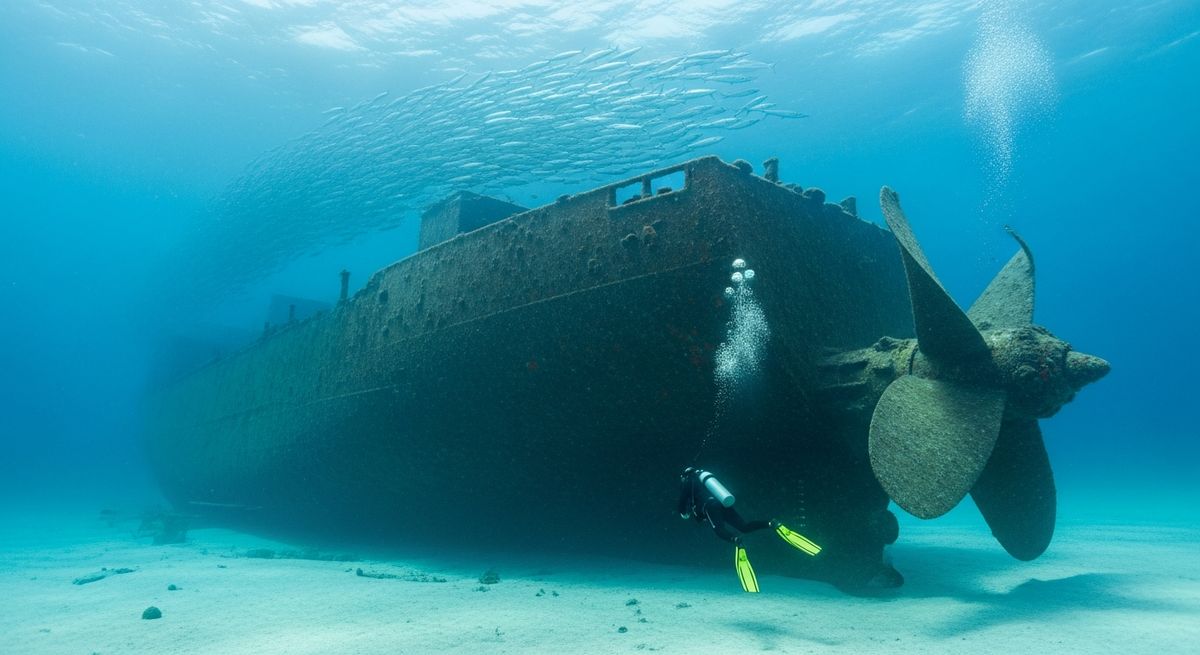
Arado 196 A
Protected Area
MIKRES KYKLADES: IRAKLEIA, SCHOINOUSSA, KOUFONISIA, KEROS, ANTIKERIA KAI THALASSIA ZONI
Why dive here
Arado 196 A is a wreck dive where divers can encounter sea turtles. Water ranges 17-27°C, warmest July, August, September.
Dropping onto the Arado 196 A, you’re not just seeing a wreck; you’re looking at a piece of wartime history resting on the seabed. This German seaplane, shot down in 1941, feels surprisingly complete for its age. We love how its wings are still largely intact, one canted slightly, giving it a real sense of its final moments. The cockpit, stripped bare of instruments, offers a shadowy peek into where the pilot once sat. Keep an eye out for the resident moray eels that often peek from gaps in the fuselage, and the schooling damselfish that shimmer around the tail section. Our favourite part has to be tracing the outline of the float planes underneath, now coated in a thin layer of sponge and small anemones. It's a straightforward dive, well-suited for those who appreciate historical wrecks without the need for intricate penetration. Go slow, take your time to appreciate the details. The real magic here is the story the plane tells, silently, through the clear Cretan water.
Typical Arado 196 A Dive Profile
Illustrative profile based on site depth and type. Actual dive profiles vary - always follow your dive computer and training.
Safety Notes
Depth of 20m - Advanced Open Water certification recommended.
Wreck site - avoid penetration without wreck diving certification. Watch for sharp metal and entanglement hazards.
Always perform a 3-minute safety stop at 5m before surfacing.
Arado 196 A Wreck History
Year Sunk
1943
Vessel Type
aircraft
Cause
unknown
The Arado Ar 196 was a German reconnaissance seaplane and the standard aircraft of the Kriegsmarine throughout World War II. Launched by catapult from battleships and cruisers, these rugged floatplanes were the eyes of the German fleet, used for patrol, submarine-spotting, and light attack roles. Their distinctive design with a large central float and two smaller underwing stabilizing floats made them a common sight over the oceans and seas of the European theatre.
This particular Arado Ar 196, located off the coast of Crete near Heraklion, is believed to have been shot down by Allied aircraft in 1943 during the German occupation of the island. It crashed into the sea not far from the shore, where it has remained for over 70 years. The exact details of its final mission and the fate of its two-man crew are lost to history, but its metal fuselage remains as a silent witness to the fierce air battles fought over the Mediterranean.
As a dive site, the Arado 196 is a fantastic and accessible piece of history. Lying upside-down on a sandy bottom at a depth of just 12 meters, it is perfect for divers of all levels, including beginners. The engine has separated from the main fuselage, allowing for a clear view of its components. Divers can explore the cockpit, wings, and tail section, which have become a small artificial reef for local marine life. Its shallow depth and typically clear water make it an excellent subject for underwater photography.
Nearest Dive Centres to Arado 196 A
Dive shops near Arado 196 A
Meltemi Dive Centre
Go Dive
PAROS DIVING CENTER
Nima
Blue Fin Divers
Cycladic Diving
Reviews for Arado 196 A
Conditions
Ocean conditions, forecast and tides for Arado 196 A
Arado 196 A Ocean Conditions
Monthly averages for Arado 196 A, sourced from Open-Meteo marine data + Copernicus Marine (EU) - nearest station: Open-Meteo marine grid (35.42, 24.79) (35km away)
October Averages
Sea Temperature
24°C
75°F · Range: 22.3–25.7°C
Current Speed
4 cm/s
Direction: S (180°)
Chlorophyll-a
0.086 mg/m³
Very clear (oligotrophic)
Salinity
39.3 PSU
Based on 4 years of monitoring data · Data sources: Open-Meteo marine data + Copernicus Marine (EU)
Plan & book
Ways to dive Crete, from day trips to liveaboards.
Day trips & courses
via GetYourGuideGuided dives, courses and snorkel trips with instant booking.
Find dive trips in CretePlaces to stay
via Booking.comHotels and dive resorts near Crete.
Search stays in CreteDive insurance
Most travel insurance excludes or limits scuba. Check what you need before you go.
Dive insurance explainedPartner links: we may earn a commission if you book, at no extra cost to you. How we make money
Where to Stay near Arado 196 A
Prices from Booking.com. We may earn a commission at no extra cost to you.