BLOSSOM (STERN SECTION)
Protected Area
Lagune de Ghar El Melh et delta de la medjerda
Why dive here
With 156+ marine species recorded in the area - including dolphins, great white sharks, mobula rays (devil rays), octopuses and sea turtles - BLOSSOM (STERN SECTION) offers some of Tabarka's richest wreck diving. Water ranges 16-28°C, warmest July, August, September.
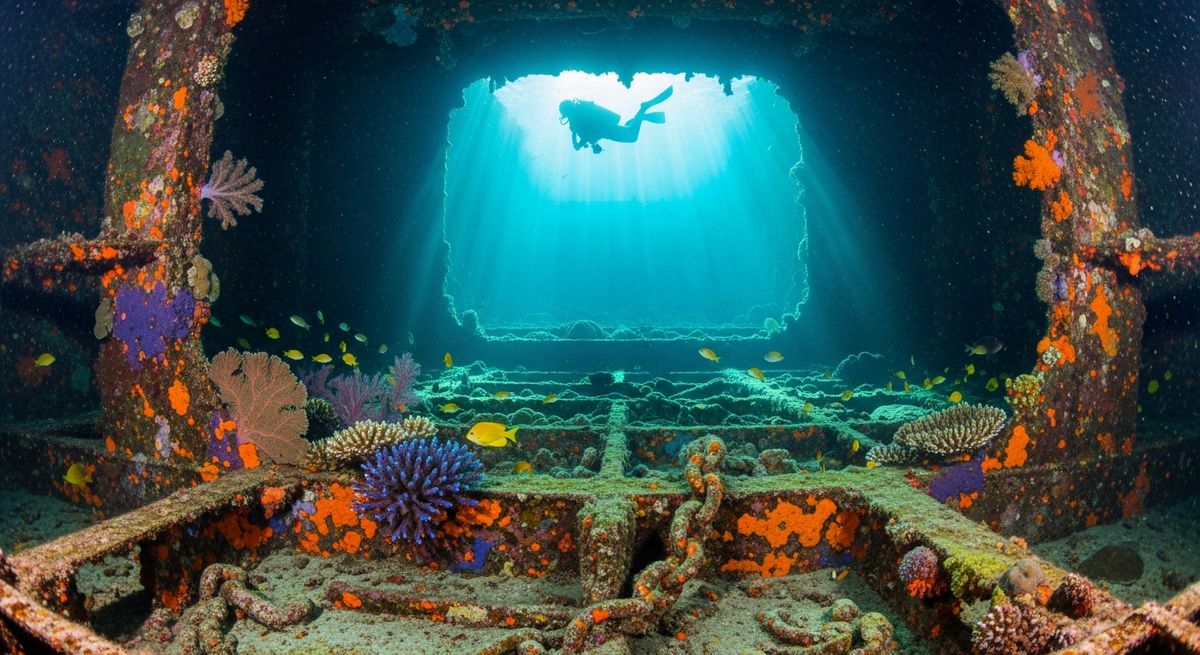
The Blossom’s stern section, resting in a mere 8 metres, is a real favourite of ours in Tabarka. We love how accessible it is, a perfect second dive or even a checkout dive if you’re keen on wrecks. This tanker met a dramatic end in 1981, splitting apart after an explosion, and what remains is a substantial structure. You’ll find the stern upright, a stark silhouette against the often-bright Mediterranean light. We’ve spent hours exploring the prop, huge and covered in growth, and the rudder, which still looks ready to steer. Inside, the engine room is largely open, allowing for some easy swim-throughs – just watch your buoyancy to avoid stirring up the fine silt. Shoals of glinting damselfish often hang around the superstructure, and we’ve regularly spotted octopus tucked into crevices. Keep an eye out for nudibranchs on the metal plates too; the colours can be surprising against the rust. This site suits anyone looking for an easy wreck dive with plenty to see without needing to go deep. It’s got that raw, industrial beauty we appreciate in a wreck.
Typical BLOSSOM (STERN SECTION) Dive Profile
Illustrative profile based on site depth and type. Actual dive profiles vary - always follow your dive computer and training.
Safety Notes
Wreck site - avoid penetration without wreck diving certification. Watch for sharp metal and entanglement hazards.
BLOSSOM (STERN SECTION) Wreck History
Year Sunk
1981
Vessel Type
tanker
Cause
explosion
The tanker Blossom was built in 1959 by Lubecker Flender-Werke A.G. and was owned by the Blossom Shipping Co. at the time of her loss. On January 11, 1981, while on a passage from Port de Bouc, France, to Taranto, Italy, a catastrophic explosion ripped the vessel in half.
The bow section sank immediately, but the stern section remained afloat before eventually sinking. Today, the stern of the Blossom rests in the clear waters off Tabarka, Tunisia. At a very accessible depth of just 8 meters, it's a fantastic site for novice wreck divers and underwater photographers. The shallow depth allows for long, relaxed dives with plenty of natural light to explore the twisted metal and witness the sheer force of the explosion that sent this vessel to its final resting place.
Reviews for BLOSSOM (STERN SECTION)
Conditions
Ocean conditions, forecast and tides for BLOSSOM (STERN SECTION)
BLOSSOM (STERN SECTION) Ocean Conditions
Monthly averages for BLOSSOM (STERN SECTION), sourced from Open-Meteo marine data - nearest station: Open-Meteo marine grid (37.3, 9.6) (20km away)
October Averages
Sea Temperature
24°C
76°F · Range: 23–25.7°C
Air Temperature
23°C
73°F
Wind Speed
8.01 m/s
15.6 knots
Atmospheric Pressure
1017.9 hPa
Based on 4 years of monitoring data · Data sources: Open-Meteo marine data
Plan & book
Ways to dive Tabarka, from day trips to liveaboards.
Day trips & courses
via GetYourGuideGuided dives, courses and snorkel trips with instant booking.
Find dive trips in TabarkaPlaces to stay
via Booking.comHotels and dive resorts near Tabarka.
Search stays in TabarkaDive insurance
Most travel insurance excludes or limits scuba. Check what you need before you go.
Dive insurance explainedPartner links: we may earn a commission if you book, at no extra cost to you. How we make money
Where to Stay near BLOSSOM (STERN SECTION)
Prices from Booking.com. We may earn a commission at no extra cost to you.