BARCELONA (AFTER PART)
Why dive here
BARCELONA (AFTER PART) is a wreck dive where divers can encounter blacktip reef sharks, sea turtles and whale sharks. Water ranges 23-34°C, warmest July, August, September.
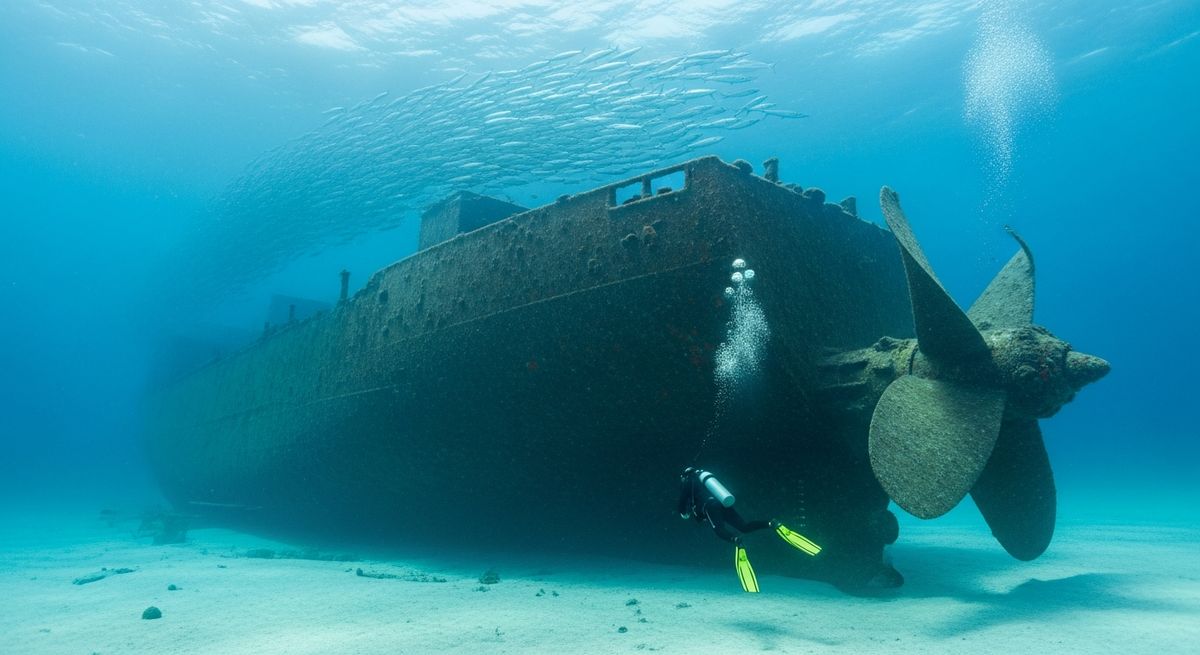
The Barcelona (After Part) offers a proper taste of history, not just another wreck. We’re talking about the stern section of a colossal tanker, attacked by Iraqi aircraft in ‘88. You can feel that drama down here. It sits upright, mostly intact, with huge propeller blades still clinging to the shaft, an incredible sight to circle. We love drifting through the giant engine room, which is surprisingly open and swim-through friendly, light piercing in from various angles. Look out for schools of snapper hanging in the shadows, and we’ve often spotted eagle rays cruising overhead, silhouetted against the surface. It’s an ideal dive for anyone who enjoys wreck penetration that isn’t too demanding, with depths never exceeding 10 metres. This means plenty of bottom time to really explore the structure and appreciate the scale of it all. Visibility can be a bit hit or miss, so we’d suggest aiming for a calm morning; that’s when the light plays best through the decaying metalwork.
Typical BARCELONA (AFTER PART) Dive Profile
Illustrative profile based on site depth and type. Actual dive profiles vary - always follow your dive computer and training.
Safety Notes
Wreck site - avoid penetration without wreck diving certification. Watch for sharp metal and entanglement hazards.
BARCELONA (AFTER PART) Wreck History
Year Sunk
1988
Vessel Type
tanker
Cause
fire
Tonnage
272,300 DWT
The Barcelona was a Spanish-flagged supertanker that met a dramatic end during the final stages of the Iran-Iraq War. On May 15, 1988, while in the Strait of Hormuz, she was struck by an Iraqi Exocet missile. The impact ignited a massive fire that raged for days, turning the colossal vessel into a blazing inferno. The attack was part of the conflict's 'Tanker War,' where both sides targeted oil shipping to cripple the other's economy.
To prevent the 334-meter tanker from sinking and blocking the vital shipping lanes, the crew managed to run her aground on the coast of Fujairah. The intense heat from the fire eventually caused the ship's structure to fail, and the stern section broke away and sank. The forward part of the vessel was later salvaged, leaving the 'after part' behind as a permanent monument to the conflict.
Today, the wreck of the Barcelona's stern lies in just 10 meters of water, making it a highly accessible dive site for all levels of divers. The sheer scale of the wreckage is impressive, with twisted metal and huge sections of the hull providing a complex habitat for marine life. Divers can explore the recognizable stern structures, now encrusted with coral and home to schools of snapper, bream, and the occasional turtle or ray seeking shelter.
Nearest Dive Centres to BARCELONA (AFTER PART)
Dive shops near BARCELONA (AFTER PART)
View all dive centres in FujairahReviews for BARCELONA (AFTER PART)
Conditions
Ocean conditions, forecast and tides for BARCELONA (AFTER PART)
BARCELONA (AFTER PART) Ocean Conditions
Monthly averages for BARCELONA (AFTER PART), sourced from Open-Meteo marine data - nearest station: Open-Meteo marine grid (26.05, 56.06) (1km away)
October Averages
Sea Temperature
32°C
89°F · Range: 30.6–33.5°C
Air Temperature
29°C
85°F
Wind Speed
4.07 m/s
7.9 knots
Atmospheric Pressure
1010.9 hPa
Based on 4 years of monitoring data · Data sources: Open-Meteo marine data
Plan & book
Ways to dive Fujairah, from day trips to liveaboards.
Day trips & courses
via GetYourGuideGuided dives, courses and snorkel trips with instant booking.
Find dive trips in FujairahPlaces to stay
via Booking.comHotels and dive resorts near Fujairah.
Search stays in FujairahDive insurance
Most travel insurance excludes or limits scuba. Check what you need before you go.
Dive insurance explainedPartner links: we may earn a commission if you book, at no extra cost to you. How we make money
Where to Stay near BARCELONA (AFTER PART)
Prices from Booking.com. We may earn a commission at no extra cost to you.