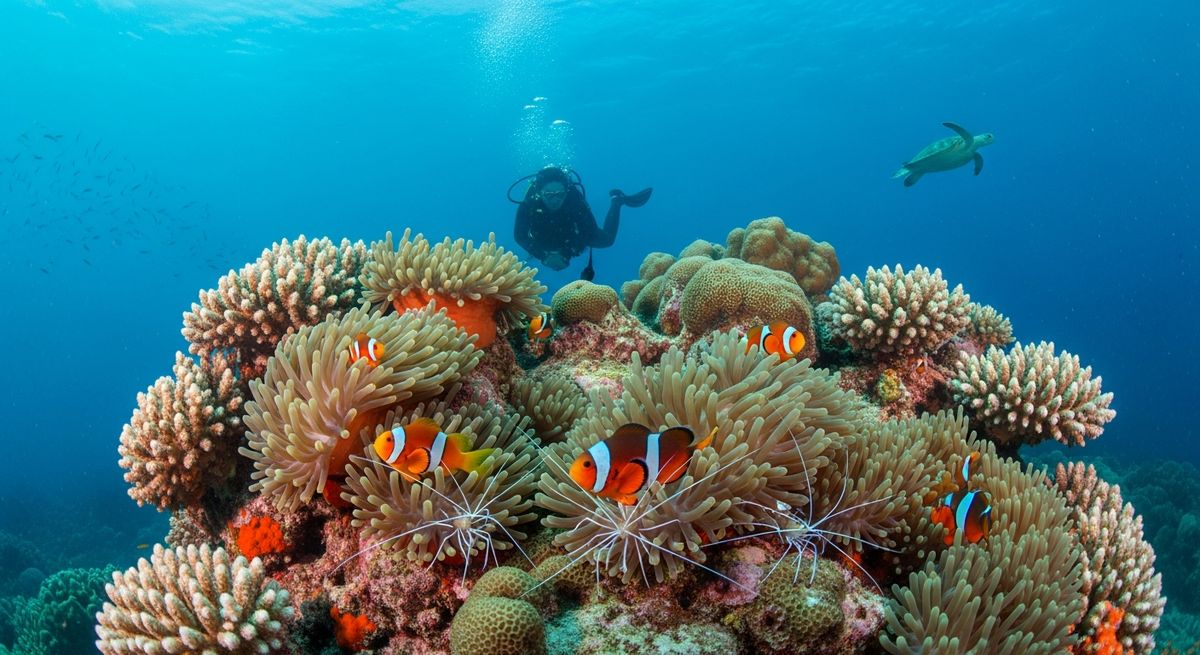
Okay, so ignore that initial data point saying this is on Nusa Penida, because it’s not. We’re talking Lombok, specifically the south coast, and Batupahet is one of our favourites down there. The Rabbit Hole itself is a narrow canyon, a real natural funnel carved into the reef, maxing out around 22 metres. When the current is running, it’s a drift, plain and simple, and you just get swept along, watching the show.
It’s the current that often brings in the bigger stuff; we’ve had some cracking manta sightings here, not in the numbers you might see at a proper cleaning station, but often solitary individuals cruising past, completely unbothered. What we really love, though, are the walls of staghorn coral. They’re just everywhere, forming these incredible, intricate structures. We’ve found Freckled Anglerfish tucked in there, and the odd Whitetip Reef Shark patrolling the edges. Visibility can be a bit variable, sometimes 14 metres, sometimes less, especially if there’s a bit of surge, but that just adds to the atmosphere. It's a site that really suits divers comfortable with a bit of movement, happy to go with the flow and keep an eye out for what drifts by.
Location
Abrolhos, Brazil, South America
Coordinates
-17.853900, -38.658600
Type
reef
Marine Protected Area: Abrolhos Marine National Park
What is the maximum depth of the Naufragio Guadiana dive site?
The Naufragio Guadiana dive site has a maximum depth of 23 meters. This depth makes it accessible for divers with various certification levels, offering a rewarding experience within recreational diving limits.
What kind of marine life and historical artifacts can divers expect to see at the Naufragio Guadiana wreck?
Divers exploring the Naufragio Guadiana can expect to encounter a vibrant artificial reef, complete with coral pinnacles and abundant marine life. Historical artifacts include identifiable parts of the 1885 shipwreck, such as the ship's machines and rudder. A highlight for many divers is spotting the big grouper that resides within the wreck.
What is the difficulty level for diving the Naufragio Guadiana, and is it suitable for beginner divers?
The Naufragio Guadiana is classified with an intermediate difficulty level. Due to this rating, it may not be suitable for absolute beginner divers who are still gaining experience. Divers should have appropriate training and comfort with intermediate conditions.
When is the best time of year to dive the Naufragio Guadiana for optimal visibility and conditions?
The provided data does not specify a "best time of year" for optimal visibility or conditions at the Naufragio Guadiana dive site. However, divers can generally expect an average visibility of 12 meters. For more general information on seasonal diving, you can visit our When to Dive section.
What scuba diving certifications are required or recommended to dive the Naufragio Guadiana?
While specific certification requirements are not explicitly stated, given the Naufragio Guadiana's intermediate difficulty and maximum depth of 23 meters, an Advanced Open Water Diver certification or equivalent is generally recommended. This ensures divers have the necessary skills and experience for deeper dives and potentially varied conditions.
What are the typical water conditions, including currents and visibility, at the Naufragio Guadiana dive site?
At the Naufragio Guadiana dive site, divers can typically expect an average visibility of 12 meters. While the data doesn't explicitly detail current strength, the Abrolhos Archipelago is noted as a "difficult navigation region," suggesting divers should be prepared for potentially varied water movements. Always consult local dive operators for real-time conditions.