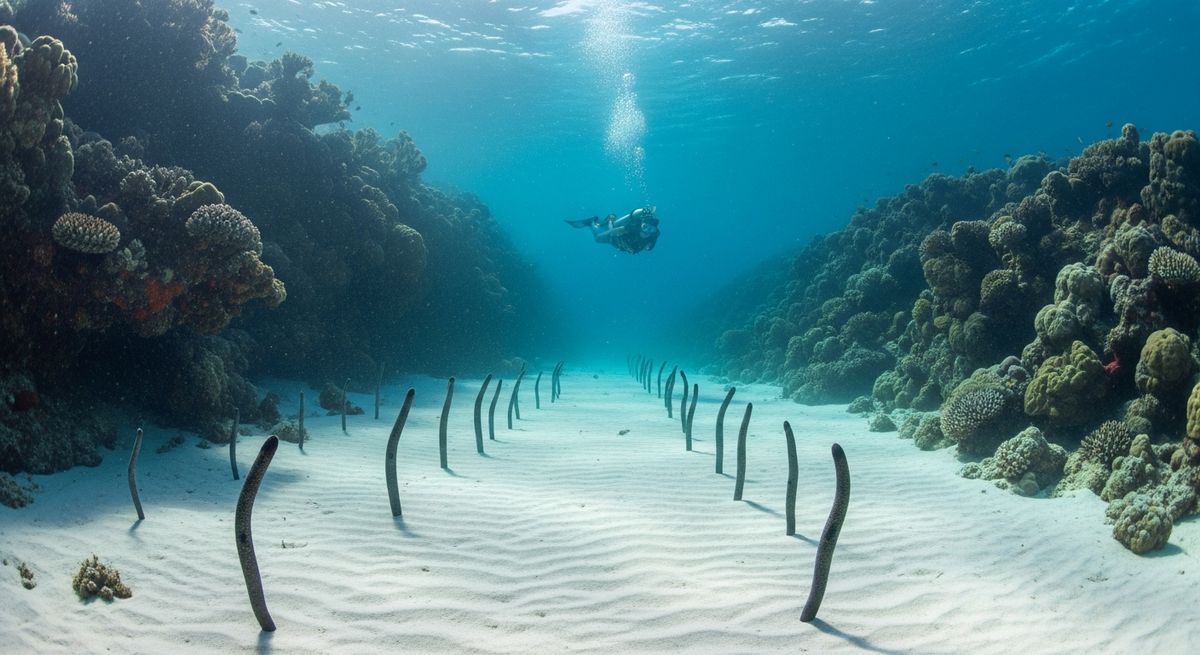
Galapagos fan dive
Why dive here
With 131+ marine species recorded in the area - including dolphins, humpback whales, seals & sea lions, sea turtles and sperm whales - Galapagos fan dive offers some of Galápagos Islands's richest drift diving. Water ranges 23-28°C, warmest February, March, April.
Galapagos Fan Dive, despite its unassuming name, is a site that quickly becomes a favourite. We love it for its quiet surprises, a contrast to some of the more dramatic, adrenaline-fuelled dives here. The current is usually mild, making it a comfortable drift along a rocky slope adorned with some truly impressive gorgonian fans. These aren't just any fans; they’re enormous, some almost as tall as a person, swaying gently, creating a hypnotic dance. Keep an eye out for the smaller residents tucked within these fans. We’ve spotted Player Scorpionfish perfectly camouflaged, and often a couple of Orangeside Triggerfish pecking around the coral. The real treat here, though, is the sheer density of Barberfish and Indian Scad schooling above the reef. Sometimes they’re so thick they create a shimmering wall, parting as you swim through. We’d suggest going in the late morning, after the initial rush, when the sun angles just right to illuminate the colours of the fans. It’s a dive that rewards slow exploration, perfect for photographers or anyone who appreciates the quieter beauty of the Galápagos.
Typical Galapagos fan dive Dive Profile
Illustrative profile based on site depth and type. Actual dive profiles vary - always follow your dive computer and training.
Safety Notes
Drift dive - carry a surface marker buoy (SMB) and stay with your group. Brief the current direction before entry.
Strong currents typical this month (avg 36 cm/s). Good buoyancy control essential.
Always perform a 3-minute safety stop at 5m before surfacing.
Nearest Dive Centres to Galapagos fan dive
Dive shops near Galapagos fan dive
Darwin
Alpha
Galápagos Fun Dive
Blue Evolution
Galaxy Expeditions Corp
Reviews for Galapagos fan dive
Conditions
Ocean conditions, forecast and tides for Galapagos fan dive
Galapagos fan dive Ocean Conditions
Monthly averages for Galapagos fan dive, sourced from Open-Meteo marine data + Copernicus Marine (EU) - nearest station: Open-Meteo marine grid (-0.32, -90.55) (15km away)
October Averages
Sea Temperature
23°C
74°F · Range: 20.2–26°C
Current Speed
36.24 cm/s
Direction: SW (230.6°)
Chlorophyll-a
0.886 mg/m³
Moderate productivity
Salinity
33.88 PSU
Based on 4 years of monitoring data · Data sources: Open-Meteo marine data + Copernicus Marine (EU)
Plan & book
Ways to dive Galápagos Islands, from day trips to liveaboards.
Day trips & courses
via GetYourGuideGuided dives, courses and snorkel trips with instant booking.
Find dive trips in Galápagos IslandsPlaces to stay
via Booking.comHotels and dive resorts near Galápagos Islands.
Search stays in Galápagos IslandsDive insurance
Most travel insurance excludes or limits scuba. Check what you need before you go.
Dive insurance explainedPartner links: we may earn a commission if you book, at no extra cost to you. How we make money
Where to Stay near Galapagos fan dive
Prices from Booking.com. We may earn a commission at no extra cost to you.