Diving in Galápagos Islands
Why dive here
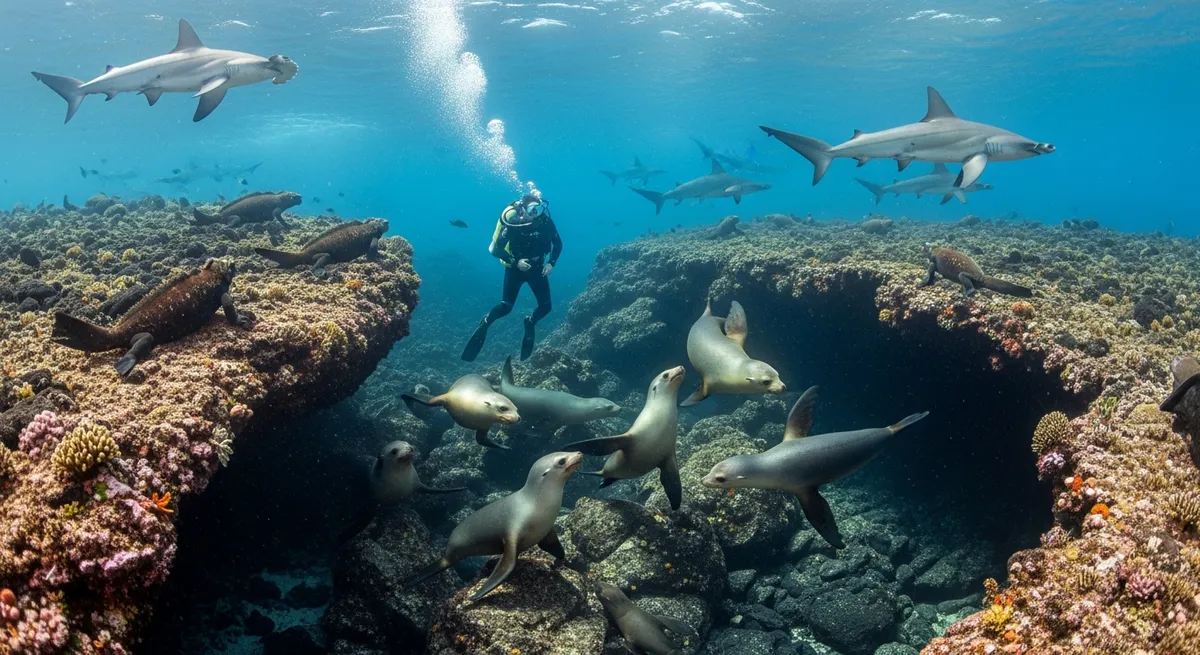
Galápagos Islands offers some of Ecuador's richest diving, with 131+ marine species recorded in the area - including dolphins, humpback whales, seals & sea lions, sea turtles and sperm whales. Water ranges 23-28°C, warmest February, March, April.
The Galápagos. It’s a name that conjures images of ancient evolution, and for good reason. Diving here is less about pretty corals, though you’ll find some lovely spots, and more about the sheer, exhilarating volume of big animals. We’re talking legendary hammerhead schools at Wolf and Darwin, so thick they create a moving wall, a truly humbling sight. We’d suggest a liveaboard to properly experience the remote northern islands; day trips just don’t cut it if you want the full impact. Drift diving is common, and often essential, with currents that can be formidable. But those currents are exactly what brings in the nutrient-rich water, attracting everything from playful sea lions to graceful Galapagos sharks. Keep an eye out for the resident marine iguanas munching algae underwater, a truly bizarre and wonderful spectacle. We’ve had incredible encounters with Mola Mola in cooler months, especially around Gordon Rocks, a site that never disappoints for schooling fish and occasional Galapagos horn sharks. It’s wild, untamed, and exactly what makes it one of our favourite places on the planet. Just be ready for cooler water and be comfortable with some serious current.
Galápagos Islands Dive Site Map
Dive sites and dive centres in Galápagos Islands
Galápagos Islands Dive Sites
85 dive sites in Galápagos Islands
Albany Rock
Albany Rock gives you a good feel for classic Galápagos diving. We often find schooling hammerheads here, sometimes in significant numbers, alongside white-tip reef sharks cruising the current. The site can have strong surges and downcurrents, so it’s best for experienced divers comfortable with these conditions. It's a proper blue water dive, more about the pelagics than the coral.
Bainbridge Rocks
Bainbridge Rocks in the Galápagos is where you go for a bit of a ride. These volcanic pinnacles stick up out of the blue, acting like magnets for some serious pelagic action. Expect a drift dive here, often with strong currents pulling you along, which is exactly why the hammerheads and Galápagos sharks hang around. We’ve seen big schools of fish here too, just cruising in the blue. It’s a site for divers comfortable with current, looking for those bigger encounters rather than intricate reef scenes.
Barranco Cave
Barranco Cave, off San Cristobal, offers a peek into a different side of Galápagos diving. It's not about the big pelagics here, more a deep dive into a geological feature. You’re looking at a cave environment, so expect to navigate some tighter spaces, but nothing overly technical. We usually find nudibranchs, some schooling fish, and lobsters tucked into crevices. Depths range from 23 to 34 metres, making it a good fit for divers comfortable with deeper profiles and overhead environments.
Bartolome and Cousins Rock
Bartolome and Cousins Rock is a good spot for a few reasons. We usually drop onto a series of terraced steps here, descending to about 30 meters, then it slopes to a sandy bottom at 40. The soft black coral is a real highlight, giving you plenty of chances to find Pacific seahorses tucked away. Keep an eye out for whitetip reef sharks resting on the sand, green sea turtles cruising past, and big moray eels peeking from the cracks. If you drift off the steps a bit, you might catch a glimpse of a manta ray or a hammerhead shark passing through. It's a relaxed dive, good for taking your time and spotting the smaller stuff as well as the larger pelagics.
Beagle Rocks
Beagle Rocks, a trio of tuff cone remnants just off Santa Cruz, offers a solid Galápagos dive. You start on a sandy platform around 12 meters, a good spot to get your bearings before the main event: a wall that drops well past 60 meters. Along this descent, you'll find plenty of black coral and sea fans clinging to the rock, with reef fish flitting about. It's a reliable spot for encounters with Galápagos sharks and green sea turtles, and if you’re lucky, a Hammerhead or a passing ray might cruise by in the blue. We'd suggest this site for those comfortable with deeper dives and a bit of current, looking for those classic Galápagos big fish sightings without the more challenging conditions of some northern sites.
Cabo Marshall
Cabo Marshall, way out west from San Cristobal, is the spot for giant mantas in the Galápagos. We've had days there where a half-dozen swept past, silent and huge, and other dives where we were just a bit too early or too late. Even on those quieter days, though, you’re still surrounded by white tips, maybe some hammerheads cruising deeper, and playful sea lions zipping around. It’s a site for those who appreciate the big pelagics and understand that nature runs on its own schedule. We’d suggest focusing on the thermocline breaks; that’s often where the action is.
Café Scuba
Café Scuba, despite its slightly uninspired name, delivers a proper Galápagos punch. We love it for its reliable action, often a good warm-up or cool-down dive from the bigger sites. What really makes it for us, though, is the sheer density of fish. Think schools of Panama sergeant majors and Peruvian mojarras so thick they shimmer like a living wall, parting just enough for you to swim through. It’s not a deep dive, typically staying in the 15-20 metre range, which makes for extended bottom times to watch the show. Look closely in the crevices for Galapagos blennies, they’re masters of camouflage and always a treat. The silvertip sharks cruise through here with a relaxed confidence, giving you plenty of time to observe them before they melt back into the blue. We've even been lucky enough to spot a Cuvier's Beaked Whale on the surface interval once, an incredibly rare sight. Café Scuba is perfect for divers who appreciate sheer fish numbers and the constant hum of the reef rather than dramatic topography.
Cape Douglas
Cape Douglas is where you’ll usually find yourself finning alongside marine iguanas feeding on algae underwater. It’s a unique spectacle, watching them dive, sometimes quite deep, to graze. You might also spot Flightless Cormorants hunting, their distinctive dives a real treat to observe. This site is genuinely a fantastic pick for anyone keen to see the Galápagos's iconic land animals in their underwater element.
Cape Marshall
Cape Marshall is an excellent drift dive along a wall where we often find big schools of barracuda and snappers. Look out into the blue for hammerheads and Galápagos sharks cruising past. The currents can be quite strong, so this site is best suited for experienced divers comfortable with active conditions. It’s a classic Galápagos big animal encounter.
Carawa Shipwreck
Diving the Carawa wreck is a trip back in time, a substantial piece of history sitting upright on the seabed. This Australian transport ship went down in 1920, and even after a century, its 100-metre frame remains impressive. We love exploring the bow and stern sections, especially where the hull has started to collapse, creating swim-throughs for the more adventurous. It’s a proper artificial reef now, with schools of snappers and grunts circling the superstructure, and the occasional whitetip reef shark patrolling the darker cargo holds. The Carawa is a fantastic dive for those who appreciate a wreck with a story, offering enough to explore without being overly complex.
Champion
Champion is a drift dive, often fast-paced, best suited for advanced divers comfortable with currents. Drop in to find schooling hammerheads, often in the deeper sections, and white-tip reef sharks cruising the walls. Keep an eye out for inquisitive sea lions; they'll often buzz divers, playing in the surge. It's a classic Galápagos site, raw and exhilarating.
Champion Islet
Champion Islet, off Floreana, is where we go when we just want to play. Drop in, and you’re pretty much guaranteed an immediate escort from a troupe of sea lions. They dart around, nibble fins, and generally put on a show – it’s a full-on interactive dive, honestly. It's not about big pelagics here, more about the pure joy of being buzzed by curious, clumsy pups. If you're looking for a fun, lively dive rather than a serious deep exploration, this is a top pick.
Show all 85 dive sites in Galápagos Islands
- Champion Rock
- Channel
- Coamaño
- Corona del Diablo
- Cousin Rock
- Cousin's Rock
- Cowley Islet
- Daphne
- Daphne Mayor
- Daphne Minor
- Darwin Bay
- Darwin Island
- Darwin s Arch
- Devil’s Crown Islet
- El Bajo Solmar
- Elizabeth Bay
- Enderby
- Enderby Islet
- Endervy
- Floreana
- Galaisa Adventure Travel Agency
- Galápagos Deep
- Galapagos Diving Adventures at Darwin and Wolf
- Galapagos fan dive
- Galapagos People
- Gardner
- Gardner Islet
- Gordon Rocks
- Gordon's Rock
- Guy Fawkes
- Hancock Bank
- Hat Island
- James Bay
- Kicker Rock
- Kicker Rock / Léon Dormido, San Cristobal, Galapagos
- Landslide
- Landslide Wall
- Leon Dormido
- Los Hermanos
- Macarron Scuba Divers
- Mosquera
- Mosquera Islet
- Nameless Rock
- North Seymour
- Ocho
- Pinaculos
- Pinzon
- Plaza islands
- Plaza Islets
- Plazas
- Punta Albemarle
- Punta Carrion
- Punta Cormoran
- Punta Espinoza
- Punta Estrada
- Punta Morena
- Punta Pitt
- Punta Suarez
- Punta Vicente Roca
- Punta Vincente Roca
- Roca Blanca
- Roca Redonda
- Santa Fe
- Scuba Eden
- Seymour Channel
- Seymour North
- Shark Bay
- Sombrero Chino
- Tagus Cove
- The Rock
- Tortuga Island
- Tower Rock
- Wolf Island
Galápagos Islands Dive Centres
21 dive shops and operators in Galápagos Islands
Academy Bay Diving
Alpha
Blue Evolution
Darwin
Dive Center Silberstein
Eagleray Galapagos Diving
Galaisa Adventure Travel Agency
GALAPAGOS AGGRESSOR III
Show all 21 dive centres in Galápagos Islands
Ocean Wildlife in Galápagos Islands
131 species recorded in Galápagos Islands
Galápagos Islands Daylight & Sunrise/Sunset
Sunrise and sunset times for Galápagos Islands, calculated from coordinates
Today - Sunday 11 October
Sunrise
05:47
Sunset
17:54
Daylight
12h 7m
Golden Hour
17:26
First light (dawn) at 05:26 · Last light (dusk) at 18:15
Monthly Averages
| Month | Sunrise | Sunset | Daylight |
|---|---|---|---|
| Jan | 06:08 | 18:17 | 12h 8m |
| Feb | 06:14 | 18:22 | 12h 8m |
| Mar | 06:09 | 18:16 | 12h 7m |
| Apr | 06:00 | 18:07 | 12h 6m |
| May | 05:57 | 18:03 | 12h 6m |
| JunShortest | 06:01 | 18:07 | 12h 6m |
| Jul | 06:06 | 18:12 | 12h 6m |
| Aug | 06:05 | 18:11 | 12h 6m |
| Sep | 05:56 | 18:02 | 12h 7m |
| OctNow | 05:46 | 17:53 | 12h 7m |
| Nov | 05:44 | 17:52 | 12h 8m |
| DecLongest | 05:54 | 18:03 | 12h 8m |
Times are approximate local times based on longitude. Actual times may vary slightly depending on the exact timezone observed in Galápagos Islands.
Where to Stay near Galápagos Islands
Prices from Booking.com. We may earn a commission at no extra cost to you.
Marine Protected Areas near Galápagos Islands
3 protected areas near Galápagos Islands - please respect local regulations when diving
Galápagos
Archipielágo de Colón (Galápagos)
Humedales del Sur de Isabela
Getting to Galápagos Islands
Isla Baltra
Plan & book
Ways to dive Galápagos Islands, from day trips to liveaboards.
Day trips & courses
via GetYourGuideGuided dives, courses and snorkel trips with instant booking.
Find dive trips in Galápagos IslandsPlaces to stay
via Booking.comHotels and dive resorts near Galápagos Islands.
Search stays in Galápagos IslandsDive insurance
Most travel insurance excludes or limits scuba. Check what you need before you go.
Dive insurance explainedPartner links: we may earn a commission if you book, at no extra cost to you. How we make money