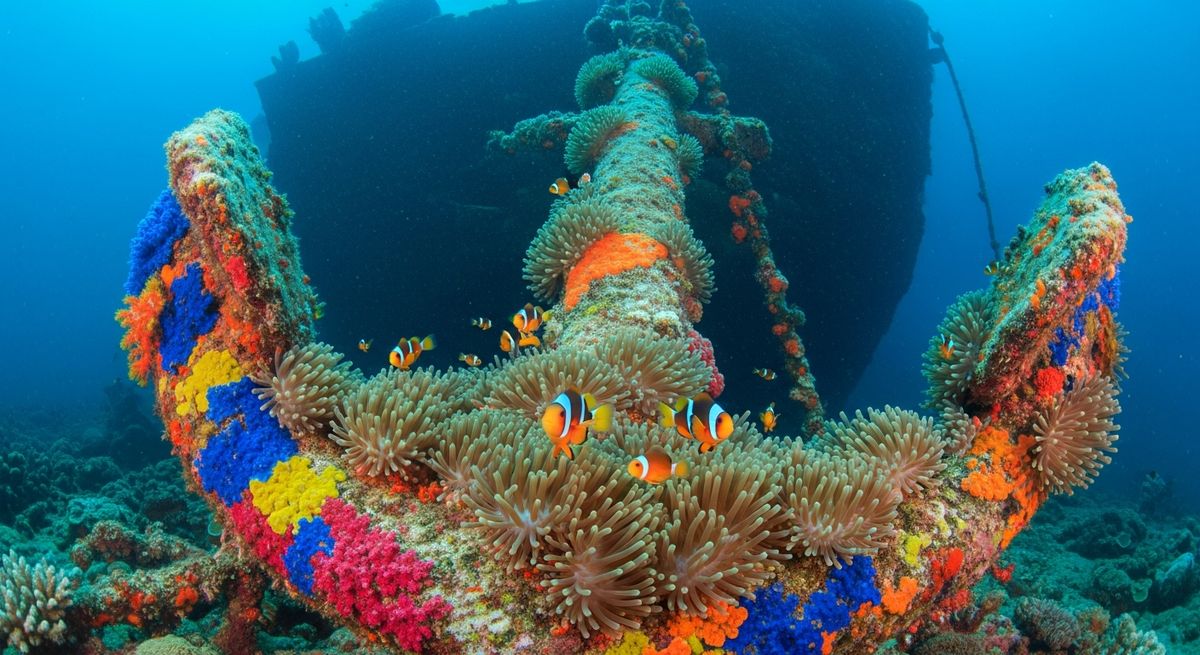
BLACK SAND I
Protected Area
Puntilla de Santa Elena
Why dive here
With 145+ marine species recorded in the area - including blue whales, dolphins, humpback whales, manta rays and mobula rays (devil rays) - BLACK SAND I offers some of Isla de la Plata's richest wreck diving. Water ranges 25-28°C, warmest February, March, April.
Black Sand I isn't a colourful reef, but we love it for its moody, almost eerie charm. This is a wreck dive, pure and simple, and it delivers. We’re talking about a bulk carrier, built in the US back in ‘71, now resting easy at 11 metres. It sat at anchor for two years before finally going down, making it more of a gentle sinking than a dramatic end. You’ll find its masts still reaching up, skeletal fingers breaking the surface on calm days. Below, the hull is a dark silhouette against the sand, and it’s surprisingly intact, considering its age. The real magic happens inside, or rather, on what’s left of the structure. The nooks and crannies are packed with life: schools of grunts drift through the cargo holds, and often, we’ve spotted giant hawkfish perched on beams, watching us pass. Look closely at the metal plates and you’ll see delicate nudibranchs, tiny pops of colour against the dark steel. It’s a photographer's dream for wide-angle shots with an atmospheric feel. This site suits divers who appreciate history and don't need a riot of colour to be captivated.
Typical BLACK SAND I Dive Profile
Illustrative profile based on site depth and type. Actual dive profiles vary - always follow your dive computer and training.
Safety Notes
Wreck site - avoid penetration without wreck diving certification. Watch for sharp metal and entanglement hazards.
Always perform a 3-minute safety stop at 5m before surfacing.
BLACK SAND I Wreck History
Vessel Type
cargo ship
Cause
unknown
Built in 1971 by Albina Engineering & Machinery Works in Portland, Oregon, the "Black Sand I" was a bulk carrier that ended its career in the Pacific waters of Ecuador. Prior to its sinking, the vessel had been laid up at anchor for two years near Isla de la Plata. The exact cause of its loss is not well-documented, but it's likely that after years of inactivity, the ship succumbed to neglect, weather, or slow decay, eventually slipping beneath the waves.
Resting at an accessible depth of 11 meters, the Black Sand I has become a fantastic artificial reef. Located off Isla de la Plata, an area renowned for its rich biodiversity and often called the "Poor Man's Galapagos," the wreck attracts an impressive array of marine life. Divers can explore the ship's structure, now colonized by corals and home to large schools of fish, rays, and sea turtles. Its shallow depth and the vibrant ecosystem make it a rewarding dive for all certification levels.
Nearest Dive Centres to BLACK SAND I
Dive shops near BLACK SAND I
View all dive centres in Isla de la PlataReviews for BLACK SAND I
Conditions
Ocean conditions, forecast and tides for BLACK SAND I
BLACK SAND I Ocean Conditions
Monthly averages for BLACK SAND I, sourced from Open-Meteo marine data + Copernicus Marine (EU) - nearest station: Open-Meteo marine grid (-1.94, -80.79) (26km away)
October Averages
Sea Temperature
25°C
76°F · Range: 23.5–25.9°C
Current Speed
2.24 cm/s
Direction: NE (63.4°)
Chlorophyll-a
0.733 mg/m³
Moderate productivity
Salinity
33.26 PSU
Based on 4 years of monitoring data · Data sources: Open-Meteo marine data + Copernicus Marine (EU)
Plan & book
Ways to dive Isla de la Plata, from day trips to liveaboards.
Day trips & courses
via GetYourGuideGuided dives, courses and snorkel trips with instant booking.
Find dive trips in Isla de la PlataPlaces to stay
via Booking.comHotels and dive resorts near Isla de la Plata.
Search stays in Isla de la PlataDive insurance
Most travel insurance excludes or limits scuba. Check what you need before you go.
Dive insurance explainedPartner links: we may earn a commission if you book, at no extra cost to you. How we make money
Where to Stay near BLACK SAND I
Prices from Booking.com. We may earn a commission at no extra cost to you.