BINTANAH
Protected Area
PKK-003 Bangkalan
Why dive here
With 515+ marine species recorded in the area - including barracuda, blue-spotted stingrays, bull sharks, giant moray eels and manta rays - BINTANAH offers some of Bali's richest wreck diving. Water ranges 29-31°C, warmest April, May, November.
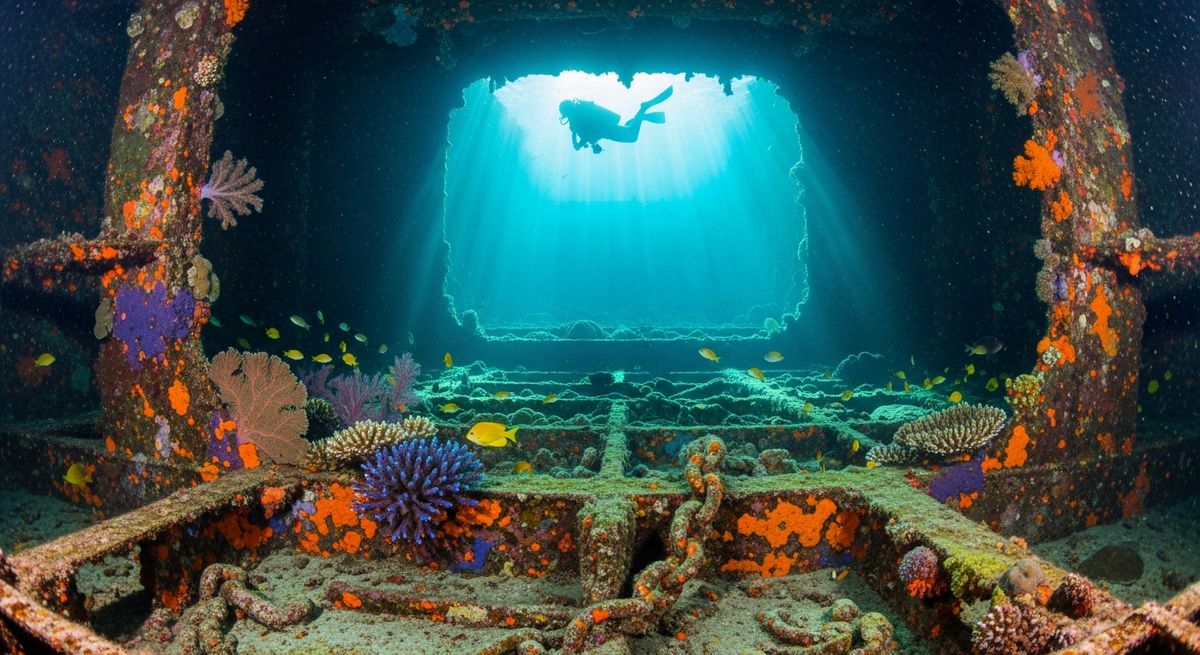
Bintanah isn’t one of those sprawling wrecks you can spend an hour on. This tugboat, lost back in ’92 after a towing mishap, sits upright, broken into two main sections at a comfortable 12 metres. It’s pretty heavily colonised now, which we love; the metal has completely disappeared under a thick carpet of soft corals, sponges, and gorgonians. Look closely, and you’ll spot nudibranchs, often some of the flashier chromodorid species, tucked into the crevices. We’ve found pygmy seahorses here a few times, clinging to the gorgonian fans, but you need a sharp eye and a patient guide. The intact propeller is a particular favourite of ours, usually surrounded by schools of glassfish shimmering in the ambient light. It’s a gentle dive, perfect for photographers or those looking to hone their buoyancy without worrying about deep deco limits. Even though it's classified as a dangerous wreck, it’s mostly just a low-lying structure now, more reef than hazard.
Typical BINTANAH Dive Profile
Illustrative profile based on site depth and type. Actual dive profiles vary - always follow your dive computer and training.
Safety Notes
Wreck site - avoid penetration without wreck diving certification. Watch for sharp metal and entanglement hazards.
Always perform a 3-minute safety stop at 5m before surfacing.
BINTANAH Wreck History
Year Sunk
1992
Vessel Type
tugboat
Cause
unknown
The Bintanah was a hardworking tugboat whose career ended in a sudden and dramatic fashion on December 8, 1992. The tug was engaged in the powerful and dangerous task of towing the massive tanker 'Rantau/Permina 1007' when the towline parted under the immense strain. The instantaneous release of tension caused the small but mighty tug to become unstable, and it quickly capsized and sank beneath the waves. It was a stark reminder of the unforgiving nature of the sea and the risks involved in maritime work.
Resting in just 12 meters of water, the Bintanah is now one of Bali's most accessible and enjoyable wreck dives. Its shallow depth and typically calm conditions make it perfect for novice divers, photographers, and those on a second dive of the day. The tug sits upright on the sandy bottom and is fully intact, allowing divers to easily explore its wheelhouse, deck, and propeller. Despite its relatively recent sinking, it has been thoroughly colonized by marine life, with vibrant corals growing on its surfaces and schools of reef fish, frogfish, and nudibranchs making it their home.
Nearest Dive Centres to BINTANAH
Dive shops near BINTANAH
View all dive centres in BaliReviews for BINTANAH
Conditions
Ocean conditions, forecast and tides for BINTANAH
BINTANAH Ocean Conditions
Monthly averages for BINTANAH, sourced from Open-Meteo marine data + Copernicus Marine (EU) - nearest station: Open-Meteo marine grid (-7.5, 113.18) (20km away)
October Averages
Sea Temperature
30°C
86°F · Range: 28.3–31.6°C
Current Speed
4 cm/s
Direction: E (90°)
Salinity
32.94 PSU
Based on 4 years of monitoring data · Data sources: Open-Meteo marine data + Copernicus Marine (EU)
Plan & book
Ways to dive Bali, from day trips to liveaboards.
Day trips & courses
via GetYourGuideGuided dives, courses and snorkel trips with instant booking.
Find dive trips in BaliPlaces to stay
via Booking.comHotels and dive resorts near Bali.
Search stays in BaliDive insurance
Most travel insurance excludes or limits scuba. Check what you need before you go.
Dive insurance explainedPartner links: we may earn a commission if you book, at no extra cost to you. How we make money
Where to Stay near BINTANAH
Prices from Booking.com. We may earn a commission at no extra cost to you.