Diving in Bali
Why dive here
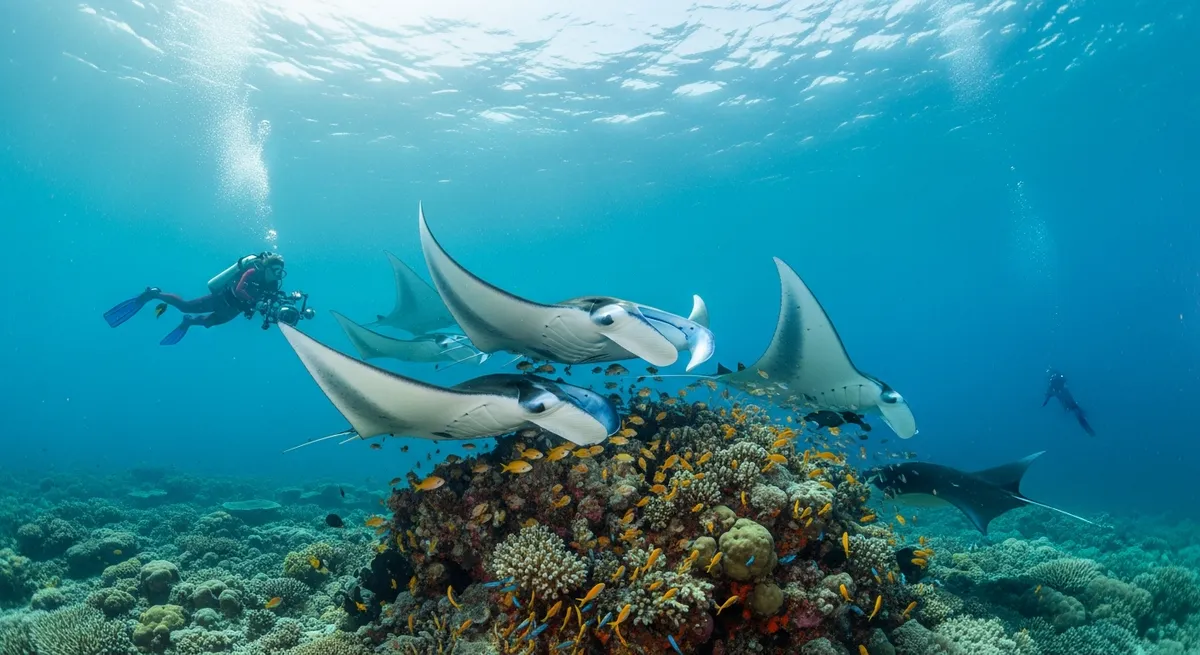
Bali offers some of Indonesia's richest diving, with 515+ marine species recorded in the area - including barracuda, blue-spotted stingrays, bull sharks, giant moray eels and manta rays. Water ranges 29-31°C, warmest April, May, November.
Bali diving feels like choosing your own adventure. We’ve had incredible luck with the USAT Liberty wreck at Tulamben - a shallow-water behemoth that’s just begging for exploration. You can spend an entire dive just circling its bow, watching the schools of fusiliers swirl so thick they block out the sun, or hunting for those tiny pygmy seahorses clinging to the gorgonians. Our favourite time there is early morning, before the day boats arrive, when the light filters through the structure and casts long, dancing shadows. Then you’ve got Nusa Penida, a completely different beast. It’s where we go for the big stuff. The drift dives around Crystal Bay and Manta Point are exhilarating - sometimes a bit of a washing machine, but that’s the price you pay for seeing a manta ray glide silently over your head, its wingtips almost brushing you. We’d suggest going between July and October for the best chance of spotting a Mola Mola at depth, though a few years back we saw one at just 15 metres, massive and serene, just off a rocky outcrop. Keep an eye out for the smaller critters too - we’ve often spotted Seastar Shrimp tucked into anemones on the reef flats when the current eases. It’s busy, yes, but the sheer variety keeps us coming back.
Bali Dive Site Map
Dive sites and dive centres in Bali
Bali Dive Sites
220 dive sites in Bali
Air Kecil Island
Air Kecil Island offers a decent coral reef in Bali. We’ve found it’s a good spot for a relaxed dive, especially if you’re looking to get away from the busier areas. Expect to see some of the usual reef fish, like angelfish and parrotfish, cruising among the hard corals. It’s a solid choice for newer divers or those who just want an easy afternoon in the water.
AKISHIO
Akishio, a tug vessel resting at 40 metres, is a serious dive, one we think experienced wreck enthusiasts will really appreciate. She's not a huge wreck, just 23 metres long, but what she lacks in size she makes up for in character. Dropping down, the first thing you notice is the way light filters through the superstructure, creating these shafts you can swim through. Inside the wheelhouse, the controls are still eerily intact, encrusted with sponges, a real nod to her history as a dangerous wreck. We’ve seen some hefty dogtooth tuna circling overhead and we always keep an eye out for resident whitetip reef sharks resting on the sand nearby. Penetration is possible for trained divers, the engine room is our favourite part, though it’s a tight squeeze. The currents can pick up here, so we always plan this dive for slack tide to really savour the details. It's a deep, dark dive, but the sense of exploration and the surprisingly robust marine life makes it a standout for us.
ALKEN PENDA
Alken Penda sits right off the shore, a shallow wreck that’s perfect for a second dive or even a snorkel. We love how accessible it is. You can practically swim to it from the beach, and with a maximum depth of two metres, it’s a site where you really don't need to rush. The wreck itself is a small wooden fishing boat, mostly intact, though time and the ocean have started to open it up. What we really enjoy here is seeing how quickly life reclaims things. Schools of juvenile snapper often dart between the timbers, and if you look closely, you’ll spot nudibranchs inching across the hull. We’ve even seen small reef sharks cruise by on occasion, which is always a surprise in such shallow water. It’s a gentle exploration, well suited for photographers wanting to practice close-up shots without the pressure of depth or currents. Our favourite part is watching the light play through the mast, creating these beautiful, shifting patterns on the sandy bottom.
All 4 Diving Indonesia
All 4 Diving Indonesia, right here in Bali, offers up a pretty fascinating collection of encounters, a spot we often find ourselves recommending for divers who appreciate the smaller, more unusual finds. Forget your big pelagic hunters here, this place is about getting down and dirty, really looking into the nooks and crannies. We’ve spent dives here just hovering, watching the peculiar dance of the Humpbacked conch, or trying to spot the notoriously shy Indonesian Shortsnout Spurdog tucked away in the sand. Our favourite time to dive this site is mid-morning, just after the initial rush, when the light starts to filter down, illuminating the subtler hues. Keep an eye out for Zonetail Butterfly Rays gliding low over the bottom, their patterns almost blending with the sand. And if you’re patient, you might even catch a glimpse of a Coral catshark, usually curled up and resting. We’d suggest this site for anyone who enjoys a slow, deliberate dive, those who love macro photography, or divers keen to tick off some truly unique species from their logbook. It’s a site that rewards observation over speed.
ALPHINE
Alright, let's talk about the Alphine. It's not the grandest wreck in Bali, but we’ve always had a soft spot for it. Lying at a comfortable 19m, this old motor vessel is perfect for a relaxed extended bottom time, making it our favourite choice when we want to just drift and soak it all in. You’ll find the Alphine reasonably intact, a good-sized cargo ship that now feels more like a living reef than a steel hulk. The superstructure is still there, and you can duck into the cargo holds, where sunlight streaks through, illuminating schools of glassfish that swirl like liquid silver. Look closely in the darker corners and you’ll often spot a shy reef shark or a cruising eagle ray passing overhead. We love exploring the bow section; the mast is a magnet for barracuda, and we’ve seen some seriously large groupers lurking under the deck plates. It’s a pretty easy dive, even if you’re newer to wreck diving, and the currents here are generally mild. We’d suggest going in the morning to catch the best light filtering into the holds, it really brings the wreck to life.
Amed wall
The Amed Wall in Bali, well, it’s a bit of a local hero for us. It’s not the biggest, deepest wall you’ll ever dive, but it has this quiet charm that keeps us coming back. You drop in and it just slopes away, covered in branching staghorn and big table corals. We've often found ourselves just drifting, eyes peeled for the little things. It’s an absolute magnet for nudibranchs – we’ve seen bicolor nudibranchs and even the tiny *Costasiella paweli* grazing on algae, if you look close enough. The wall is etched with small ledges and crevices, perfect hiding spots for rosy frogfish or a freckled anglerfish. We particularly love the schooling glassy cardinalfish that shelter in the overhangs, shimmering in the shafts of light. While currents can pick up occasionally, it’s generally a pretty relaxed drift, making it great for photographers who want to take their time. Our favourite time to hit it is early morning, before the dive boats from further afield arrive, when the light is softer and the reef feels like it’s just waking up.
Amed Zen Divers
Amed’s been a bit over-loved lately, but even with the crowds, we still have a soft spot for the Zen Divers site. It’s a good little drift, usually gentle enough that you can just kick back and let the current do the work. What really gets us here is the sheer number of glassfish. You’ll be swimming through schools so thick they practically blot out the sun, a shimmering, pulsing tunnel that just keeps going. Keep an eye out for rosies, the rosy frogfish are pretty common here, tucked into the branch coral or just chilling on the sandy bottom. We've also spotted more than a few elegant sandburrowers doing their thing, and sometimes you’ll catch a slender snake eel poking its head out. The staghorn corals are coming back nicely, too, providing some good shelter for the resident groupers. It’s not the most dramatic reef in Bali, but for a relaxed afternoon drift where you can just immerse yourself in the sheer numbers of small fish, it's our favourite Amed spot. It suits divers who appreciate the quiet beauty of a healthy, recovering reef and those who love watching tiny critters in their natural habitat.
AMUKTI
Amukti, near Padangbai, might just be our favourite little wreck dive in Bali. It’s not a huge wreck, more a motor vessel, sitting upright and mostly intact on a sandy slope, topping out around 15 metres. We love that you can see her entire silhouette from a distance, just begging for a closer look. The real beauty here is how marine life has absolutely taken over. Clouds of glassfish ripple around the wheelhouse, and we’ve often spotted a blue-spotted stingray tucked under the stern. Keep an eye out for moray eels peering from every nook and cranny. The visibility is usually pretty good, making it a comfortable dive for anyone who loves exploring a wreck without deep technical requirements. We’d suggest going in the morning; the light filtering through the water really makes the structure pop. If you’re into photography, the resident lionfish make for some striking portraits against the encrusted hull.
Anchor Wreck
The Anchor Wreck is one of those sites that quietly delivers. It's not the biggest wreck in Bali, but we think it’s one of the most atmospheric. You start in a shallow, sandy patch at around five metres, which gives way to a gentle slope dotted with soft corals before you hit the main event. We’ve always found the visibility here to be reliably good, often pushing past 20 metres, which is a real bonus for photography. The wreck itself, a small wooden fishing boat, lies broken up across the slope, resting at its deepest point around 20 metres. It’s been down there long enough for the structure to become completely encrusted, a patchwork of orange and purple soft corals and some impressive sea fans. Look closely, and you’ll spot yellowstripe monocle bream schooling just above the deck, while red sea butterflyfish flit through the gaps. Our favourite part is peeking under the larger pieces of hull; it’s a good spot for finding moray eels tucked away, and sometimes a grumpy frogfish blending perfectly into the sponges. The resident banded sea krait often makes an appearance, too, slithering gracefully over the coral-covered timbers. This site is fantastic for macro lovers and photographers who appreciate a wreck that feels more like a living reef than an artificial structure. It’s generally a calm dive, making it suitable for newer divers looking for their first wreck experience without strong currents.
Anchor Wreck
The Anchor Wreck is one of those sites we always try to fit in when we're diving Bali, especially if we've got a day to explore Amed's coastline. It’s a fishing boat, maybe 20 metres long, sitting upright on a sandy slope. The interesting bit is how completely it's been taken over by the reef. There are giant gorgonian fans perched on the bow, big schools of glassfish shimmering in the holds, and we've even seen pygmy seahorses tucked into the coral branches. What makes it a standout for us isn't just the wreck itself, but the way light plays through the water here, particularly in the mornings. You get these shafts of sunlight cutting through, illuminating all the soft corals and sponges that have plastered themselves to the hull. Keep an eye out for resident lionfish sheltering under ledges and moray eels poking their heads out from inside the engine room. It's a relaxed dive, usually minimal current, so it’s perfect for photographers or anyone who just wants to take their time exploring a smaller, intimate wreck. Best to hit it early before the day boats get too busy.
Anchor Wreck
The Anchor Wreck is one of those sites that quietly delivers. It's not the biggest wreck in Bali, but we think it’s one of the most atmospheric. You start in a shallow, sandy patch at around five metres, which gives way to a gentle slope dotted with soft corals before you hit the main event. We’ve always found the visibility here to be reliably good, often pushing past 20 metres, which is a real bonus for photography. The wreck itself, a small wooden fishing boat, lies broken up across the slope, resting at its deepest point around 20 metres. It’s been down there long enough for the structure to become completely encrusted, a patchwork of orange and purple soft corals and some impressive sea fans. Look closely, and you’ll spot yellowstripe monocle bream schooling just above the deck, while red sea butterflyfish flit through the gaps. Our favourite part is peeking under the larger pieces of hull; it’s a good spot for finding moray eels tucked away, and sometimes a grumpy frogfish blending perfectly into the sponges. The resident banded sea krait often makes an appearance, too, slithering gracefully over the coral-covered timbers. This site is fantastic for macro lovers and photographers who appreciate a wreck that feels more like a living reef than an artificial structure. It’s generally a calm dive, making it suitable for newer divers looking for their first wreck experience without strong currents.
Ayer Sedang
Ayer Sedang offers a solid coral reef dive in Bali. You'll find a good mix of hard and soft corals, with plenty of reef fish flitting about. It's a comfortable spot for divers looking for a relaxed experience without strong currents or deep profiles. We'd suggest it for an easy second dive or a tranquil afternoon exploration.
Show all 220 dive sites in Bali
- Bali Aqua Diving
- Bali Dive Trek
- Bali International Diving Professionals (BIDP)
- Bali Reef
- Bali Reef
- Bali Scuba
- Bat Cave
- Batu Belah
- BAWEAN EXPRES
- BERKAT KARYA
- Big Fins TecDiving
- BINA SETIA
- BINTANAH
- Bintang Beach Club Dive And Water Sport
- BINTANG HARAPAN DUA
- Blue Corner
- Blue Corner
- Blue Corner
- Blue Hill Dive Site
- Blue Lagoon
- Brunda Reef
- BUANA SEJATI
- BUDI MURNI
- Bulakan
- Cave Point
- CINTA BAHARI
- CIPTA ABADI
- Close Encounters
- Close Encounters
- Coral garden
- Coral Garden
- Coral Garden
- Crocodile Reef
- Crystal Bay
- Crystal Divers
- Deep Blue
- Dewaruci Perkasa
- Diving Spot
- Diving Spot
- Diving Spot
- Diving Spot
- Diving Spot
- Diving Spot
- Diving Spot
- DONGGALA II
- Dream Wall
- Dream Wall
- Drift Divers Nusa Lembonang
- Eddys Park
- ELPAPUTIH
- Emerald
- EX-PURNAMA
- FAJAR INDRAMAYU
- FOMENI WINI I
- Geisterschiff
- Gili Mimpang
- Gili Tepekong North
- Gili Tepekong South
- Glashouse Pemuteran
- Gondolreef
- Gosong Tengah
- Gosong Tengah
- HAM
- Ise Baru
- Jetty House Reef Naya Gawana
- JOURNEY
- KANA BARU
- Kapal Budak
- Karang Ayer
- Karang Betsy
- Karang Congkeh
- Karang Cuka
- Karang Lantung
- Karang Munira
- Karang Rakit Utara
- Karang Rakit Utara
- Karang Satin
- Karang Tohorjantan
- KARYA ABADI
- KAWITAN
- KELAPA
- Kisik Pegemetan
- KLM Arto
- KM JOURNEY
- KM. KTC-1
- KM PERTAMA - 1
- KMP Rafelia 2
- KM. SMS 233
- KM,WIHAN SEJAHTERA
- KRAKATAU
- KUNIA
- Lap 2015
- LAUTAN BERKAT
- LONG MARAK
- Magic Forest
- Mama Dive
- Mandarin Point
- MANGGIS
- Mangrove 2
- Mangrove Point
- Mangrove Point Gawana
- Manta Bay
- Manta Point
- Marta Dive
- MEGA KARYA
- Menjangan - Eel Garden
- Menjangan - Pos 2
- Middle Reef
- Middle Riff
- MITRA SIONTAPINA
- MV IDOLA
- NANTAI 1
- Napoleon Reef
- Napoleon Reef
- Nautilus Diving Bali Shop
- NOER RAHMAT
- Noodles
- NUSANTARA
- OB BUJIBA
- Octagon Reef
- OK snorkeling site
- Orca Diveclub Lovina
- PADI Bali Scuba Masters
- PADI Hammerhead Bali Dive
- Palapa
- Paradise Diving
- PEACH MOUNTAIN
- Ped
- Pemuteran Bio Rock Project
- Pemuteran house reef
- Peti
- pety reef
- PINUS
- Pos 1
- Post I Jetty
- Pulau Dapur
- Puri Jati
- PUTRA BERLIAN XII
- PUTRA BULIAN
- putri menjangan 1
- Putri Menjangan 2
- Pyramids
- R I ULAR SENDOK
- RUHUI RAHAJU I
- SAMUDERA INDAH
- Sandy Slope
- Sandy Slope
- SARI AYU
- SARI REJEKI (POSSIBLY)
- SARI REJEKI (POSSIBLY)
- Sea Garden
- Secret Bay
- Secret Bay
- Seraya Beach Dive Site
- SINAR PAGI
- SURYA NIAGA
- SV TK. UTAMA 9
- SWAKARYA
- Taka Jaran
- Taka Lebar
- Taka Menaum
- Takat Besar
- Takat Bonsa
- Takat Bunginsaor
- Takat Demak
- Takat Duabungin
- Takat Jalue
- Takat Kamboja
- Takat Karangan Besar
- Takat Karangan Kecil
- Takat Kering
- Takat Lemuruan
- Takat Mbomandra
- Takat Pajanlanggar
- Takat Pajantengki
- Takat Panjang
- Takat Parendan
- Takat Patage
- Takat Saebus
- Takat Salarangan
- Takat Sapa
- Takat Silan
- Takat Sitabok Kecil
- Takat Susunan
- Takat Tingkarang
- Takat Tuku
- Tanjung Gelap
- TANTO HARI
- TANTO NIAGA
- Temple Point
- Temple Wall
- Terumbu Karang
- Terumbu Karang
- TIPISON
- TIPISON (POSSIBLY)
- TJILANTJAR
- TORINO
- TRISILA PRATAMA
- TRI STRIA
- TUNDA DJANTERA
- Underwater Cave
- Underwater Shrine
- USAT Liberty Wreck
- UTAMA 9
- VAN DER WIJK
- WAHANA UTAMA V
- Water Walk
- YITRUS
Bali Dive Centres
19 dive shops and operators in Bali
Ocean Wildlife in Bali
515 species recorded in Bali
Bali Daylight & Sunrise/Sunset
Sunrise and sunset times for Bali, calculated from coordinates
Today - Sunday 11 October
Sunrise
06:06
Sunset
18:20
Daylight
12h 14m
Golden Hour
17:52
First light (dawn) at 05:45 · Last light (dusk) at 18:41
Monthly Averages
| Month | Sunrise | Sunset | Daylight |
|---|---|---|---|
| Jan | 06:20 | 18:50 | 12h 30m |
| Feb | 06:30 | 18:51 | 12h 20m |
| Mar | 06:31 | 18:40 | 12h 9m |
| Apr | 06:28 | 18:25 | 11h 57m |
| May | 06:29 | 18:16 | 11h 47m |
| JunShortest | 06:36 | 18:17 | 11h 42m |
| Jul | 06:40 | 18:24 | 11h 44m |
| Aug | 06:35 | 18:27 | 11h 52m |
| Sep | 06:20 | 18:23 | 12h 3m |
| OctNow | 06:04 | 18:20 | 12h 15m |
| Nov | 05:57 | 18:24 | 12h 27m |
| DecLongest | 06:05 | 18:38 | 12h 33m |
Times are approximate local times based on longitude. Actual times may vary slightly depending on the exact timezone observed in Bali.
Where to Stay near Bali
Prices from Booking.com. We may earn a commission at no extra cost to you.
Marine Protected Areas near Bali
18 protected areas near Bali - please respect local regulations when diving
PKK-001 Sumenep
KK Pulau Panjang
KK Buleleng
Meru Betiri
Bali Barat
Baluran
PKK-043 Banyuwangi
PKK-026 Situbondo
PKK-007 Sampang
PKK-114 Malang
PKK-003 Bangkalan
PKK-059 Pamekasan
Showing 12 largest of 18
Getting to Bali
Surabaya
Kediri
Kuta, Badung
Plan & book
Ways to dive Bali, from day trips to liveaboards.
Day trips & courses
via GetYourGuideGuided dives, courses and snorkel trips with instant booking.
Find dive trips in BaliPlaces to stay
via Booking.comHotels and dive resorts near Bali.
Search stays in BaliDive insurance
Most travel insurance excludes or limits scuba. Check what you need before you go.
Dive insurance explainedPartner links: we may earn a commission if you book, at no extra cost to you. How we make money