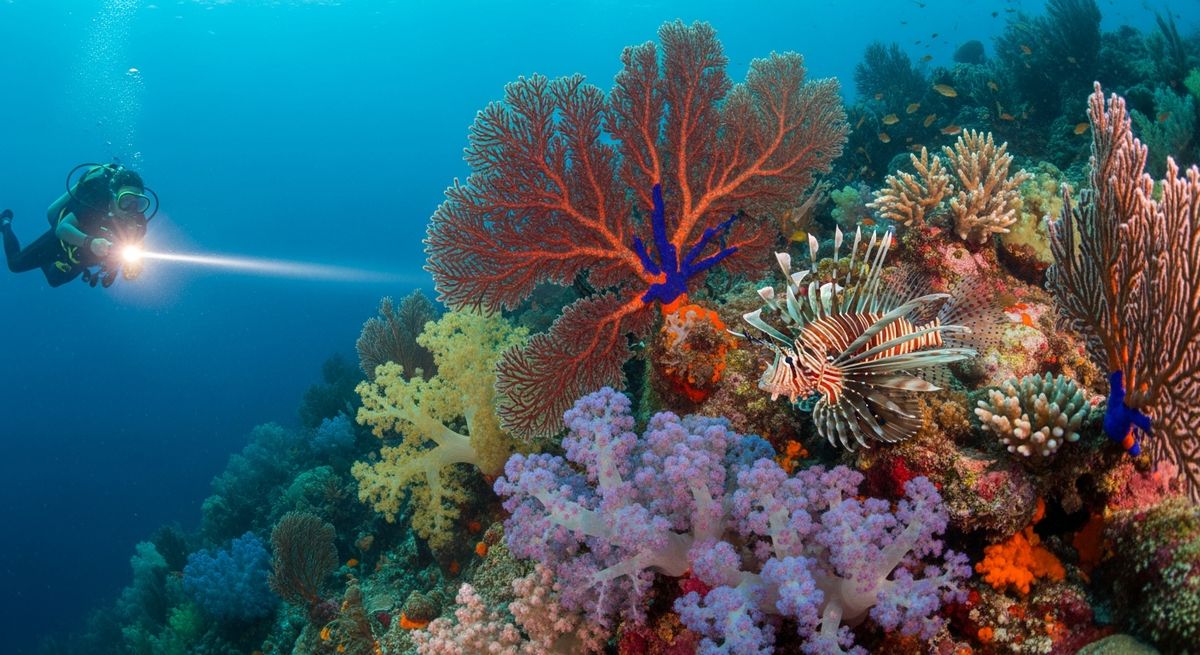
Takat Tuku - Bali
Bajo Caribana is classic Malpelo: a seamount that just begs for a strong current to really switch it on. We've often found ourselves hanging in the blue here, waiting for the surge to bring in the magic. What we love most about this site isn't just the sheer number of sharks, though they certainly deliver. It's the smaller, more unusual stuff that really sets Bajo Caribana apart, if you're patient enough to spot it. Look closely and you'll find Red Scorpionfish tucked into crevices, almost invisible against the rock. We've spent whole dives just trying to tick off the different gobies here – the Goldspot and White-eye are particularly charming. And those Eight-ray Finger Corals provide perfect hiding spots for things like the Lofty Triplefin. Our favourite moments usually involve a school of Hogfish cruising past, chunky and confident, or seeing a Bluespotted Searobin darting along the bottom. This site is for divers who appreciate the big pelagics but are also happy to slow down and scour every inch for the rare and unusual. It’s not always an easy dive, often with a decent push, but the rewards are always worth the effort.
- Location
- Bali, Indonesia, Southeast Asia
- Coordinates
- -6.986667, 115.699165
- Type
- reef
Best Time to Dive in Bali
The warmest water temperatures in Bali occur in December, averaging 30.9°C. The coolest conditions are in August at 29.1°C.
Monthly Water Temperatures
- January: 30.1°C
- February: 29.7°C
- March: 30.1°C
- April: 30.7°C
- May: 30.6°C
- June: 30.2°C
- July: 29.4°C
- August: 29.1°C
- September: 29.3°C
- October: 30.1°C
- November: 30.9°C
- December: 30.9°C
Nearby Dive Sites in Bali
- Air Kecil Island (reef)
- AKISHIO - 40m (wreck)
- ALKEN PENDA - 2m (wreck)
- All 4 Diving Indonesia
- ALPHINE - 19m (wreck)
- Amed wall (wall)
- Amed Zen Divers - 5-15m (reef)
- AMUKTI - 20m (wreck)
- Anchor Wreck (wreck)
- Anchor Wreck (cenote)
- Anchor Wreck (wreck)
- Ayer Sedang (reef)
- Bali Aqua Diving
- Bali Dive Trek
- Bali International Diving Professionals (BIDP)
Nearest Dive Centres to Takat Tuku
Marine Life in Bali
Home to 528 recorded species including 359 reef fish, 73 hard corals, 42 sharks & rays, 12 other, 12 sea snails & nudibranchs, 11 seagrass & algae.
Notable Species
- Small giant clam (Tridacna maxima) - Clams & Mussels
- Boring Clam (Tridacna crocea) - Clams & Mussels
- Fluted clam (Tridacna squamosa) - Clams & Mussels
- cymodocea (Cymodocea rotundata) - Seagrass & Algae
- Species code: Ea (Enhalus acoroides) - Seagrass & Algae
- Black sea cucumber (Holothuria atra) - Sea Cucumbers
- thalassia (Thalassia hemprichii) - Seagrass & Algae
- chocolate chip sea star (Protoreaster nodosus) - Starfish
- Staghorn coral (Acropora hyacinthus) - Hard Corals
- Rock Cod (Cephalopholis boenak) - Reef Fish
- Pinkfish (Holothuria edulis) - Sea Cucumbers
- Philippine Spurdog (Squalus montalbani) - Sharks & Rays
- Gendarme Fish (Acanthurus olivaceus) - Reef Fish
- seagrass (Halophila ovalis) - Seagrass & Algae
- Staghorn coral (Acropora cerealis) - Hard Corals
- Staghorn coral (Acropora solitaryensis) - Hard Corals
- Hoeven's wrasse (Halichoeres melanurus) - Reef Fish
- Sperm Whale (Physeter macrocephalus) - Whales & Dolphins
- Staghorn coral (Acropora nasuta) - Hard Corals
- Argus Grouper (Cephalopholis argus) - Reef Fish
Recommended Packing List for Takat Tuku
Based on average water temperature of 30.1°C, currents 3 cm/s.
- Shorty or Rashguard - warm 30°C water needs minimal exposure protection
- Mask - essential for every dive
- Fins
- BCD - buoyancy compensator
- Regulator - your most safety-critical piece of gear
- Dive Computer - tracks depth, time, and NDL
- Surface Marker Buoy (SMB) - essential for boat pickups
- Dive Torch - useful for crevices and colour at depth
- Underwater Camera - capture your diving memories