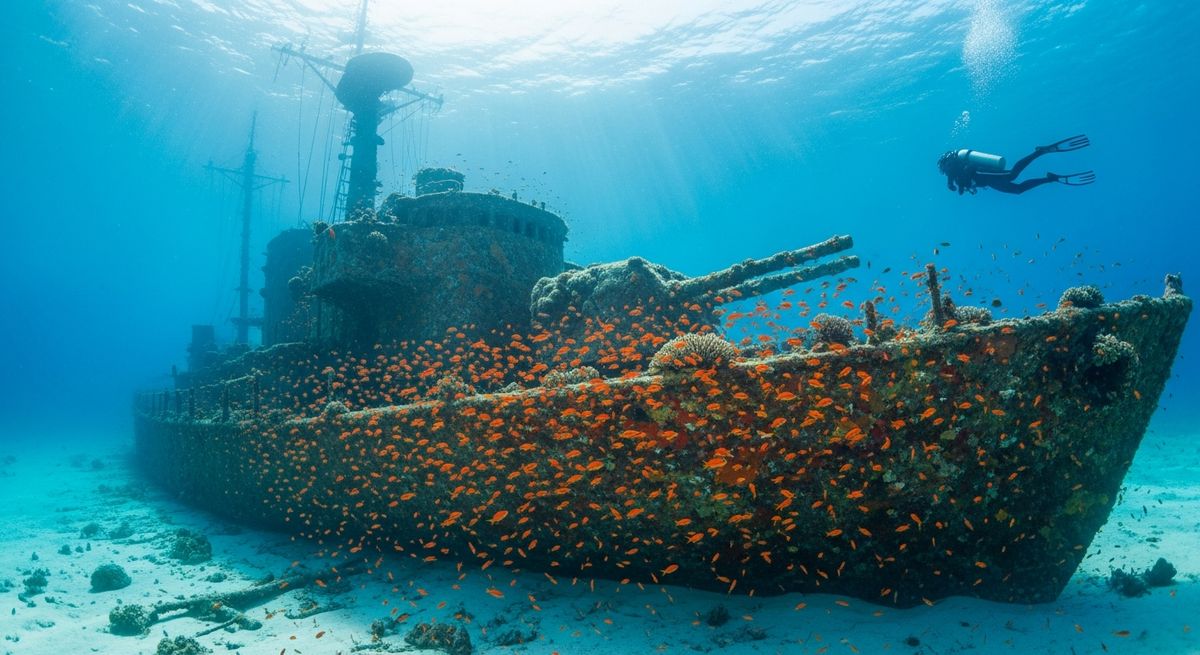
IGARA (BOW SECTION)
Why dive here
With 263+ marine species recorded in the area - including blue-spotted stingrays, dugongs, giant moray eels, seahorses and sea turtles - IGARA (BOW SECTION) offers some of Southern Islands's richest wreck diving. Water ranges 28-31°C, warmest May, June, November.
The Igara’s bow section is a moody, deep dive, and for us, it’s one of Singapore’s more compelling wrecks. Sitting upright at 38 metres, she’s become a massive artificial reef, and the sheer scale is impressive. We usually descend onto the deck, where the anchor chains spill out like giant metal spaghetti. Look closely, and you’ll spot schooling fusiliers, bannerfish, and sometimes even a solitary great barracuda patrolling the mast. Inside, the forward cargo holds are open, a cavernous space that draws in photographers. We’ve found resident giant morays tucked into the darker corners, and the occasional lionfish drifts lazily past. Visibility here can swing wildly, but on a good day, the light filtering down from above makes for a truly dramatic scene. This isn’t a beginner’s dive; strong currents can appear, and it demands respect, but for experienced wreck divers, it's a fantastic, atmospheric dive, offering a tangible connection to a piece of maritime history.
Typical IGARA (BOW SECTION) Dive Profile
Illustrative profile based on site depth and type. Actual dive profiles vary - always follow your dive computer and training.
Safety Notes
Deep dive (38m) - monitor air consumption closely. Advanced certification recommended.
Wreck site - avoid penetration without wreck diving certification. Watch for sharp metal and entanglement hazards.
Always perform a 3-minute safety stop at 5m before surfacing.
Reviews for IGARA (BOW SECTION)
Conditions
Ocean conditions, forecast and tides for IGARA (BOW SECTION)
IGARA (BOW SECTION) Ocean Conditions
Monthly averages for IGARA (BOW SECTION), sourced from Open-Meteo marine data - nearest station: Open-Meteo marine grid (1.18, 103.96) (8km away)
October Averages
Sea Temperature
30°C
86°F · Range: 29.5–31.1°C
Air Temperature
27°C
81°F
Wind Speed
4.07 m/s
7.9 knots
Atmospheric Pressure
1009.8 hPa
Based on 4 years of monitoring data · Data sources: Open-Meteo marine data
Plan & book
Ways to dive Southern Islands, from day trips to liveaboards.
Day trips & courses
via GetYourGuideGuided dives, courses and snorkel trips with instant booking.
Find dive trips in Southern IslandsPlaces to stay
via Booking.comHotels and dive resorts near Southern Islands.
Search stays in Southern IslandsDive insurance
Most travel insurance excludes or limits scuba. Check what you need before you go.
Dive insurance explainedPartner links: we may earn a commission if you book, at no extra cost to you. How we make money
Where to Stay near IGARA (BOW SECTION)
Prices from Booking.com. We may earn a commission at no extra cost to you.