Diving with Giant Groupers
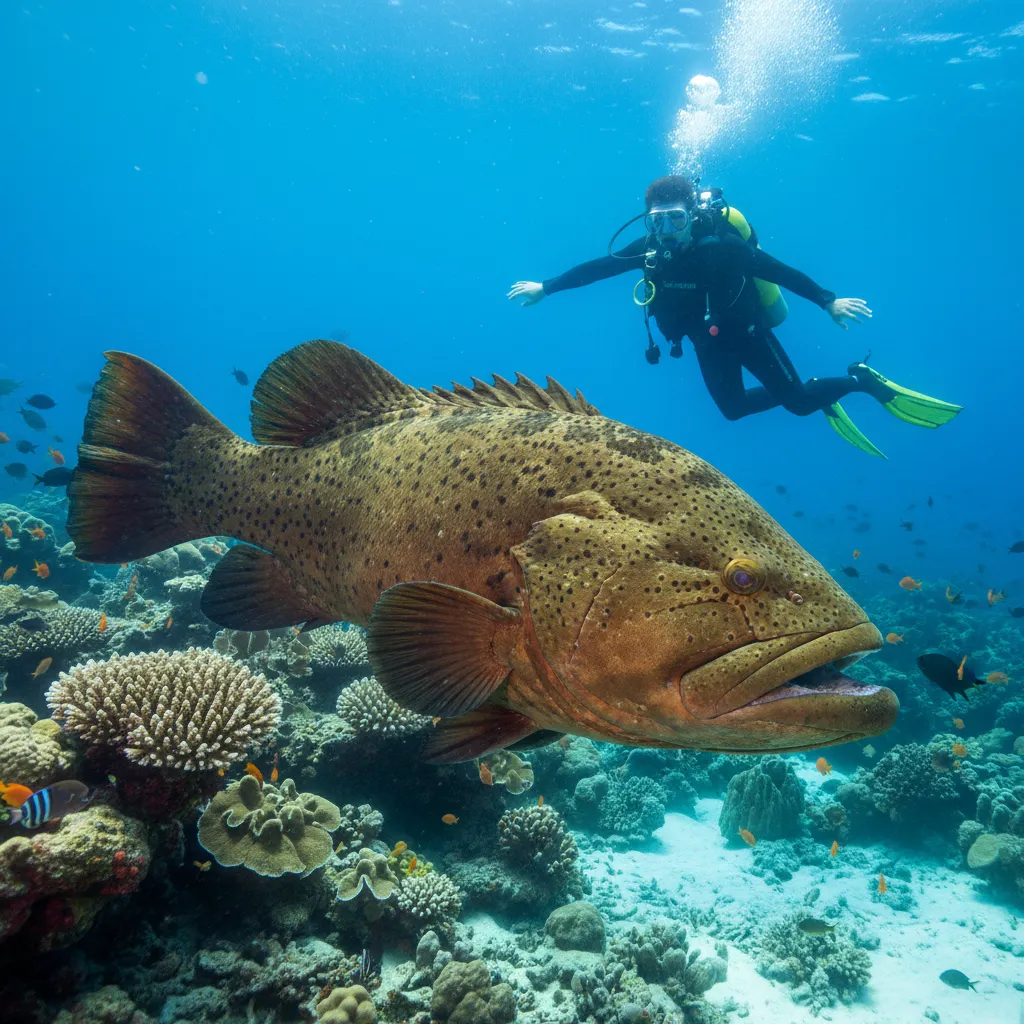
The giant grouper is the colossus of the coral reef. As the largest bony fish found on reefs, Epinephelus lanceolatus can grow to a staggering 2.7 metres in length and weigh over 400 kilograms - large enough to swallow a small shark whole. Despite their imposing size, giant groupers are remarkably docile around divers, often displaying a calm curiosity that belies their status as apex reef predators. Their massive, broad heads and cavernous mouths give them an almost prehistoric appearance, and watching one cruise slowly along a reef wall, dwarfing everything around it, is a humbling reminder of just how large reef fish can grow. At Australia's famous Cod Hole on the Great Barrier Reef, potato cod (a closely related species) have become so habituated to divers that they approach within touching distance, following dive groups like oversized, inquisitive puppies. These encounters rank among the most memorable in all of tropical diving.
Best Time to See Giant Groupers
Giant groupers are non-migratory reef residents and can be encountered year-round at known sites. The Great Barrier Reef's Cod Hole and Ribbon Reefs are best visited from June to October when conditions are calmest, though liveaboard trips operate year-round. Thailand's Similan Islands are open from October to May (the national park closes during monsoon season). The Maldives offers grouper encounters year-round, with the best visibility from January to April. Spawning aggregations, where the largest individuals gather, occur at predictable times - typically during full moons in warmer months - but these events are deep and often beyond recreational diving limits.
How to Dive with Giant Groupers
Giant grouper encounters happen on deep reef walls, at current-swept channel entrances, and at famous aggregation sites where the fish have become habituated to divers. Australia's Cod Hole on the Ribbon Reefs (northern Great Barrier Reef) is the most famous site, where large potato cod (Epinephelus tukula, a close relative) approach divers voluntarily. In Thailand, the Similan Islands have resident giant groupers at several dive sites. The Maldives offers encounters on deeper reef walls and in channels between atolls. The technique is simple: descend to the reef, settle into a comfortable position, and wait. Giant groupers are curious and will often approach divers who remain still and non-threatening. Advanced Open Water is recommended for most giant grouper sites due to depth and currents, though some encounters occur in relatively shallow water.
Is it Safe to Swim with Giant Groupers?
Giant groupers are not dangerous to divers, but their sheer size demands respect. A 400-kilogram fish could easily knock a diver's regulator out or damage equipment with an accidental bump. Maintain a comfortable distance and never corner or block a grouper's escape route - like all large animals, they can become defensive if they feel trapped. At sites where groupers have been fed, the fish may approach very closely and even bump divers in expectation of food. Feeding wild groupers is discouraged as it alters natural behaviour and can lead to increasingly aggressive food-seeking behaviour. Never put your hand near a giant grouper's mouth - their powerful suction feeding can generate enough force to injure a hand.
Conservation Status
The giant grouper is classified as Vulnerable by the IUCN, with populations declining due to overfishing, particularly in Southeast Asia where they are highly prized in the live reef food fish trade. Large individuals are especially valuable - a single giant grouper can fetch thousands of dollars at market. Like Napoleon wrasse, giant groupers are slow-growing and long-lived (up to 50 years), and they aggregate to spawn at predictable times and locations, making them vulnerable to targeted fishing. Aquaculture of giant groupers has developed significantly in Southeast Asia, which may reduce pressure on wild populations. Marine protected areas where diving tourism generates revenue from live groupers provide the strongest economic argument against fishing these magnificent animals.
Recommended Equipment
A wide-angle lens is essential for photographing giant groupers - their size and tendency to approach closely means a fisheye or rectilinear ultra-wide (10-17mm on crop sensor) produces the most dramatic results. The classic shot is a close-focus wide-angle portrait with the grouper filling the frame against a reef background. A strobe helps bring out the mottled brown, grey, and yellow patterns of their skin, though natural light can produce atmospheric silhouette shots. For video, a wide-angle action camera captures the scale and curious behaviour well. Standard tropical scuba gear is appropriate - 3mm to 5mm wetsuit depending on location, BCD, and regulators. Carry a DSMB for sites with current.
Browse dive equipmentFrequently Asked Questions
Where is the best place to dive with giant groupers?
Australia's Cod Hole on the Great Barrier Reef's Ribbon Reefs is the world's most famous grouper dive, where large potato cod approach divers voluntarily. Thailand's Similan Islands, the Maldives, and various sites in Indonesia also offer excellent giant grouper encounters.
How big do giant groupers get?
The giant grouper (Epinephelus lanceolatus) can reach 2.7 metres in length and weigh over 400 kilograms, making it the largest bony fish found on coral reefs. They are large enough to swallow small sharks and rays. Most individuals encountered by divers are between 1 and 2 metres long.
Are giant groupers dangerous to divers?
Giant groupers are not aggressive toward divers but their size demands respect. Avoid putting hands near their mouths - their powerful suction feeding can generate surprising force. At sites where they have been fed, they may bump divers in expectation of food. Maintain a comfortable distance and never corner them.
Why are giant groupers endangered?
Giant groupers are classified as Vulnerable due to overfishing, particularly for the live reef food fish trade in Southeast Asia where large individuals are extremely valuable. Their slow growth, late maturity, long lifespan (up to 50 years), and predictable spawning aggregations make them especially susceptible to overexploitation.
What is the difference between the Cod Hole groupers and giant groupers?
The famous fish at the Cod Hole are potato cod (Epinephelus tukula), a closely related species that reaches about 2 metres. The true giant grouper (Epinephelus lanceolatus) is even larger at up to 2.7 metres. Both species are docile, curious, and provide outstanding dive encounters.
More Encounter Guides
Ocean Sunfish (Mola Mola)
The ocean sunfish is one of the most surreal creatures a diver can encounter. Holding the record as ...
Clownfish
Few marine creatures have captured the public imagination quite like the clownfish. Made famous by F...
Napoleon Wrasse
The Napoleon wrasse - also known as the humphead wrasse or Maori wrasse - is one of the most charism...
Lionfish
Few fish command attention quite like the lionfish. With its dramatic array of elongated, venomous s...
Barracuda
The great barracuda is one of the reef's most impressive predators - a silver torpedo with a mouth f...
Giant Moray Eels
The giant moray is the reef's most charismatic lurker. Reaching up to 3 metres in length and weighin...