Diving with Napoleon Wrasse
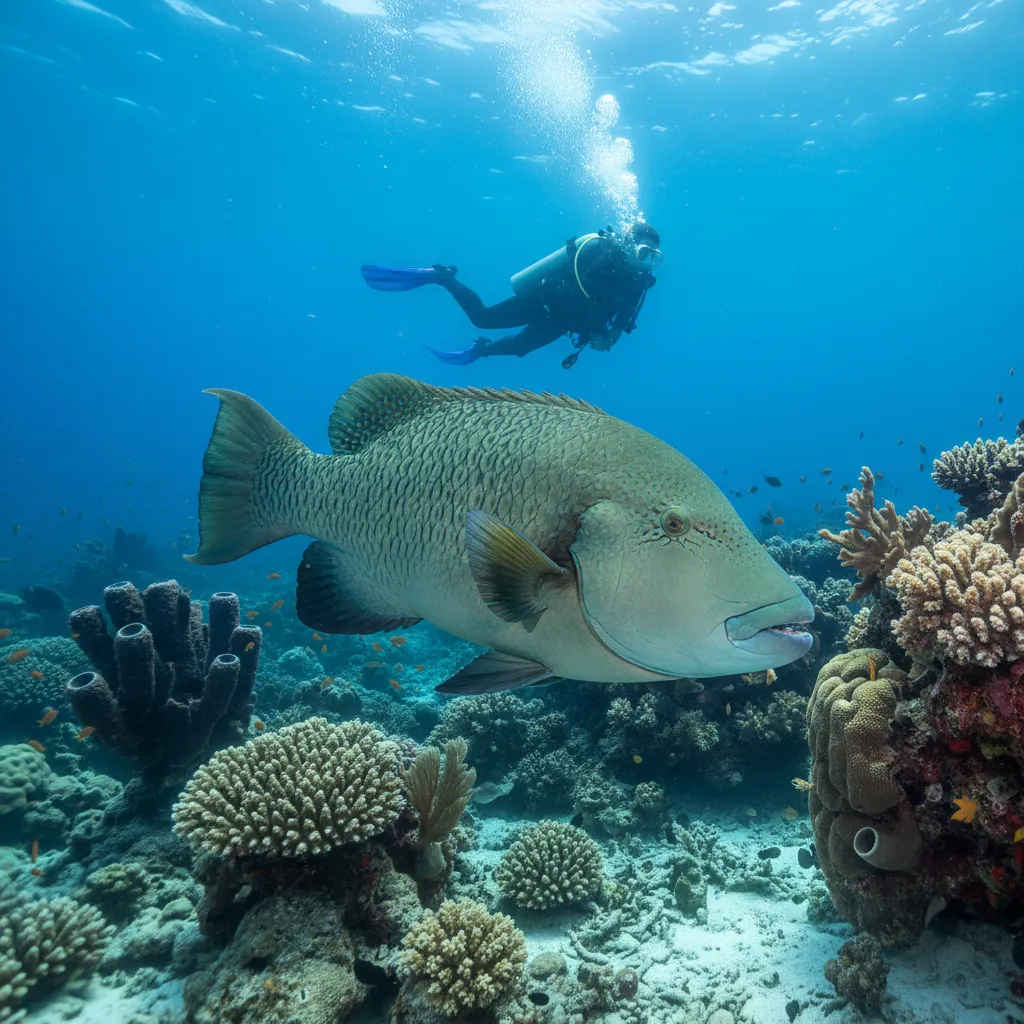
The Napoleon wrasse - also known as the humphead wrasse or Maori wrasse - is one of the most charismatic fish on the reef. Growing up to 2 metres long and weighing over 180 kilograms, these gentle giants are the largest members of the wrasse family. Their most distinctive feature is the prominent hump on the forehead of mature males, which grows larger with age. Napoleon wrasse are remarkably curious and intelligent, often approaching divers with an almost dog-like friendliness, making eye contact and circling at close range. Their thick, fleshy lips and intricate facial markings give each individual a distinctive, almost human-like expression. Encountering a large male Napoleon wrasse on a coral reef is one of the most memorable experiences in tropical diving.
Where to Dive with Napoleon Wrasse
Found across 25 countries, based on 985 verified observation records.

Micronesia
4 areas

Samoa
2 areas

Australia
5 areas
Seychelles
1 area

Palau
2 areas

Philippines
3 areas

Tanzania
2 areas

Kenya
1 area
+ 17 more countries
Best Time to See Napoleon Wrasse
Napoleon wrasse are non-migratory reef residents and can be encountered year-round at known locations. The best destinations include the Great Barrier Reef (particularly the Ribbon Reefs and Cod Hole), the Red Sea (Ras Mohammed, Brothers Islands), Palau (Blue Corner), Sipadan (Malaysia), and Raja Ampat (Indonesia). Dive conditions vary by destination: the Great Barrier Reef is best from June to October, the Red Sea is diveable year-round, Palau is optimal from October to May, and Sipadan has consistent conditions year-round but requires permits booked well in advance.
How to Dive with Napoleon Wrasse
Napoleon wrasse are found on coral reefs from the surface down to around 60 metres, though most encounters happen between 5 and 30 metres. They frequent reef drop-offs, channel entrances, and areas with good current flow. Many dive sites have resident individuals that are habituated to divers and will approach closely - some famous Napoleon wrasse at popular dive sites are recognisable personalities that guides know by name. The best approach is to remain calm, move slowly, and let the fish come to you. They are particularly curious about cameras and will often pose at close range. Open Water certification is sufficient for most Napoleon wrasse encounters, though some of the best sites involve drift diving that benefits from Advanced Open Water training.
Is it Safe to Swim with Napoleon Wrasse?
Napoleon wrasse are completely harmless to divers and are among the friendliest large fish on the reef. They have no dangerous features and no aggressive tendencies toward humans. At some popular dive sites, individuals have become so habituated to divers that they may bump or nudge you - this is curious behaviour, not aggression. The only concern is that at some locations, Napoleon wrasse have been fed by dive guides to guarantee sightings. This practice is controversial as it alters natural behaviour and can make the fish dependent on handouts. Choose operators who show wildlife naturally without feeding.
Conservation Status
The Napoleon wrasse is classified as Endangered by the IUCN and is protected under CITES Appendix II, making international trade regulated. They face severe threats from the live reef food fish trade, particularly in Southeast Asia, where large individuals fetch extremely high prices in restaurants - a single fish can sell for thousands of dollars. They are also vulnerable because of their biology: Napoleon wrasse are slow-growing, long-lived (up to 30 years), and are protogynous hermaphrodites (all individuals begin life as female, with some transitioning to male). This means that targeting large males disproportionately impacts breeding populations. Marine protected areas and dive tourism provide crucial economic alternatives to fishing.
Species Profile

Recommended Equipment
Standard tropical scuba equipment is all you need - a 3mm wetsuit, BCD, and regulators. A camera with a wide-angle lens is the best choice, as Napoleon wrasse are large and often approach very closely. A fisheye or rectilinear wide-angle (10-17mm on crop sensor, 15-30mm on full frame) with a dome port produces dramatic close-up portraits. The fish move slowly enough that natural light photography works well in shallow water, though a strobe helps bring out the beautiful blue and green hues of their scales. A video setup is also rewarding, as their curious behaviour makes for engaging footage.
Browse dive equipmentFrequently Asked Questions
Where can you see Napoleon wrasse?
The best places to dive with Napoleon wrasse include the Great Barrier Reef (Cod Hole), the Red Sea (Ras Mohammed, Brothers Islands), Palau (Blue Corner), Sipadan (Malaysia), and Raja Ampat (Indonesia). Many of these sites have resident individuals habituated to divers.
Why are Napoleon wrasse endangered?
Napoleon wrasse are Endangered due to overfishing for the live reef food fish trade, where a single large fish can sell for thousands of dollars. Their slow growth, late maturity, and sex-changing biology make populations especially vulnerable to overexploitation.
How big do Napoleon wrasse get?
Napoleon wrasse can grow up to 2 metres in length and weigh over 180 kilograms, making them the largest species in the wrasse family. Males are larger than females and develop a prominent forehead hump that grows with age.
Are Napoleon wrasse friendly to divers?
Yes, Napoleon wrasse are among the most curious and approachable fish on the reef. They frequently approach divers, make eye contact, and circle at close range. At some dive sites, resident individuals are so habituated that they accompany divers throughout the dive.
What is the difference between a Napoleon wrasse and a humphead wrasse?
They are the same fish. Napoleon wrasse, humphead wrasse, and Maori wrasse are all common names for Cheilinus undulatus. The name varies by region - 'Napoleon' is most common in Asia and the Red Sea, 'humphead' in Australia, and 'Maori' in New Zealand.
More Encounter Guides
Ocean Sunfish (Mola Mola)
The ocean sunfish is one of the most surreal creatures a diver can encounter. Holding the record as ...
Clownfish
Few marine creatures have captured the public imagination quite like the clownfish. Made famous by F...
Lionfish
Few fish command attention quite like the lionfish. With its dramatic array of elongated, venomous s...
Barracuda
The great barracuda is one of the reef's most impressive predators - a silver torpedo with a mouth f...
Giant Moray Eels
The giant moray is the reef's most charismatic lurker. Reaching up to 3 metres in length and weighin...
Seahorses
Seahorses are among the ocean's most enchanting and improbable creatures. With their horse-shaped he...